Coconut Oil vs Calendula Oil on Baby Skin: What to Know
Before comparing two oils for a baby, it helps to ask a quieter question: does a healthy baby need an oil at all? The research is less settled than most baby-care pages suggest, and neither coconut oil nor our calendula oil has been shown to do what that comparison implies. Here is what the studies say, where each oil fits, and why a pediatrician belongs in the conversation.
Calendula Oil
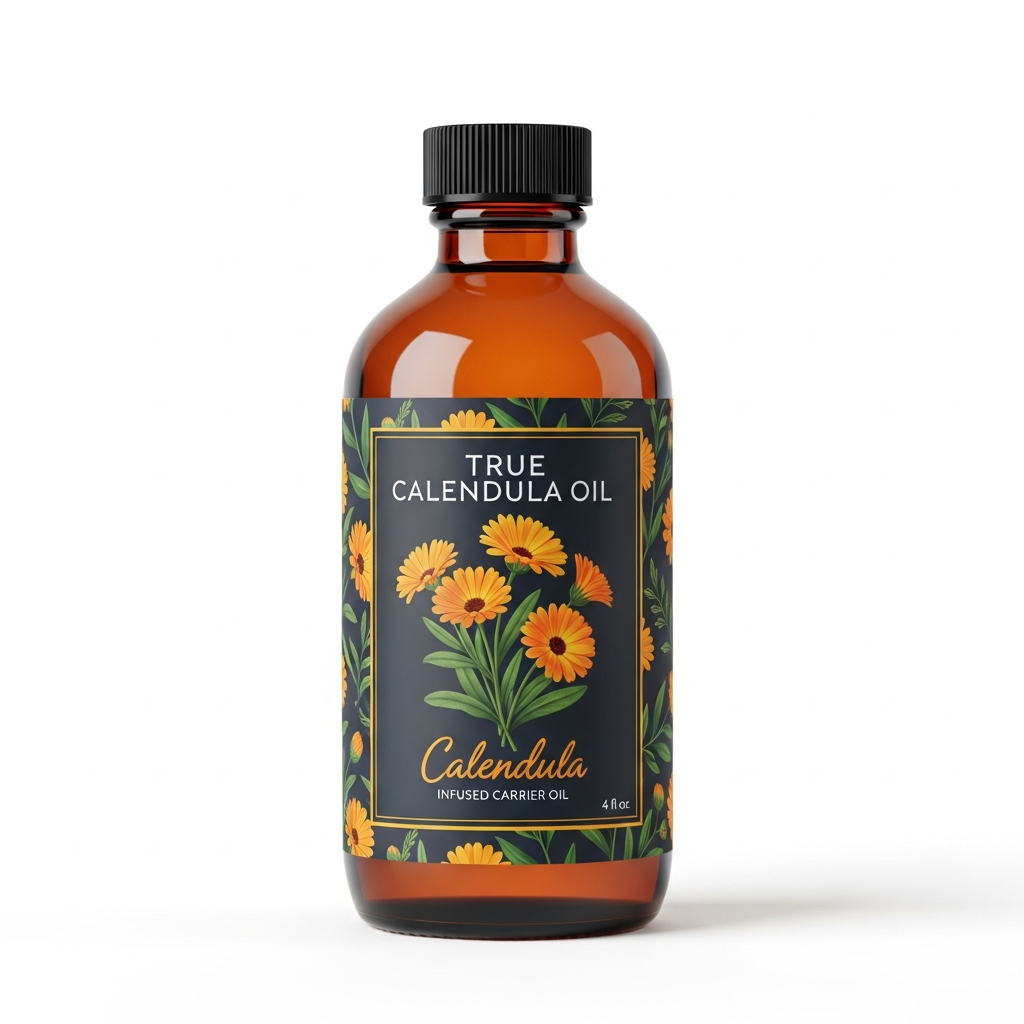
Our own small-batch calendula oil, in sizes from 0.5 oz to bulk.
From $13.99
Shop Calendula Oil →What did the newborn oil pilot trial find?
One carefully designed pilot trial asked the plain question in healthy newborns. In it, 115 full-term babies were assigned to olive oil, sunflower oil or no oil, twice daily for four weeks. Both oil groups had better skin hydration, but they showed less improvement in the ordered fat layers of the skin barrier than the no-oil group, with no significant differences in water loss, pH or redness. The authors noted the study was not powered for clinical conclusions and advised caution when recommending oils for newborn skin. Neither oil in that trial was coconut or calendula, so it does not rank our two. It simply shows that "natural oil, therefore good for the barrier" is an assumption and not a result.
We want to be plain about where we stand. We make one oil, calendula, and we are not baby-care experts. We are people who care about what goes on skin and who would rather give you an honest "ask your pediatrician" than a confident answer we cannot back up. If you are a new parent, you are probably hearing advice from every direction, and it helps to have one trusted person, your child's doctor, to check it against.
Coconut oil pediatric evidence in atopic dermatitis
Coconut oil has the stronger pediatric research of the two, and it deserves a fair reading. In a double-blind trial of 117 children with mild to moderate atopic dermatitis, virgin coconut oil was compared with mineral oil for eight weeks. Symptom scores fell by about 68% with coconut oil and about 38% with mineral oil, and the coconut group also showed better skin hydration measures. Two things shape how far to take that. The comparison was against another oil, not against nothing, and the children already had a skin condition, so it says little about routine care for healthy skin.
Calendula ointment diaper rash studies, not infused oil
There is no trial of calendula oil on healthy baby skin. What exists is a handful of diaper rash studies of calendula ointments and creams, for instance a randomized trial in 66 infants that compared a calendula ointment with an aloe cream. Those are different products from an infused oil, so their results do not transfer, and our diaper rash article goes through them.
The regulatory text is direct. The EU herbal monograph says the use of calendula flower preparations on the skin of children under 6 has not been established because of a lack of adequate data. That is an absence of information, not a finding of harm, and it was written for licensed herbal medicines, but it is a good reason to bring a pediatrician in first.
Does calendula oil raise a daisy-family allergy risk?
Calendula belongs to the daisy family, and the same monograph lists hypersensitivity to that family as a contraindication. In an Austrian clinic series of 443 patients, about 2% reacted to a marigold patch-test preparation; they were people already referred for skin problems, so it is not a rate for babies. Coconut is not in that plant family. If a parent or sibling reacts to chamomile, ragweed or daisies, that history belongs in the pediatrician conversation before any calendula product goes on an infant. Our patch test guide covers the adult routine; for a baby, ask the pediatrician how to test.
One practical thing you can do before any appointment is read the ingredient list on every product that already touches your baby: wipes, wash, diaper cream, laundry soap. A rash is often a clue about something in that routine, and a list of the products in use makes it much easier for the doctor to work out what is going on.
Deciding between coconut and calendula oil for baby skin
- Healthy baby with dry patches: ask the pediatrician what they suggest. Oils improved hydration but not barrier structure in the one newborn pilot.
- Family history of eczema: a pediatrician or dermatologist can recommend a bland moisturizer; see our article on calendula and children's eczema.
- Diaper rash that lasts or looks raw: a pediatrician. Our baby questions article lists what to ask.
- You are choosing for yourself: a different question altogether, and our oil is a lovely option for adult dry skin.
For our part, we do not offer our oil as a baby product. It is calendula extract brought into a carrier oil, with no synthetic preservatives, tocopherol or stabilizers, and the carrier is named on the batch paperwork (email the lot number to support@truecalendulaoil.com). If a rash, redness or swelling shows up after any product, FDA's advice for cosmetics is to stop using it and call a healthcare provider.
For a tiny baby, the gentlest plan is usually the simplest: ask the person who knows your child, and keep the oils for the grown-ups until they say otherwise.
Babies grow quickly, and what suits them at two months may not suit them at six. Check in often, and trust the person who can actually see your child.
Calendula Oil
Nature's Golden Botanical, bottled: small-batch calendula oil in sizes from 0.5 oz to bulk.
From $13.99
Shop Calendula Oil →Sources & Further Reading
- Olive Oil, Sunflower Oil or no Oil for Baby Dry Skin or Massage: A Pilot, Assessor-blinded, Randomized Controlled Trial (the Oil in Baby SkincaRE [OBSeRvE] Study) (Cooke et al., Acta Derm Venereol, 2016)
- The effect of topical virgin coconut oil on SCORAD index, transepidermal water loss, and skin capacitance in mild to moderate pediatric atopic dermatitis: a randomized, double-blind, clinical trial (Evangelista et al., Int J Dermatol, 2014)
- A randomized comparative trial on the therapeutic efficacy of topical aloe vera and Calendula officinalis on diaper dermatitis in children (Panahi et al., ScientificWorldJournal, 2012)
- European Union herbal monograph on Calendula officinalis L., flos (EMA/HMPC, 2018)
- The seamy side of natural medicines: contact sensitization to arnica (Arnica montana L.) and marigold (Calendula officinalis L.) (Reider et al., Contact Dermatitis, 2001)
- Using Cosmetics Safely (U.S. Food and Drug Administration)