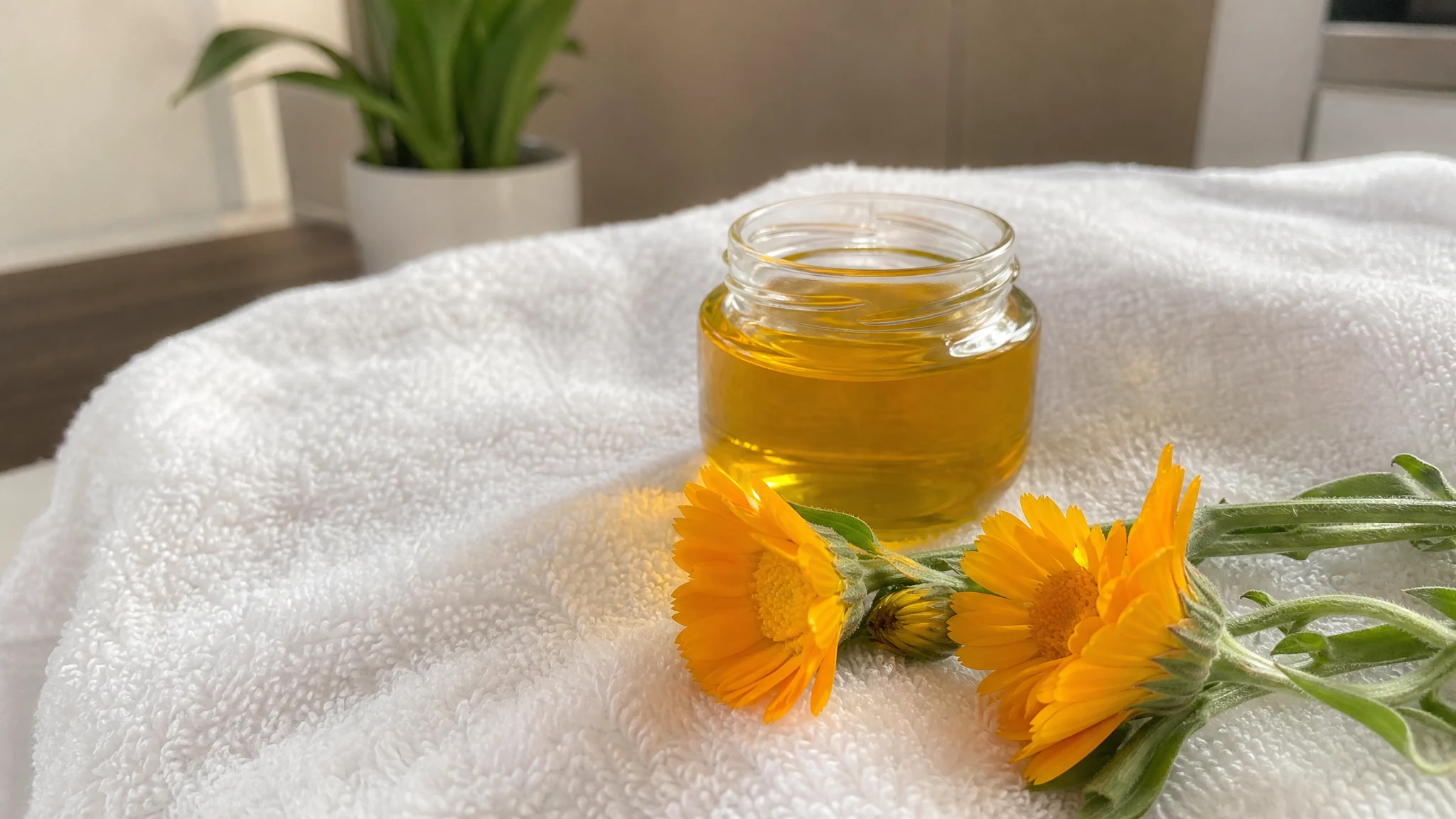
Vitamin E Oil vs Calendula Oil: What's in the Bottle?
There is a cabinet-door habit in many homes: after a cut or a surgery, break open a vitamin E capsule and rub it on. It is such a familiar idea that it rarely gets questioned. A fair way to compare it with calendula oil is to look at what the vitamin E trials actually found, because the answer is more interesting than a head-to-head.
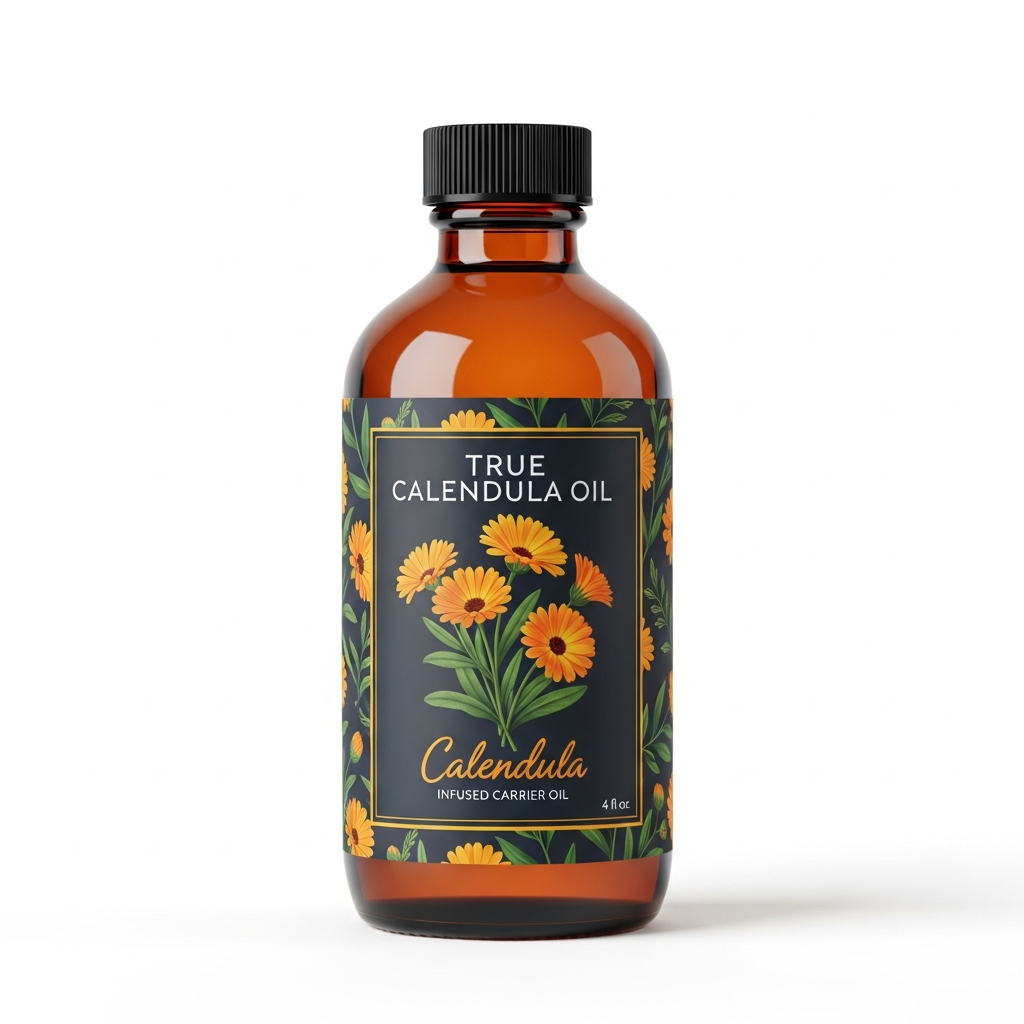
Calendula Oil
Our own small-batch calendula oil, in sizes from 0.5 oz to bulk.
From $13.99
Shop Calendula Oil →Vitamin E wound-healing trials: what they tested
Two controlled studies are worth knowing. In a double-blind study of 15 people who had skin-cancer surgery, the healing line was divided in half: one half was dressed with a plain emollient and the other with the same emollient plus vitamin E, twice daily for four weeks. Evaluators judged the appearance at weeks 1, 4 and 12. The authors reported that vitamin E did not improve the cosmetic appearance, in 90 percent of cases it either made no difference or looked worse, and a third of participants developed contact dermatitis to it. They concluded that topical vitamin E on surgical wounds should be discouraged.
A larger 1986 randomized study of 159 reconstructive procedures after burns found no beneficial effect of topical vitamin E, and adverse reactions occurred in 16.4 percent of patients receiving an active drug (vitamin E or a steroid cream) compared with 5.9 percent on the plain base cream. And a 2020 systematic review of 34 trials of over-the-counter topical products found the strongest evidence behind silicone gel, with only a limited number of studies supporting vitamin E and others. These are small, old or mixed studies, but they point in one direction: the vitamin E habit is not as well supported as its reputation.
That is not a reason to be alarmed. It is a reason to talk to your surgeon or doctor about what goes on healing skin, and to follow their advice on products, silicone included.
Is calendula oil a vitamin E oil?
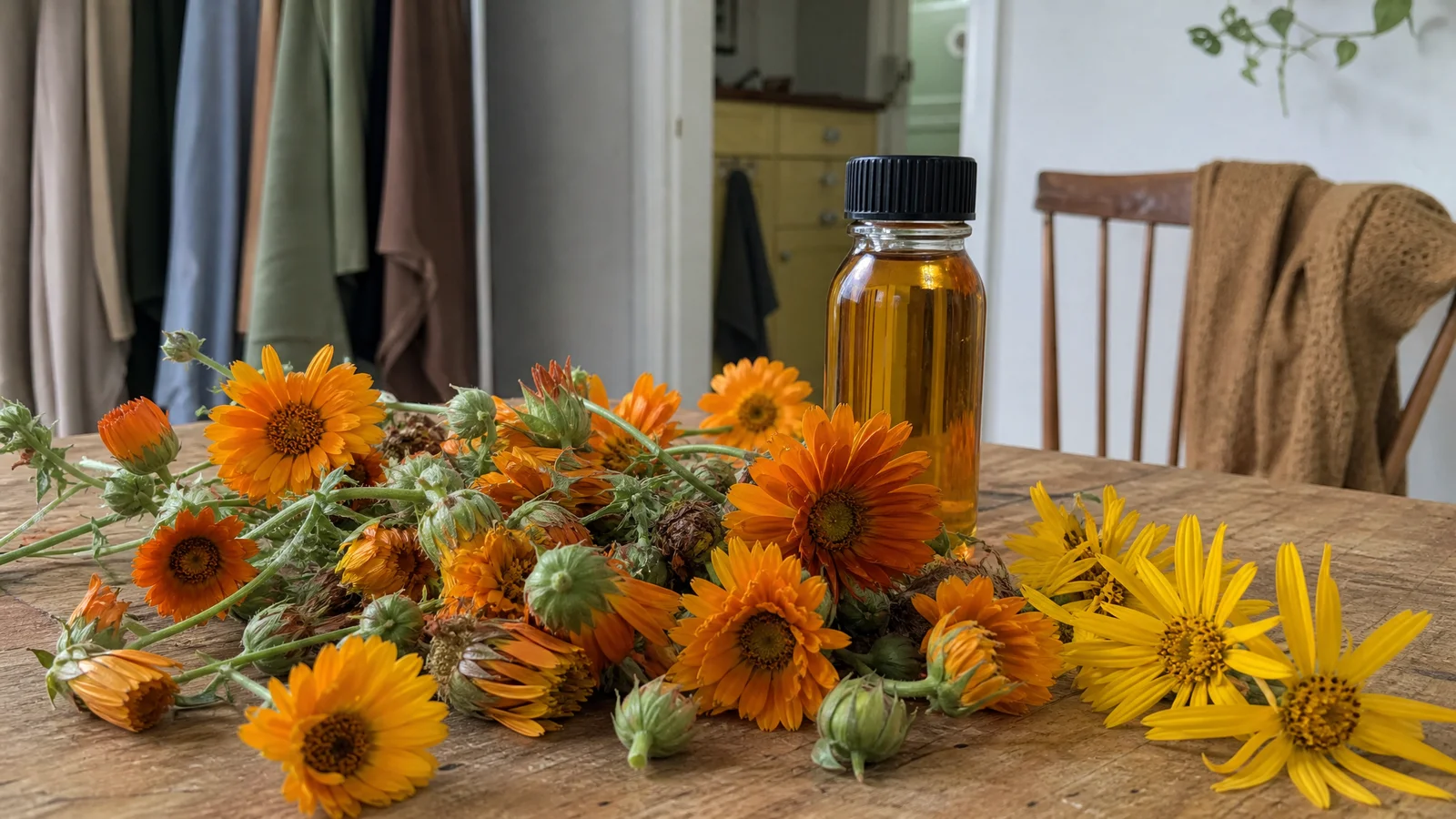
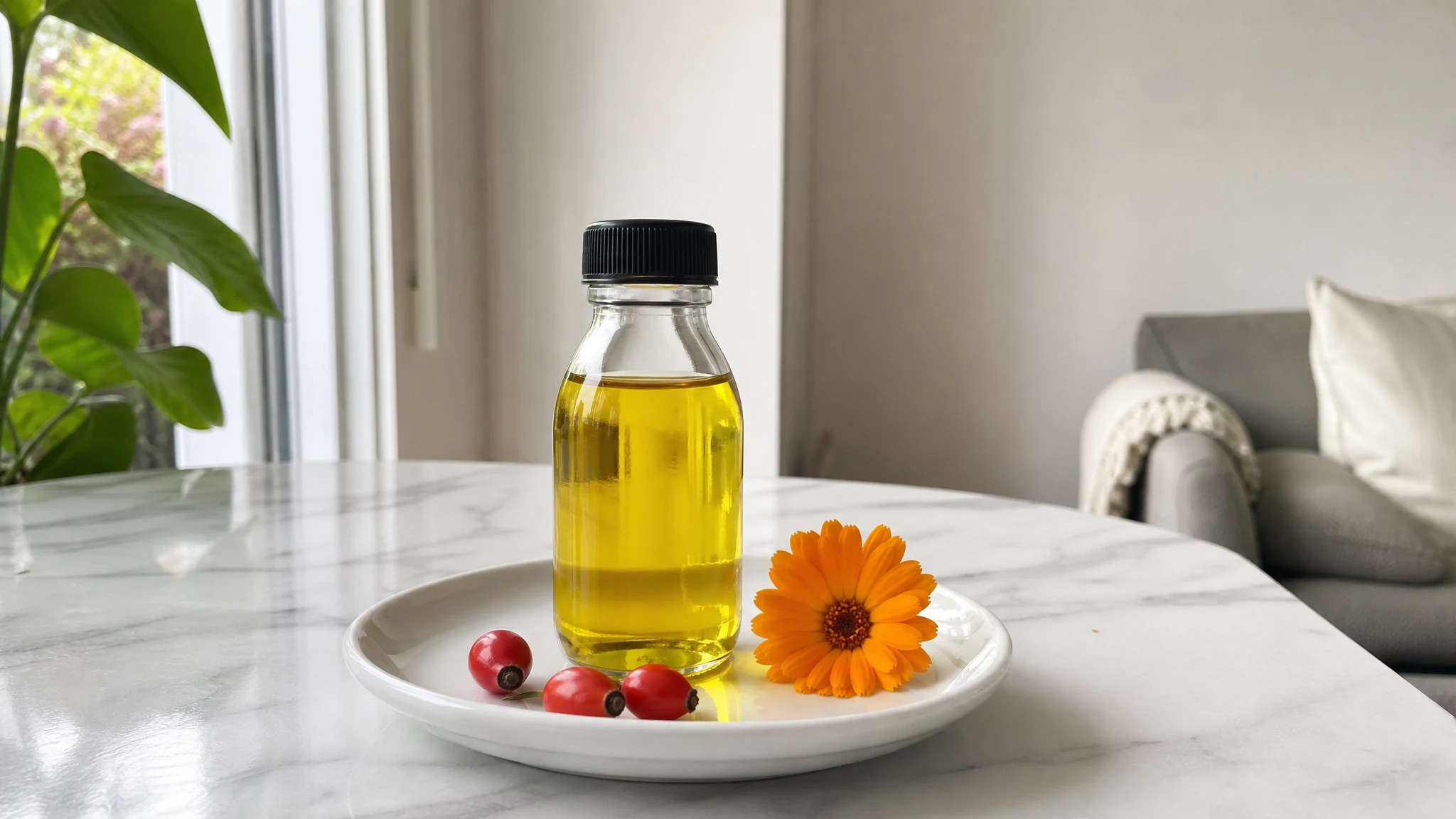
We want to be clear about this because the names can confuse. Our calendula oil is not a vitamin E oil. We extract calendula flowers on their own, bring the extract into a carrier oil, and add nothing afterward: no tocopherol, no preservatives, no stabilizers. If you want vitamin E, you will need to look elsewhere, and we would encourage you to read the studies above first.
It also means our oil has no added antioxidant to slow oxidation. That is why every bottle is dated and lot-numbered in glass, and why we suggest keeping it cool, closed and used up in good time. Our storage guide covers it.
What does research show on calendula and healing skin?
For calendula, the picture is early. A 2025 trial of 35 patients compared a 10 percent calendula ointment with petroleum jelly on opposite ears for seven days after earlobe repair. The abstract reports a difference in evaluation scores by day 15, but day 15 is early for judging anything about the long run, and an ointment is not an infused oil. European regulators recognize calendula preparations only as traditional-use products for minor skin inflammation and minor wounds, and they advise seeing a doctor if symptoms last more than a week. A surgical incision is not a minor wound in that sense.
So there is no trial showing our oil changes how healed skin looks, and we make no claim that it does. What we can say is what calendula oil is: a plain, golden infused oil that people use to moisturize skin. Our dry-skin article shows what that looks like.
Reading an ingredient list: single oil or mix
Many people reach for a product because of a familiar name on the front, and it is worth turning the bottle around. Read the ingredient list slowly. Is it a single oil, or a mix? Is vitamin E listed, and where? Are there fragrances or colors? A short list is not automatically better, but it is easier to understand, and understanding what you use is half of using it well.
Ours reads simply: calendula, extracted into a carrier oil, with nothing added afterward. If you want the carrier named, email us the lot number and we will send the batch paperwork.
Calendula oil on healed skin: habits and patch test
Once a wound has closed and your clinician is happy with it, some people simply like a daily massage with an oil, and that is a reasonable personal ritual so long as expectations are modest. A few habits keep it comfortable. Patch test first: calendula is a daisy-family (Asteraceae) plant, the European monograph lists hypersensitivity to that family as a contraindication, and in one Austrian series of 443 patients 9 reacted to marigold on a patch test. Add one new product at a time so you can tell what a reaction came from, and stop and ask your clinician if you notice redness, itch, blisters or oozing. Our patch test guide explains how, and if you are pregnant or nursing, start with our pregnancy and postpartum article.
One more small habit: keep a note of what you put on your skin and when, especially around healing skin. A line in a notebook or on your phone, covering the product and the date, makes it much easier to talk with a clinician if something looks off.
Anything raised, growing, painful or intensely itchy belongs with a dermatologist or surgeon, not with a bottle of oil. We would rather you have that conversation than choose between two oils on a hunch.
Calendula Oil
Nature's Golden Botanical, bottled: small-batch calendula oil in sizes from 0.5 oz to bulk.
From $13.99
Shop Calendula Oil →Sources & Further Reading
- The effects of topical vitamin E on the cosmetic appearance of scars (Baumann and Spencer, Dermatologic Surgery, 1999).
- Failure of topical steroids and vitamin E to reduce postoperative scar formation following reconstructive surgery (Jenkins et al., Journal of Burn Care and Rehabilitation, 1986).
- Topical Scar Treatment Products for Wounds: A Systematic Review (Tran et al., Dermatologic Surgery, 2020).
- Comparative Evaluation of Bilateral Cleft Earlobe Rejuvenation with and without Calendula Officinalis 10% V/W- Randomised Control Trial (Kunjir et al., Indian Journal of Otolaryngology and Head and Neck Surgery, 2025).
- European Union herbal monograph on Calendula officinalis L., flos (EMA/HMPC/437450/2017, 2018).
- The seamy side of natural medicines: contact sensitization to arnica (Arnica montana L.) and marigold (Calendula officinalis L.) (Reider et al., Contact Dermatitis, 2001).