Calendula and Your Child's Eczema: Where an Oil Fits
Anyone who has worked out a child's eczema routine knows how quickly one new product can start to feel like a big decision. Calendula comes up often, because it sounds gentle and looks lovely in the bottle. Before it goes near your child's skin, it helps to know what dermatologists put first, what the calendula research does and does not cover, and what to bring to the appointment.
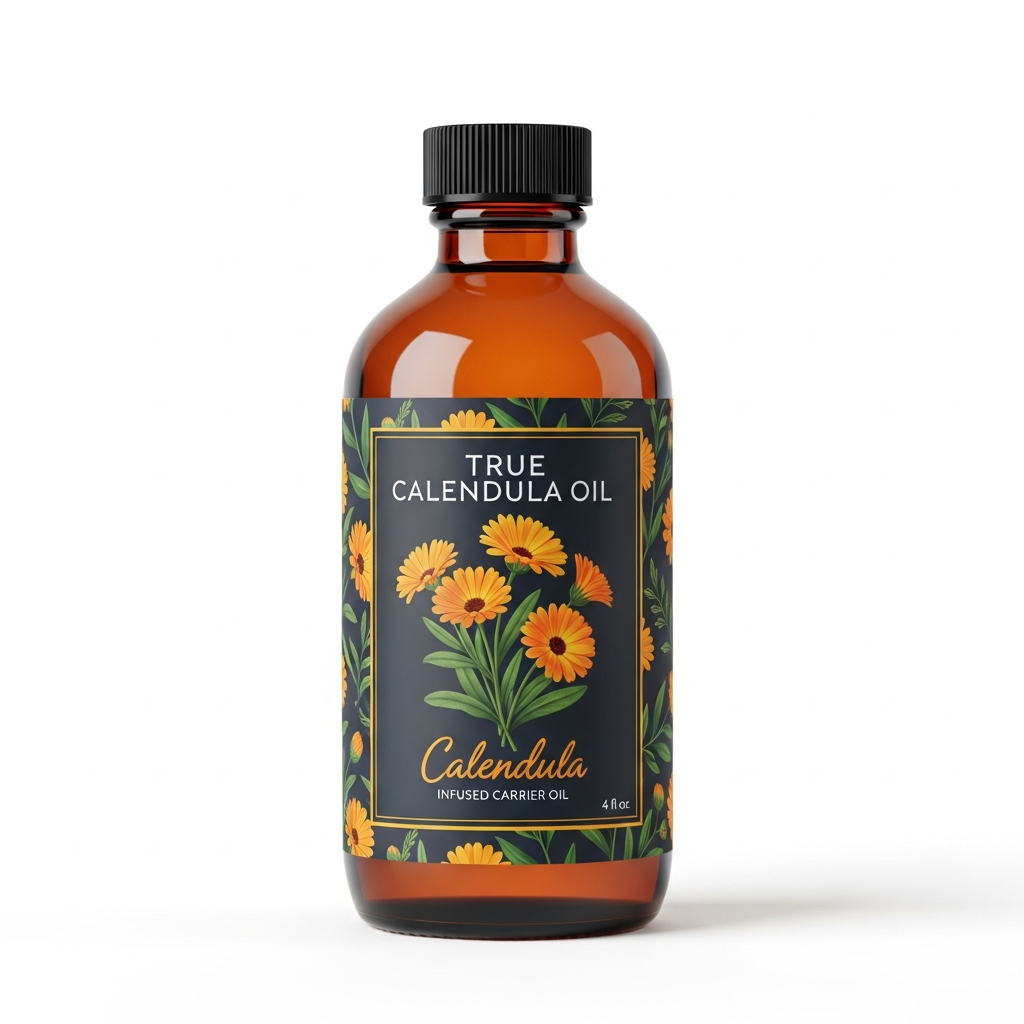
Calendula Oil
Our own small-batch calendula oil, in sizes from 0.5 oz to bulk.
From $13.99
Shop Calendula Oil →Moisturizer routine for a child's eczema
The American Academy of Dermatology's advice for babies is to apply a fragrance-free moisturizer right after the bath and to repeat it twice a day or as often as needed. It adds that thick creams and ointments are generally more effective than lotions or oils. We make an oil, and we read that sentence as a fair guide to where an oil sits: as an extra layer of softness on top of whatever routine your child's clinician has set, not as the routine itself.
Parents of children with eczema tend to become careful label readers, and we admire that. If you are one, you already know how a calm evening routine can fall apart over a single itchy night. We make an oil, and we would never want to add one more worry to that pile, so the sections below are meant to help you decide what to ask, not to push anything.
What do calendula studies cover for children?
The closest study is a 2025 trial in which 57 children aged 2 to 14 used a gel on one forearm twice a day for 10 days, with the other forearm as comparison. Redness, water loss and hydration were better on the treated arm. The gel held six ingredients, including hyaluronic acid, glycerol, grape seed oil, aloe vera, calendula and a synthetic growth-factor peptide, so nobody can say how much of the result belongs to calendula, and it is a gel rather than an oil (Gómez-Farto et al., 2025).
Zooming out, a 2023 review gathered 17 clinical studies of herbal remedies for children's skin, calendula among them, and rated eight as low quality. The encouraging signal it picked out for atopic dermatitis was evening primrose oil, not calendula (Kloter et al., 2023). European regulators reached a similar view of calendula skin studies in general: most are small, and the evidence falls short of a well-established use (EMA assessment report, 2018). The better-known calendula work in infants concerns diaper rash, a different condition, which we cover on our baby page.
Calendula oil age guidance for children under 6
The EU herbal monograph for calendula flowers says use on the skin in children under 6 is not recommended and has not been established because adequate data are lacking (EMA/HMPC monograph, 2018). That describes missing data, not documented harm, and it is written for licensed herbal medicines rather than cosmetics. For a parent of a younger child it is still the first thing to weigh, and a pediatrician is the right person to talk it through with.
Why does Asteraceae sensitivity matter for eczema skin?
Calendula belongs to the daisy family, Asteraceae, and the same monograph lists sensitivity to that family as a reason not to use it. An updated 2026 meta-analysis found no overall link between atopic dermatitis and contact allergy, but it did find positive associations with the Compositae mix and sesquiterpene lactone mix, the two patch-test screens for this plant family, and it concluded that patch testing has value in atopic dermatitis (Jensen et al.). Reasoning from that, a flare after a new product is hard to read, so it makes sense to change one thing at a time and to keep any botanical off weeping or broken areas, where a reaction would be hardest to interpret. Our patch test guide explains the basic idea of trying a small area first.
A few things make a clinic visit more useful. Write down the products your child uses in a normal week, including wash, laundry soap and sunscreen. Note when flares seem to start, and take a photo of the skin on a bad day, since eczema often looks different by the time you get to the appointment. Bring any new product you are curious about, bottle in hand, so the clinician can read the label rather than rely on your memory.
It also helps to involve your child where their age allows. A small child who knows that a new cream or oil is going on, and who gets a say in which arm it goes on first, often finds the whole routine less stressful.
Trying calendula officinalis oil with a child's doctor
Here is what we can offer from our side. We buy dried, organically grown calendula flowers and make the oil ourselves: calendula is extracted on its own, then brought into a carrier oil, and nothing else is added, with no synthetic preservatives, tocopherol or stabilizers. Every batch is tested by independent labs. The carrier is the part a clinician will want to know about, and it appears on the batch paperwork, which we send when you email the lot number to support@truecalendulaoil.com.
Stop at the first redness, itching or new bumps and call the clinician. Ours is a cosmetic oil for skin, and we make no claims about eczema, so for anything medical your child's dermatologist sets the plan. If you are weighing the same questions for yourself, our sensitive skin evidence review goes through the adult research.
The most useful thing to carry into that appointment is a short list: the bottle, its lot number, and the question of where an oil should sit alongside the ointment your child already uses.
Calendula Oil
Nature's Golden Botanical, bottled: small-batch calendula oil in sizes from 0.5 oz to bulk.
From $13.99
Shop Calendula Oil →Sources & Further Reading
- American Academy of Dermatology Association. Eczema in babies, skin care guidance page. aad.org
- Gómez-Farto A et al., 2025. Update on the Research of an Emulgel for the Effective Treatment of Atopic Dermatitis: Clinical Investigation in Children. PubMed 41294565
- Kloter E et al., 2023. Phytotherapy in paediatric skin disorders - A systematic literature review. PubMed 36958415
- Jensen MB et al. Association Between Atopic Dermatitis and Contact Sensitization: An Updated Systematic Review and Meta-Analysis. PubMed 41423749
- European Medicines Agency, HMPC, 2018. European Union herbal monograph on Calendula officinalis L., flos. ema.europa.eu
- European Medicines Agency, HMPC, 2018. Assessment report on Calendula officinalis L., flos. ema.europa.eu