Calendula vs Chamomile Oil: Which Is Right for Your Skin?
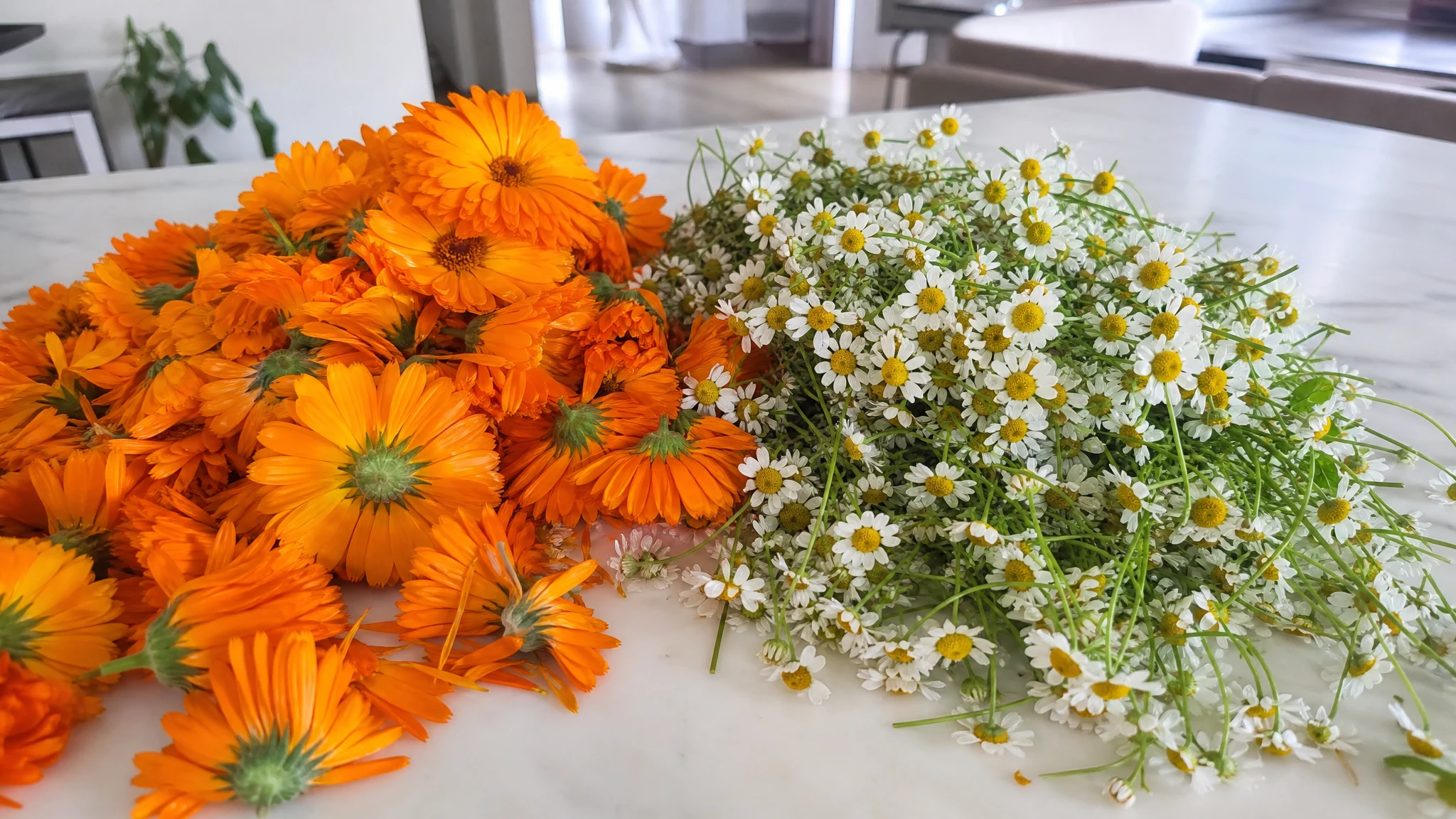
Chamomile and calendula both sit on the shelf as gentle, golden, daisy-like flowers, and both get described as soothing. People often ask us which is better. The honest starting point is that "chamomile oil" can mean several different things, and the more useful question turns out to be whether either plant agrees with your skin.
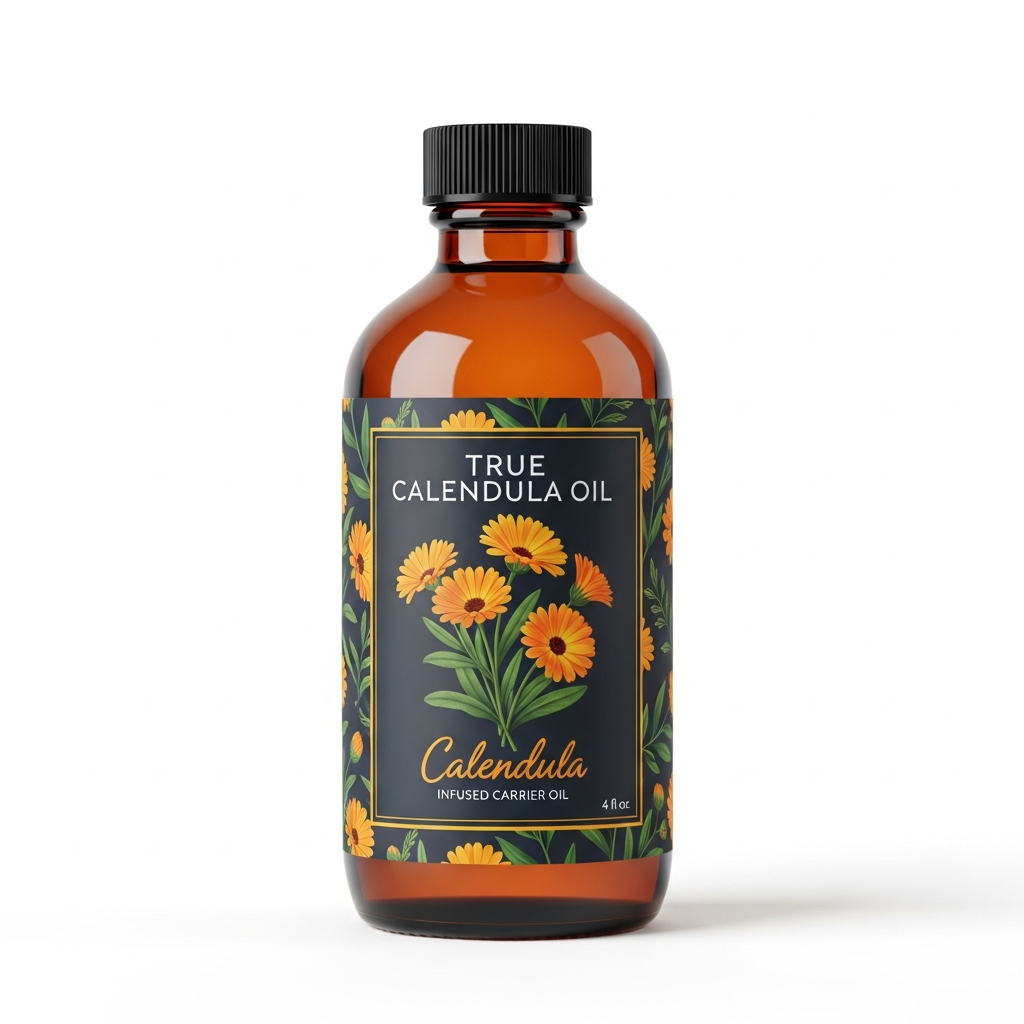
Calendula Oil
Our own small-batch calendula oil, in sizes from 0.5 oz to bulk.
From $13.99
Shop Calendula Oil →Which chamomile oil are you comparing against?
A 2026 review of the two chamomiles makes the point well. German chamomile (Matricaria chamomilla) and Roman chamomile (Chamaemelum nobile) are both sold simply as "chamomile," yet they differ in what they contain. German chamomile is rich in alpha-bisabolol and chamazulene; Roman chamomile has an ester-rich essential oil and sesquiterpene lactones. The review concludes the two should not be treated as interchangeable, and that infusions, extracts, powders and essential oils are not equivalent to one another.
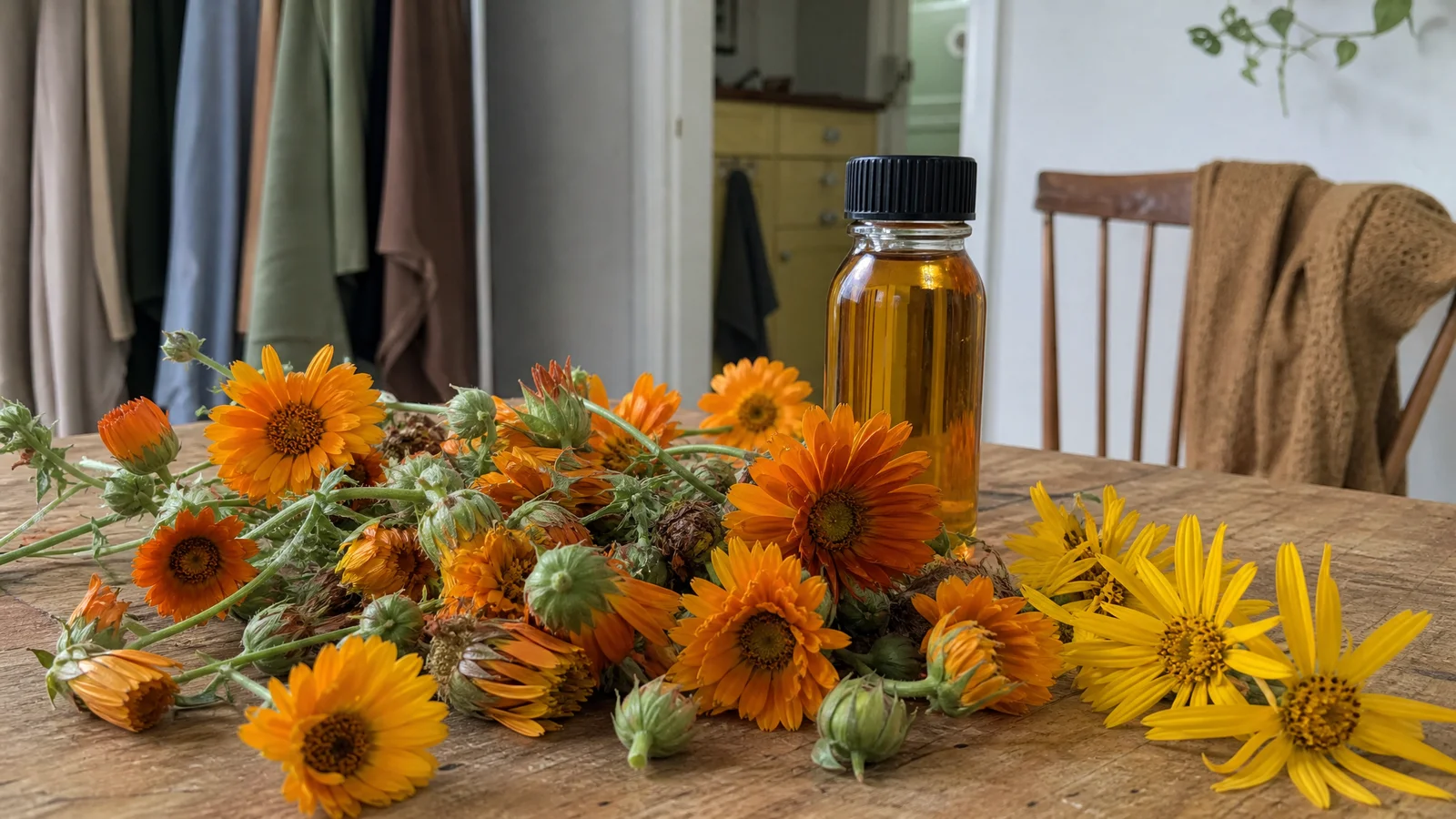
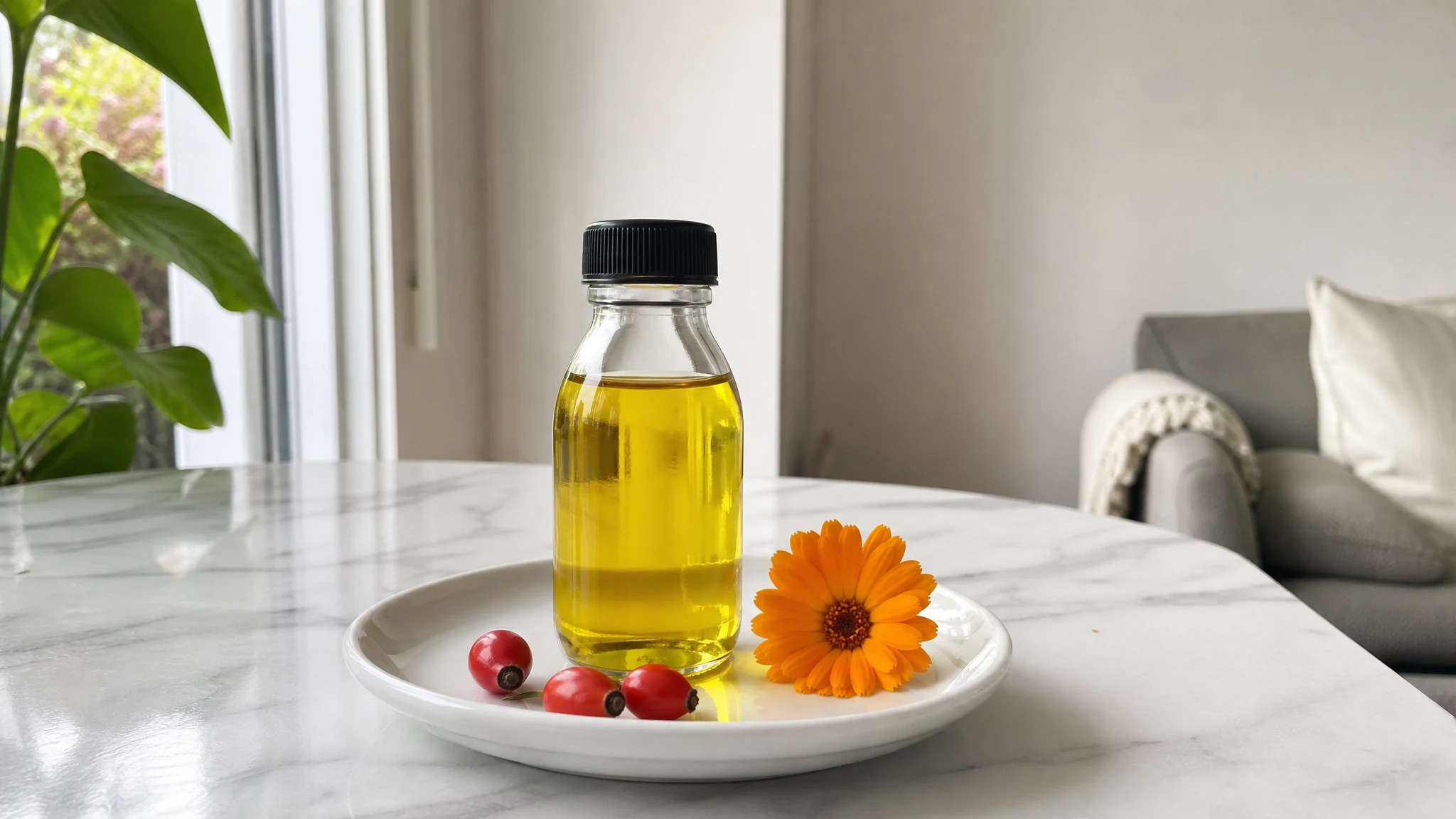
Calendula is simpler in the bottle. Ours is an infused oil: calendula flowers extracted, with that extract brought into a carrier oil, and nothing else added. A distilled calendula essential oil exists but is a rare, low-yield material, which we cover in our infused versus essential oil article. When you compare any two oils, look for the botanical name, the plant part, and whether it is an infused or a distilled oil.
Calendula and chamomile in EU traditional herbal use
The EU herbal medicines committee covers both plants as traditional herbal medicines, meaning their use rests on long tradition and not on trials. Both have a long history of skin use, the chamomile medicines come with advice to see a practitioner if symptoms last beyond a week, and both carry the same contraindication: allergy to plants in the daisy family (Asteraceae, also called Compositae). The chamomile medicines are generally for adults and adolescents above 12, while calendula's monograph does not recommend skin use under 6.
As for head-to-head trials, we are not aware of a published comparison of calendula oil and chamomile oil. Most calendula human data come from creams and ointments, and the EU committee judged most of those studies small and methodologically weak. So any page that ranks the two by "soothing power" is offering an opinion no study has measured, and we would rather tell you that than invent a winner.
Compositae cross-reactivity between calendula and chamomile
These two are close relatives, and that shows up in allergy research. A Danish study of Compositae-allergic patients found that 8 of 12 chamomile-sensitive patients tested positive to chamomile-containing products, including tea, creams, ointments and an oil, and the authors concluded that Compositae-allergic people should be warned against topical use of Compositae-containing products. In an Austrian clinic series of 443 patch-tested patients, about 2% reacted to marigold, though clinic patients are not the general public.
Putting those together gives us a practical rule, which is our reasoning and not a trial result: if chamomile has disagreed with your skin, treat calendula with the same caution, and the other way round. Swapping one for the other because the first "did not agree" is not the safest move. An allergist or dermatologist can patch test the actual products. Our patch test guide and our ragweed article walk through the how and why.
Reading botanical name and plant part on labels
Because "chamomile oil" can mean so many things, we like to slow down at the shelf and read. Look for the botanical name first, then the plant part, then whether it is an infused oil, a distilled oil or an extract. If any of those is missing from a label, ask the seller. A good supplier will tell you without fuss.
The same questions apply to ours. Ours is Calendula officinalis, the flower, extracted and brought into a carrier oil. The golden color you see in the bottle comes from the petals.
Calendula or chamomile oil if you have no allergies?
- A base oil for skin or blending: an infused oil is the natural choice. Ours has no synthetic preservatives, tocopherol or stabilizers, and the carrier is named on the batch paperwork (email the lot number to support@truecalendulaoil.com).
- A scent: that is a chamomile essential oil question, with its own dilution rules, and worth choosing by species. We make the infused oil and leave the aromatherapy details to specialist sources.
- A baby, pregnancy or a pet: a comparison article is not the place to decide. A pediatrician, OB/GYN, midwife or veterinarian is.
- A rash that persists, or a wound: a dermatologist comes first.
Keeping a skin log for calendula oil trials
We are fans of the simplest tracking system there is: a note on your phone with the product, the date you started it and how your skin felt. After a few weeks it becomes a quiet record of what suits you. It also makes any conversation with a pharmacist or dermatologist much easier, because you can say exactly what you used and when. It costs nothing and takes ten seconds.
A last practical thought. When you are trying a new oil of any kind, use it by itself for a few days instead of layering three new things at once. That way, if your skin has an opinion, you know exactly who to thank.
Our calendula versus chamomile article looks at the two herbs from the plant side. Whichever you reach for, the best bottle is the one that sits easily on your skin.
Calendula Oil
Nature's Golden Botanical, bottled: small-batch calendula oil in sizes from 0.5 oz to bulk.
From $13.99
Shop Calendula Oil →Sources & Further Reading
- German and Roman Chamomile: Species-Specific Phytochemical Profiles, Bioactive Potential, and Relevance for Functional Foods and Nutraceutical Development (Nutrients, 2026)
- Matricariae flos - herbal medicinal product (European Medicines Agency)
- European Union herbal monograph on Calendula officinalis L., flos (EMA/HMPC, 2018)
- Assessment report on Calendula officinalis L., flos (EMA/HMPC, 2018)
- Cosmetics and herbal remedies with Compositae plant extracts - are they tolerated by Compositae-allergic patients? (Paulsen et al., Contact Dermatitis, 2008)
- The seamy side of natural medicines: contact sensitization to arnica (Arnica montana L.) and marigold (Calendula officinalis L.) (Reider et al., Contact Dermatitis, 2001)