Blending Essential Oils Into Calendula Oil: A Dilution Guide
Blending an essential oil into calendula oil feels like a scent decision, but the number that matters most is a percentage. Calendula oil is an infused oil, plant goodness carried in a base oil, so it is a generous carrier for an essential oil, and once you know the dilution you are aiming for, the rest is the fun part. Here is the arithmetic, the published ranges, and a few reasons you might leave the blend for another day.
Calendula Oil
Our own small-batch calendula oil, in sizes from 0.5 oz to bulk.
From $13.99
Shop Calendula Oil →Essential oil dilution percentages for calendula oil blends
The Tisserand Institute describes dilution as the share of essential oil in the finished product, so 1% means 1 part essential oil in 100 parts of the whole mix. It lists ranges for adults: 0.2 to 1% for reaction-prone or impaired skin, 0.5 to 1.2% for facial cosmetics, and 1 to 3% for body oils and lotions, and it suggests starting low and increasing only if you need to (Dilution for essential oils). Its note on ratios is worth remembering too: a recipe that says "1 in 4" works out to 25%, far too strong for ordinary use.
We start at the low end of those ranges for anything that touches the face. That is our recommendation, and it follows from the fact that a higher percentage raises the chance of a reaction without necessarily adding anything you will notice.
Here is what that looks like in a 30 mL (about 1 fl oz) bottle. This is simple arithmetic, volume of essential oil equals bottle volume times the percentage, not a recipe:
| Dilution | Essential oil in 30 mL | Where it sits in the Tisserand ranges |
|---|---|---|
| 0.5% | 0.15 mL | Within the sensitive-skin and facial ranges |
| 1% | 0.3 mL | Top of the sensitive range, within facial and body ranges |
| 1.2% | 0.36 mL | Top of the facial range |
| 2% | 0.6 mL | Body oils and lotions |
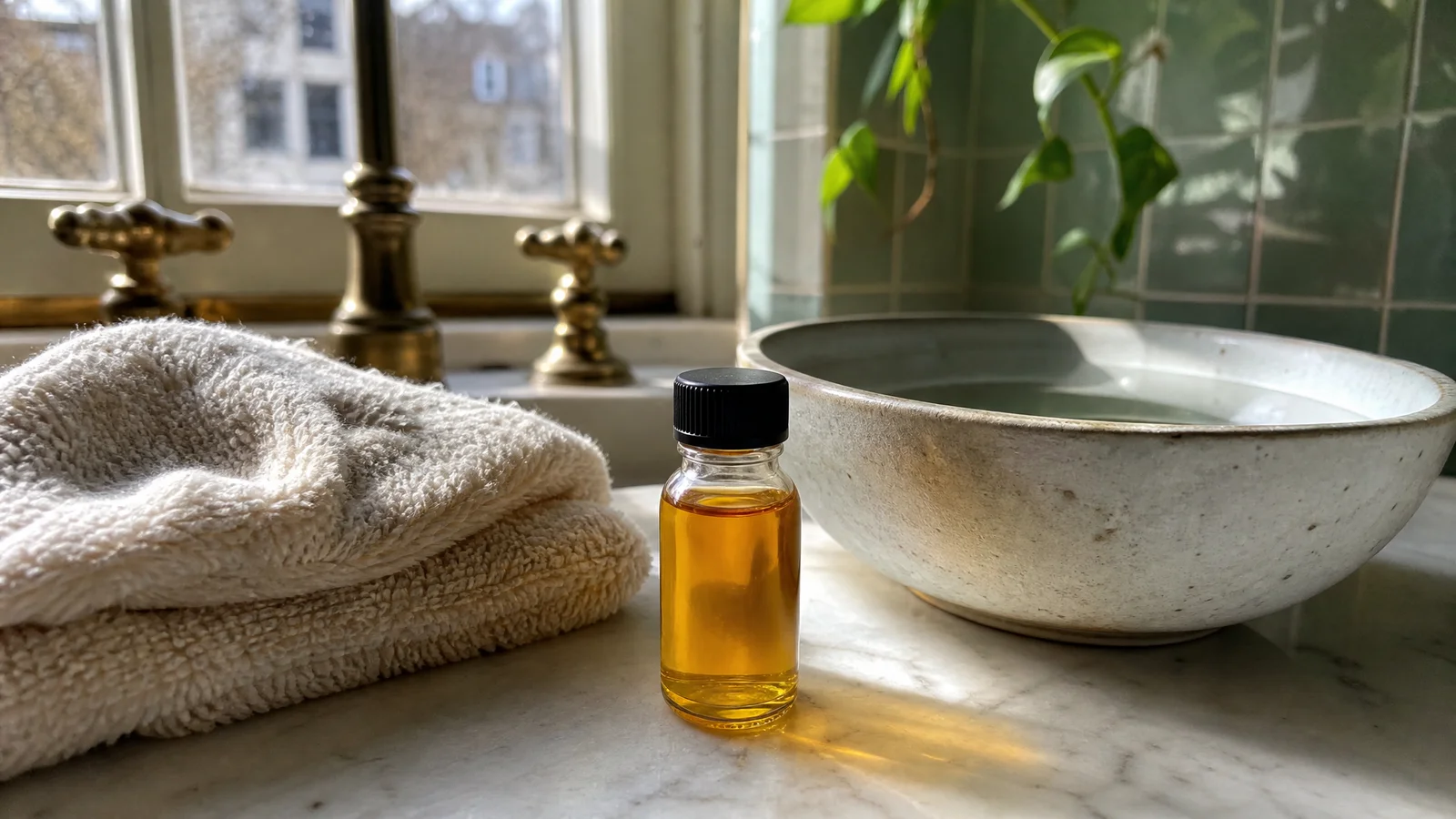
Drop counts are best avoided, since a drop varies with the oil and the dropper. A small syringe or graduated pipette gives you millilitres, and a kitchen scale in grams works if you stay consistent. Mix in a clean dark glass bottle and label it with the date and the percentage.
How to mix essential oil into calendula oil?
Set yourself up the way you would for baking: a clean surface, a clean dry bottle, and everything measured before anything is opened. Pour the calendula oil in first, then add the essential oil, cap the bottle and roll it gently between your palms for a minute. Shaking hard puts air into the mix, and rolling is calmer and does the job.
Then wait a day before you judge it. A fresh blend often smells sharper than it will once the two oils have settled together, and the first sniff can mislead you into adding more. Open the cap after a day, breathe in once, and decide then. If it already smells strong, that is your answer, because a blend you can smell from across the room is usually too much for skin.
Phototoxic citrus and other essential oil checks
Because we make a single oil, we do not sell essential oils, so you would pick those up from an aromatherapy supplier. A few things are worth checking at the shelf.
- Citrus. Citrus oils pressed from the peel (expressed oils) can be phototoxic because of furanocoumarins, while distilled citrus oils are not, according to the Tisserand Institute (Citruses: a comparison of different oils). The label should say which kind it is, and some, such as lemon, carry their own maximum.
- One at a time. A single essential oil is easier to read than a trio. If your skin reacts, you know who to blame.
- Fresh and well labeled. Look for the plant's Latin name and a recent batch on the bottle.
There is no "best" scent to name here, since no source we read shows a particular pairing doing anything special, so choose by what you enjoy smelling.
A small habit that pays off: keep a note on your phone or the back of the label with the date, the percentage and the oil you chose. When you come back to the bottle in a month, you will know exactly what you made, and if you want to adjust it, you will be changing one thing at a time instead of guessing.
When should you skip an essential oil blend?
Adding an essential oil adds a second source of possible allergens to a mix that already has one. That is why we suggest a longer patch test of the finished blend rather than the calendula alone. Our patch test guide gives the steps.
Plain calendula oil is the better starting point for a few situations:
- Daisy-family allergy. The EU herbal monograph lists hypersensitivity to Asteraceae as a contraindication for calendula (European Union herbal monograph on Calendula officinalis L., flos).
- Pregnancy and breastfeeding. The same monograph says safety has not been established and use is not recommended without sufficient data, so a conversation with a midwife or OB/GYN comes first.
- Young children. The monograph does not establish use on the skin under age six, and a pediatrician is the right person to ask about anything beyond plain oil.
- Homes with cats. Pet Poison Helpline says cats are especially sensitive to essential oils, which are rapidly absorbed through the skin and by mouth, and cats lack a liver enzyme that helps clear certain toxins (Essential Oils and Cats). Ask your veterinarian before using blends near pets.
Small blend batches and fresh calendula oil storage
Blend a bottle you will use within a few weeks rather than a year's worth. Our oil has nothing added, so the same rules for any plant oil apply: keep it cool, dark and tightly capped, and our storage guide explains why. If you are comparing carriers before you blend, the notes on calendula and jojoba and on infused oil versus essential oil are useful companions.
It also helps to think about where the bottle will live. A blend left on a sunny bathroom windowsill ages faster than one in a drawer, and a scent that delighted you in week one can turn muddy in week eight. A small dark bottle on a shelf you pass every morning gets used up while it is still at its best.
A good blend is a quiet one: a low percentage, a scent you love and a bottle small enough to finish. If you would like to see which carrier our oil is made in before you plan your recipe, email us the lot number and we will send the batch paperwork.
Calendula Oil
Nature's Golden Botanical, bottled: small-batch calendula oil in sizes from 0.5 oz to bulk.
From $13.99
Shop Calendula Oil →Sources & Further Reading
- Dilution for essential oils (Tisserand Institute)
- Citruses: a comparison of different oils (Tisserand Institute)
- European Union herbal monograph on Calendula officinalis L., flos (EMA/HMPC/437450/2017)
- Essential Oils and Cats (Pet Poison Helpline)