Does Calendula Oil Have a pH? What to Check Instead
Every so often someone asks us for the pH of our calendula oil, usually because they want something "pH balanced" for their skin. It is a thoughtful question, and the honest answer is a little surprising: a plain oil does not have a pH at all. That sounds like a gap, but it is simply chemistry, and the interesting part is what to look at in its place.
Calendula Oil
Our own small-batch calendula oil, in sizes from 0.5 oz to bulk.
From $13.99
Shop Calendula Oil →Why does calendula oil have no pH?
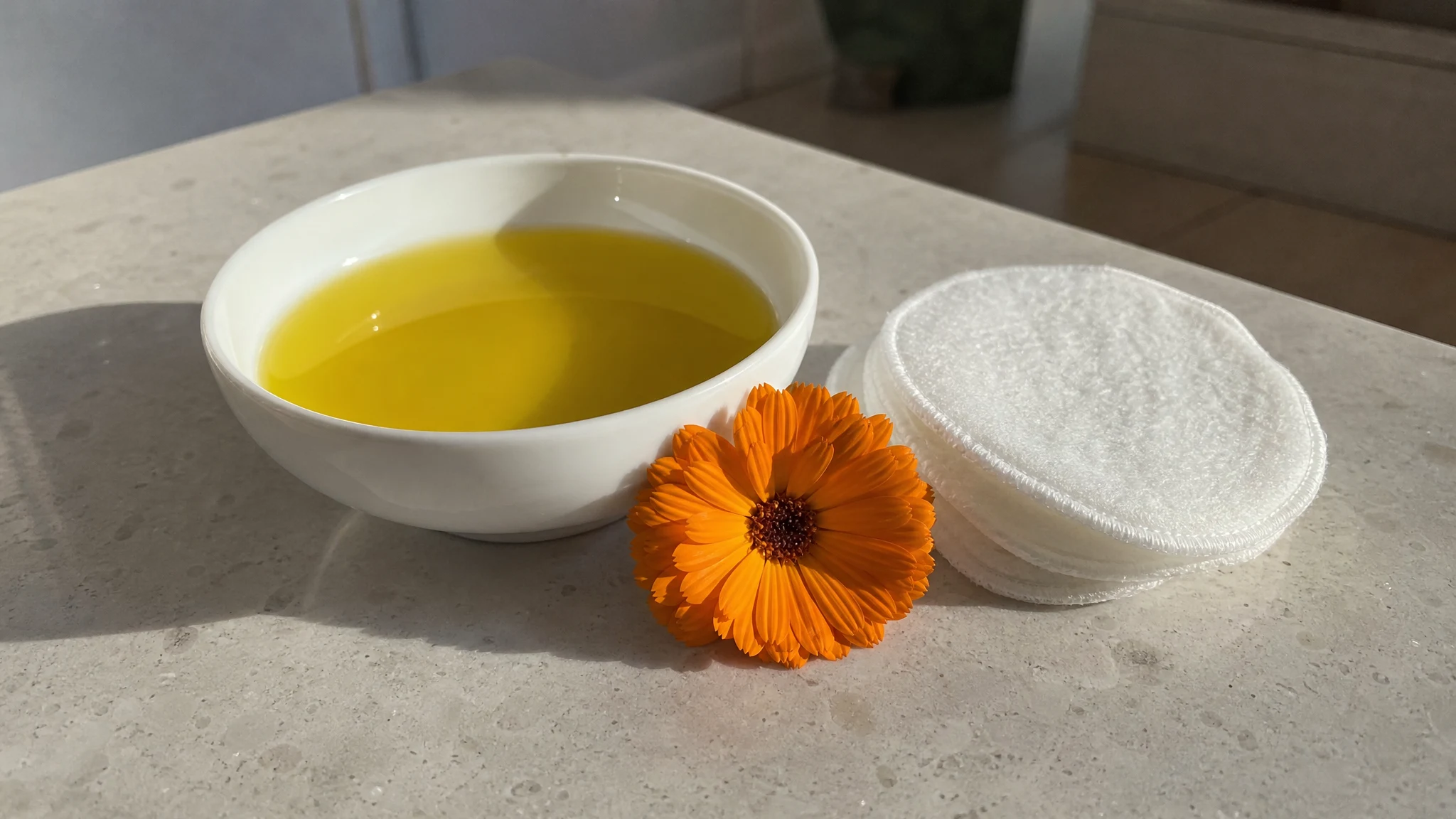
pH measures how acidic or alkaline a water-based solution is. A formulator's Q&A on a supplier site puts it directly: an all-oil formulation contains no water, so it does not have a pH, and the idea of adjusting it does not apply (MySkinRecipes, pH Adjustment in Formulations). Our oil is a calendula extract brought into a carrier oil, with nothing else added, so we do not state a pH for it. If you see a number quoted for a plain oil, a fair question is what it was measured in, since a reading taken on water shaken with the oil describes that water.
Normal skin pH ranges and barrier changes
Skin, on the other hand, is quite acidic. A review gives the normal pH of the outer layer, the stratum corneum, as 4.1 to 5.8, and notes that it tends to rise when the barrier is disrupted (Proksch, 2018). A multicentre study of 330 people measured forearm skin at 5.12 on average, falling to 4.93 after 24 hours without showering or cosmetics, which suggests a natural value of about 4.7. The same study found that soap and even tap water raise skin pH, tap water for up to six hours, and that skin below pH 5.0 scored better on barrier, moisture and scaling measurements (Lambers et al., 2006). That is an association, so we use it only to explain why washing matters.
Where does pH matter for skincare products?
Think of it as a short decision tree, in the order we would walk someone through it.
- You use the oil on its own. pH is not a factor. The practical questions are plant allergy, freshness and the carrier.
- You are choosing a wash. This is where pH lives. A 2025 review reports that conventional soap generally sits between pH 8.5 and 11, while synthetic detergent cleansers, called syndets, sit between 5.5 and 7, closer to the skin's 4 to 6 (Bohbot et al., 2025). A calendula soap is still a soap, and a calendula label does not change its pH. The cleanser you pick affects your skin far more than an oil applied afterward.
- You mix the oil into something with water. Now the mixture has a pH, and it also needs a preservation plan. FDA's guidance for consumers is not to add water to cosmetic products, because it can introduce microorganisms and dilute the preservatives meant to hold them back (FDA, Microbiological Safety and Cosmetics). Our oil carries no preservative, so it will not make a water-based mixture keep. Mostly-oil balms are the simpler route.
Better questions for any calendula oil maker
If someone asks us for a pH, we like to turn the conversation around and ask what they are trying to find out. Usually the real worry is whether the oil will be gentle on their skin, whether it is fresh, and what is in the bottle. Those are questions we can answer, and they are the ones we would ask any maker.
Try it with your own oil shelf. Open each bottle and look at it. Is it clear? Does it smell clean and plant-like, or sharp and stale? Is there a date? A bottle that is dated and lot-numbered gives you a place to start, and a maker who answers a short email about what is in it is a good sign.
Reading pH balanced labels on skincare products
You will see "pH balanced" on many products, and it can feel reassuring. Our advice is to read it as a prompt for a question: balanced for what, and measured in what? A good label tells you. If it does not, the phrase is just decoration, and the ingredient list is the more useful place to look.
Calendula oil compatibility: allergy, freshness, carrier
For an oil, we think compatibility comes down to three plain things. First, whether you react to the plant. Calendula is in the daisy family, Asteraceae, and the EU herbal monograph lists sensitivity to that family as a contraindication, noting that skin sensitization has been reported (EMA/HMPC monograph, 2018). In one Austrian clinic, 9 of 443 people tested for dermatitis reacted to marigold, about 2%, though that group is not the general population (Reider et al., 2001). Our patch test guide shows how to try a small area first.
Second, whether the oil is fresh. A pH reading will never tell you that. Each of our bottles is dated and lot-numbered so you can match it to its paperwork, and our storage article covers keeping it in good shape. Third, what else is in the bottle. Ours is calendula and a carrier, with no synthetic preservatives, tocopherol or stabilizers, and the carrier is named on the batch paperwork when you email us the lot number at support@truecalendulaoil.com.
The same monograph does not recommend skin use under age 6 and says safety in pregnancy has not been established, so a pediatrician or OB/GYN is the person to ask in those cases.
So when pH is on your mind, look at what you wash with and what you mix in, and let the oil be what it is: a simple, oil-based way to leave skin feeling soft.
Calendula Oil
Nature's Golden Botanical, bottled: small-batch calendula oil in sizes from 0.5 oz to bulk.
From $13.99
Shop Calendula Oil →Sources & Further Reading
- MySkinRecipes. pH Adjustment in Formulations (expert Q&A, 2019). myskinrecipes.com
- Proksch E, 2018. pH in nature, humans and skin. PubMed 29863755
- Lambers H et al., 2006. Natural skin surface pH is on average below 5, which is beneficial for its resident flora. PubMed 18489300
- Bohbot JM, Rebelo C, Nappi RE, 2025. Vulvar Care: Reviewing Concepts in Daily Hygiene. PMC12248671
- U.S. Food and Drug Administration. Microbiological Safety and Cosmetics. fda.gov
- European Medicines Agency, HMPC, 2018. European Union herbal monograph on Calendula officinalis L., flos. ema.europa.eu
- Reider N et al., 2001. The seamy side of natural medicines: contact sensitization to arnica (Arnica montana L.) and marigold (Calendula officinalis L.). PubMed 11722485