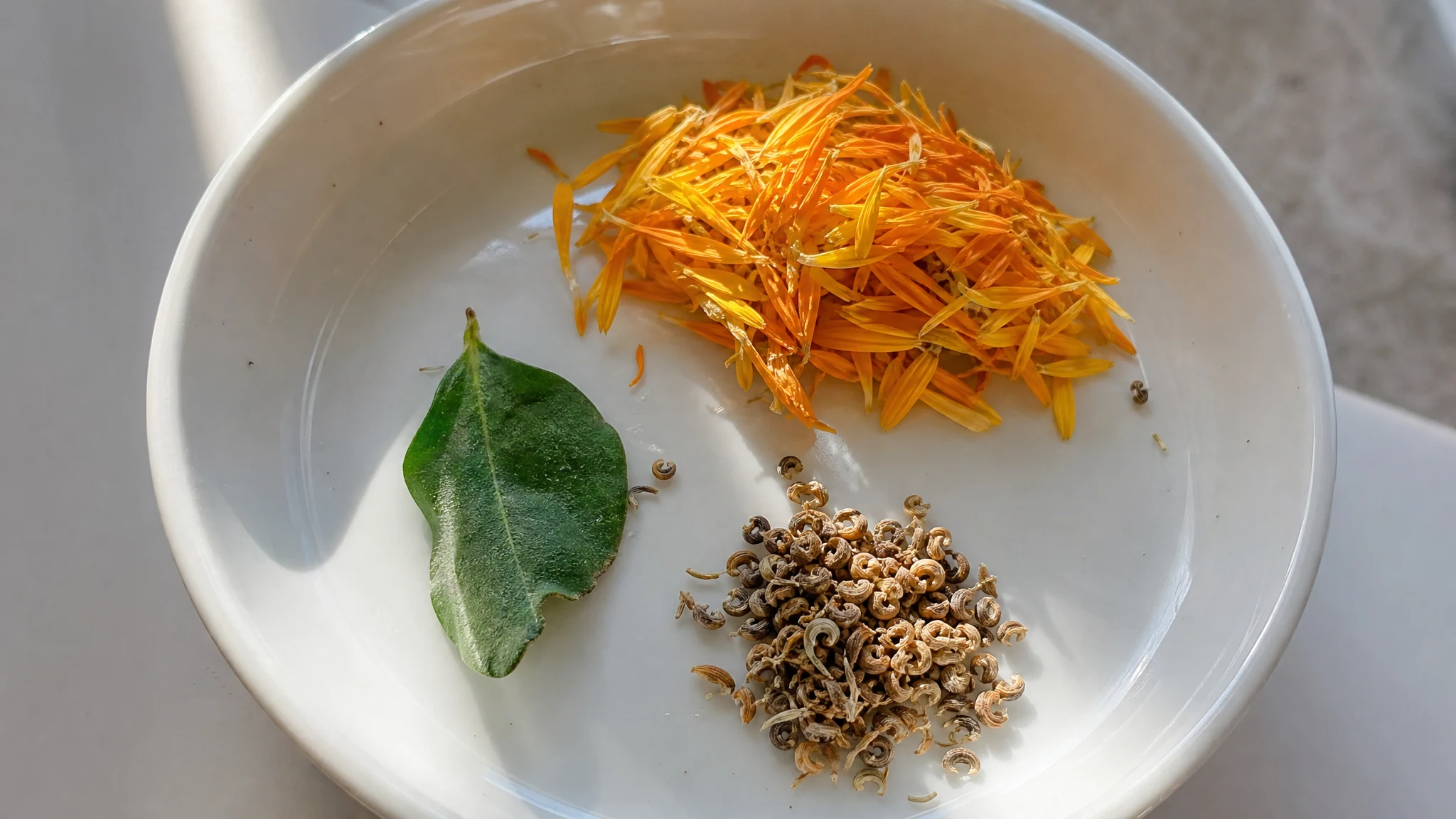
Calendula Oil Composition: What's Really in the Bottle
Search for the chemistry of calendula oil and you will find long, impressive lists of compounds. Those lists are about the flower. An infused oil is a different thing: dried petals steeped in a carrier oil, which leaves the finished oil mostly carrier, colored and scented by what the flower lends it. Sorting what is measured from what is assumed makes the chemistry far more interesting, not less.
Calendula Oil
Our own small-batch calendula oil, in sizes from 0.5 oz to bulk.
From $13.99
Shop Calendula Oil →Carotenoids: why calendula oil is golden
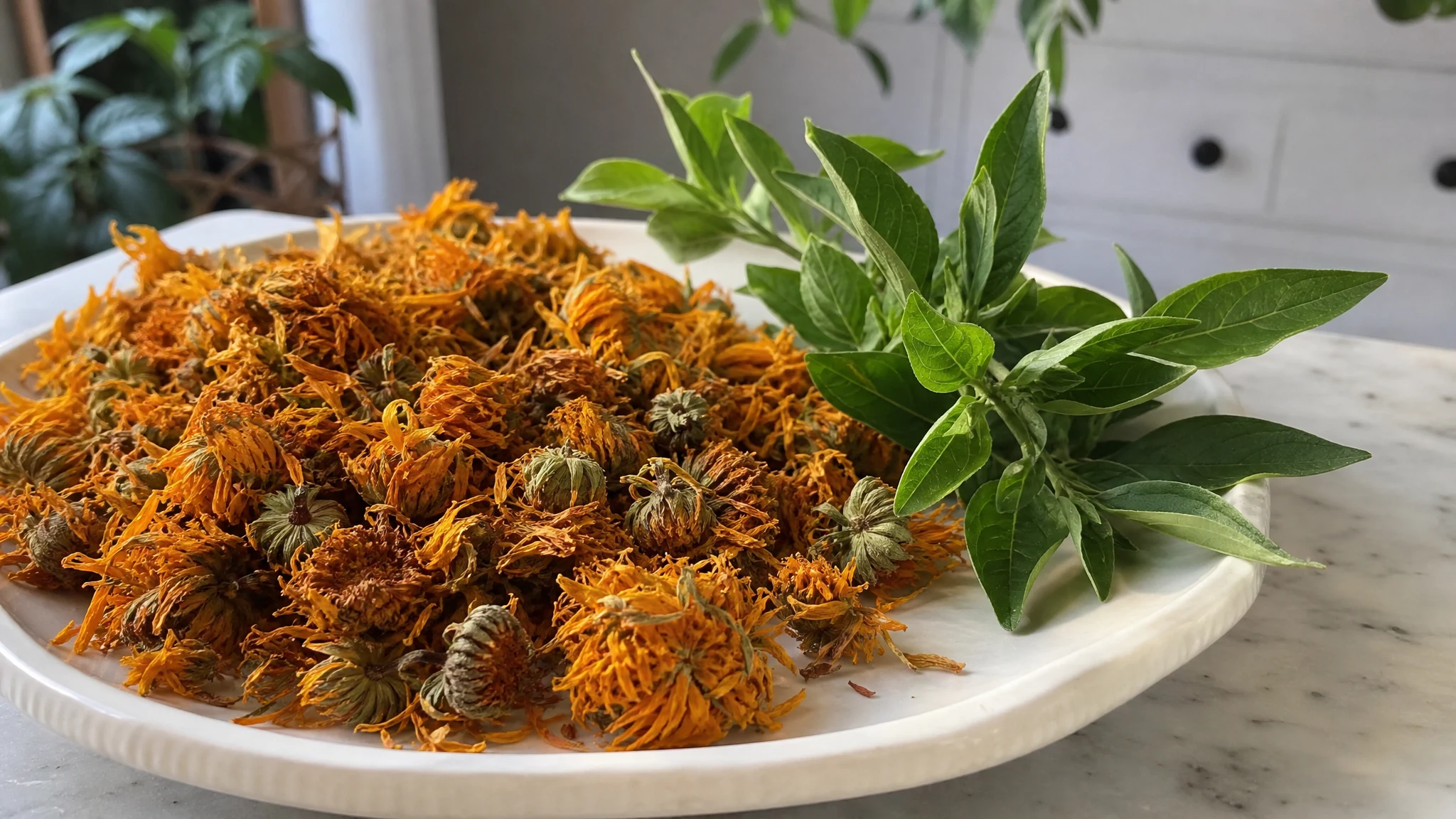
The best-documented thing calendula gives an oil is color. The flower's yellow to orange shade is mostly down to carotenoids, pigments that dissolve in fat, which is exactly why they travel into an oil. A Romanian study that measured four varieties by HPLC found total carotenoids ranging from about 48 mg per 100 g of fresh flowers in a yellow-orange type to 276 mg in a dark orange double-flowered one. Inside a single flower, the petals carried most of it: in one variety, 103.8 mg per 100 g in the petals against 8 mg in the tubular center.
That is why we infuse petals separated by hand from sound, whole dried flower heads, not broken florets. It is reasoning rather than a measurement of our own oil, but it points the effort at the part of the flower where the pigment sits.
Why is the carrier oil most of the bottle?
The EU herbal monograph for calendula flower describes the oil preparation as a 1:10 extract: one part flower to ten parts fatty vegetable oil, olive oil being its example. Here is some simple arithmetic of our own, not a measurement: at that ratio, 10 g of flower sits in 100 g of oil, and only a fraction of the flower's weight can dissolve into fat. Whatever the flower contributes, by weight most of the bottle is carrier.
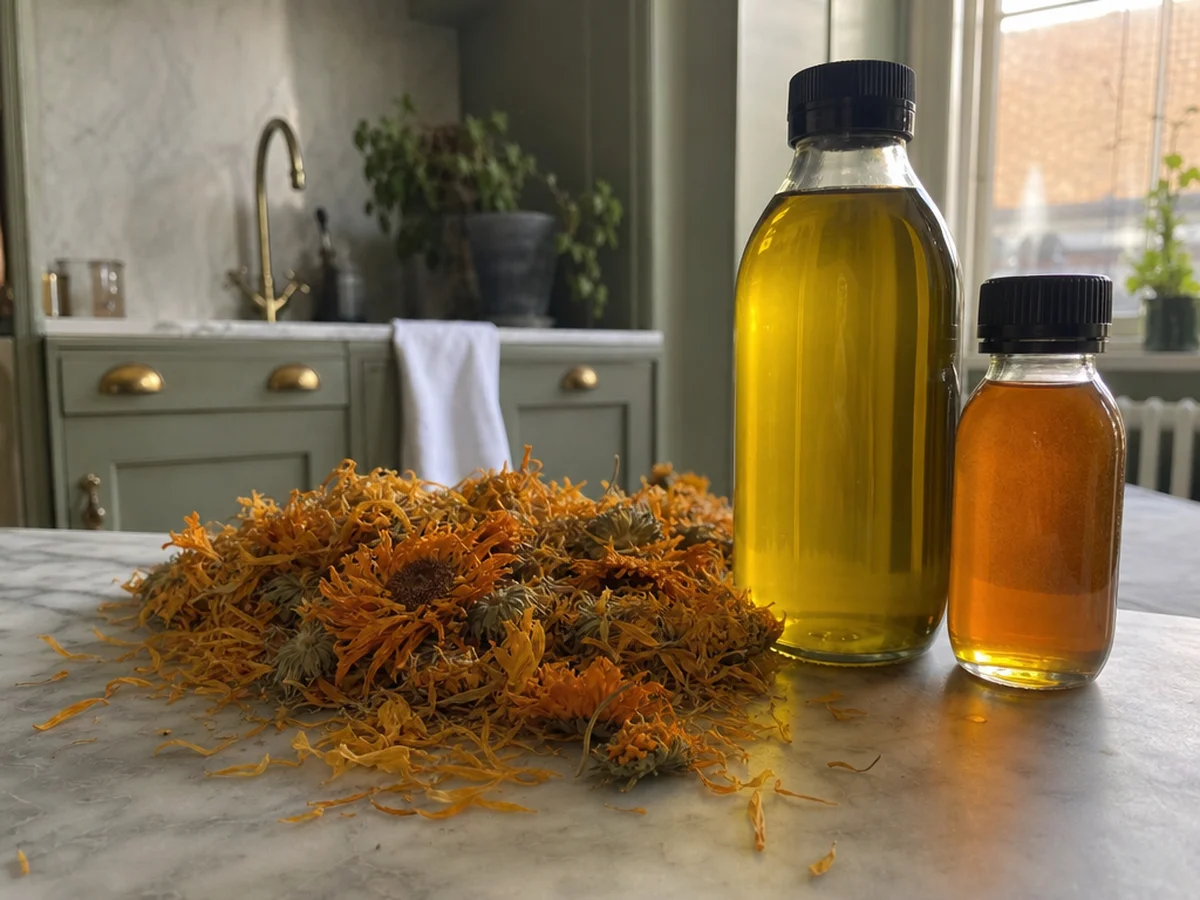
It follows that the fatty acid profile of an infused oil is mostly that of its carrier. This is why we are cautious about claims that calendula oil is rich in calendic acid. Calendic acid is real: it made up roughly 51 to 58 percent of the fatty acids in the seed oil of eleven calendula genotypes in a published study. But that is seed oil. The petals used for an infused oil are not seeds, and we have not found a published fatty acid analysis of an infused calendula oil. The two materials share a plant and little else. Our article on calendula fatty acids goes through the difference.
Which compounds in calendula come up most?
Two other groups come up repeatedly. Triterpene esters, of which faradiol esters are the best known, are fat-soluble, so it is plausible that some reach an oil, though we know of no study that measured them in one. In a 2025 laboratory study, researchers confirmed that C16-hydroxylated triterpenoids in calendula flower extracts contributed to anti-inflammatory activity in lab tests and mapped how the plant builds them. That is a finding about extracts and plant biochemistry, not about a cosmetic oil on skin, and we mention it because it explains why chemists find the flower so interesting. Our faradiol article looks at it more closely.
The flower also holds flavonoids, saponins and polysaccharides. Many of these dissolve in water more readily than in oil, so by chemical reasoning less of them is likely to reach an oil. That is an inference, and we would say the same about anything we have not seen measured.
Choosing a calendula oil: ask about the carrier
Because so much of the bottle is carrier, the carrier is the first thing worth asking about. We buy dried flowers, extract the calendula on its own, and bring that extract into a carrier oil. The carrier is named on our batch paperwork: email the lot number to support@truecalendulaoil.com and ask for it. Nothing else goes in, so there are no synthetic preservatives, no added tocopherol and no stabilizers.
Next comes the testing. Every batch goes to independent third-party labs for physical assays, chemical assays and contaminant screening, and a Certificate of Analysis PDF is linked on our shop page. A certificate lists only the tests that were run, and some analytical methods can be fooled by adulterants, as a review of botanical ingredient authentication documents, so read which tests are listed and ask about any you wanted that are missing. We do not quote composition numbers for our oil in articles; the paperwork is where they belong.
Saucer test for oil color in daylight
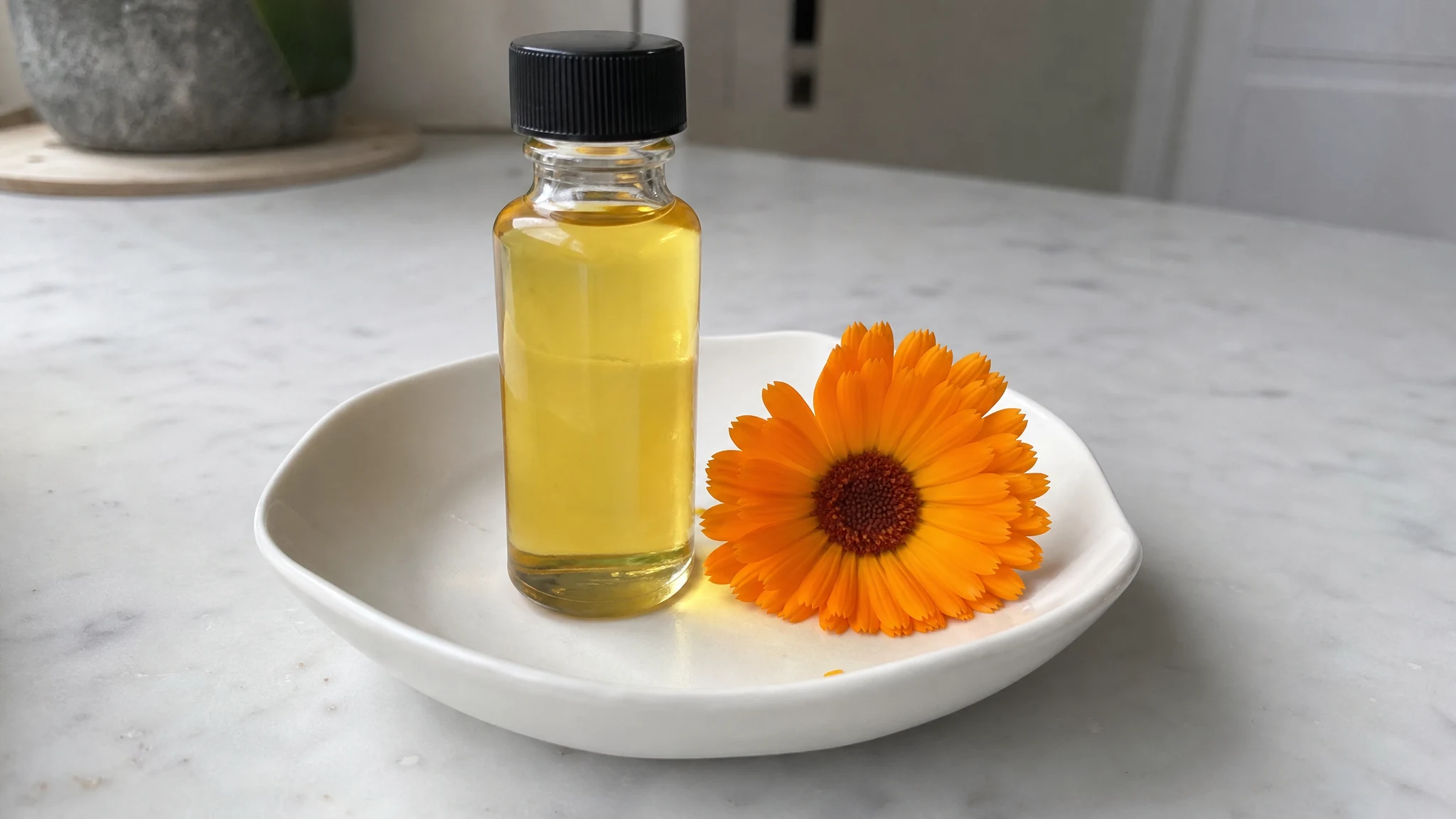
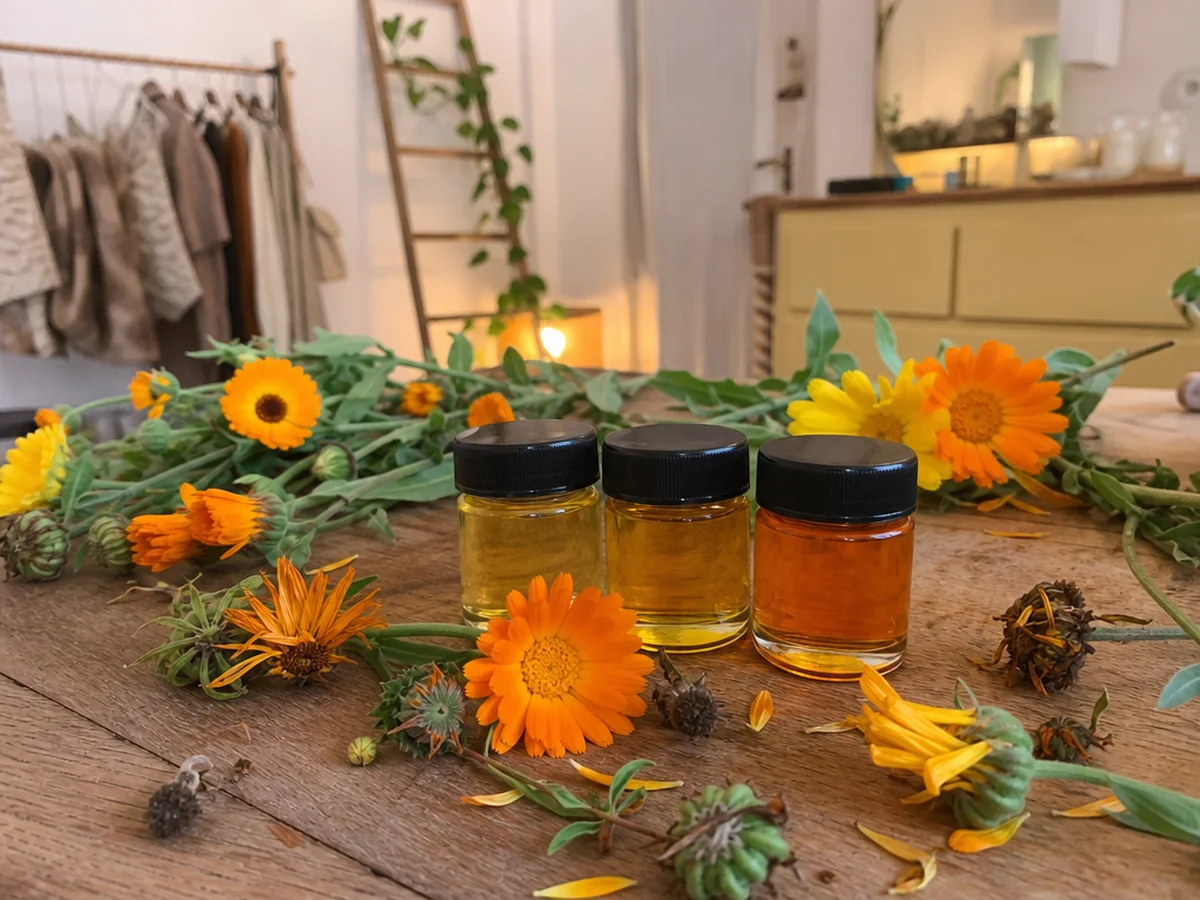
You do not need a laboratory to enjoy the chemistry. Pour a few drops onto a white saucer or spoon and look at it in daylight. The depth of gold is the flower's fat-soluble color showing through the carrier, and it is lovely to see. Rub a drop between your finger and thumb and notice how it glides and how quickly it spreads. That glide is mostly the carrier at work. None of this replaces the paperwork, but it makes the words on a lab sheet feel less abstract.
Our recommendation when you compare any two infused oils: ask the same questions of each seller, in writing, and keep the answers side by side. A maker who answers plainly and promptly is telling you something useful too.
Daisy-family hypersensitivity and calendula officinalis oil
Calendula is a daisy-family plant. The EU monograph lists hypersensitivity to Asteraceae as a contraindication and notes that skin sensitization has been reported. Patch test first (our patch test guide shows one way), and keep calendula away from the eyes. A cosmetic oil is for external use, and chemistry is not a claim about what it does for anyone's skin; for a skin condition, a dermatologist is the person to ask. For the bigger picture, our extraction methods article compares ways of getting the flower into an oil.
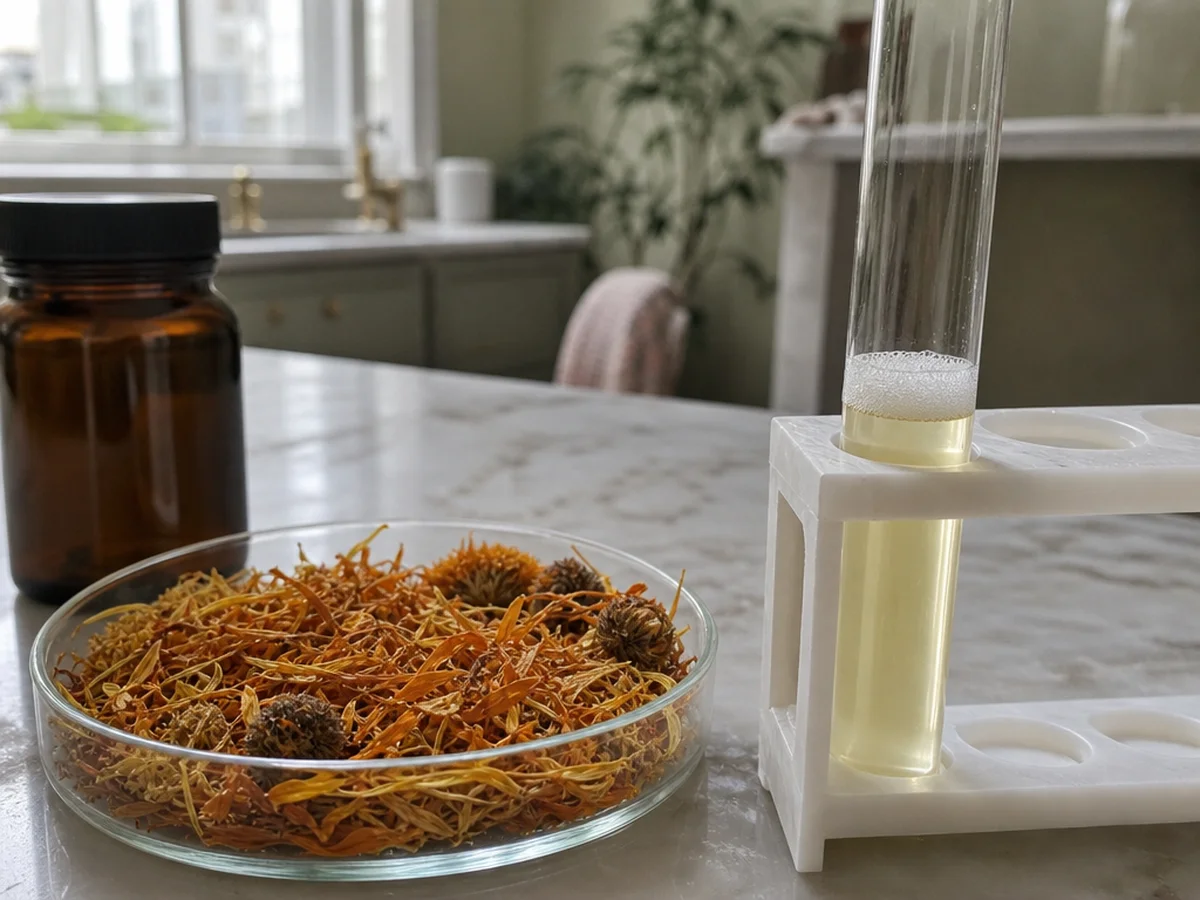
The nicest thing about the chemistry of calendula is how much of it you can see: a golden jar is a small lesson in fat-soluble pigments. Knowing which parts are measured and which are only plausible lets you enjoy it without being sold more than it can deliver.
Calendula Oil
Nature's Golden Botanical, bottled: small-batch calendula oil in sizes from 0.5 oz to bulk.
From $13.99
Shop Calendula Oil →Sources & Further Reading
- Pintea A et al., 2003. HPLC analysis of carotenoids in four varieties of Calendula officinalis L. flowers. Acta Biologica Szegediensis.
- EMA/HMPC, 2018. European Union herbal monograph on Calendula officinalis L., flos.
- Dulf FV et al., 2013. Fatty acid composition of lipids in pot marigold (Calendula officinalis L.) seed genotypes. Chem Cent J.
- Golubova D et al., 2025. Biosynthesis and bioactivity of anti-inflammatory triterpenoids in Calendula officinalis. Nat Commun.
- Gafner S et al., 2023. Botanical Ingredient Forensics: Detection of Attempts to Deceive Commonly Used Analytical Methods for Authenticating Herbal Dietary and Food Ingredients and Supplements. J Nat Prod.