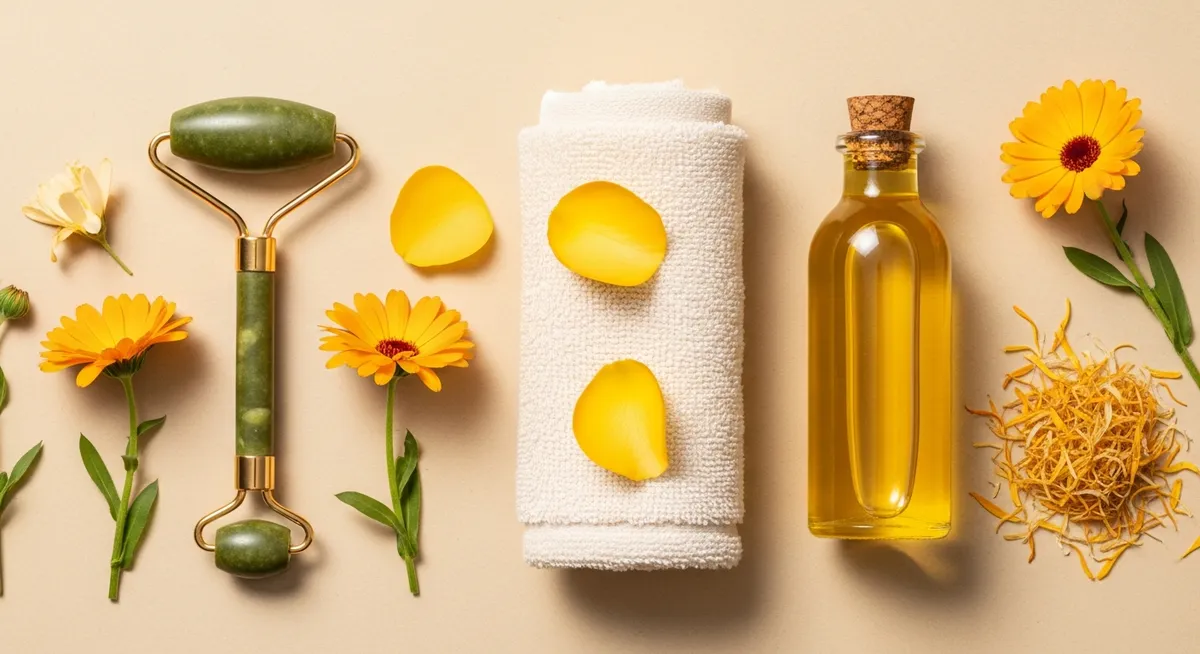
30-Day Calendula Oil Face Challenge: Before & After Method
The before and after worth having is your own, and this page is the method for producing one that means something. We are not publishing a single person's photographs here, and the reason is the whole argument of the article: one unblinded subject, no control, no measurement instrument and a camera held at whatever distance felt right that morning produces a picture, not a finding. A 30-day calendula oil for face challenge is worth running. It is worth running properly.
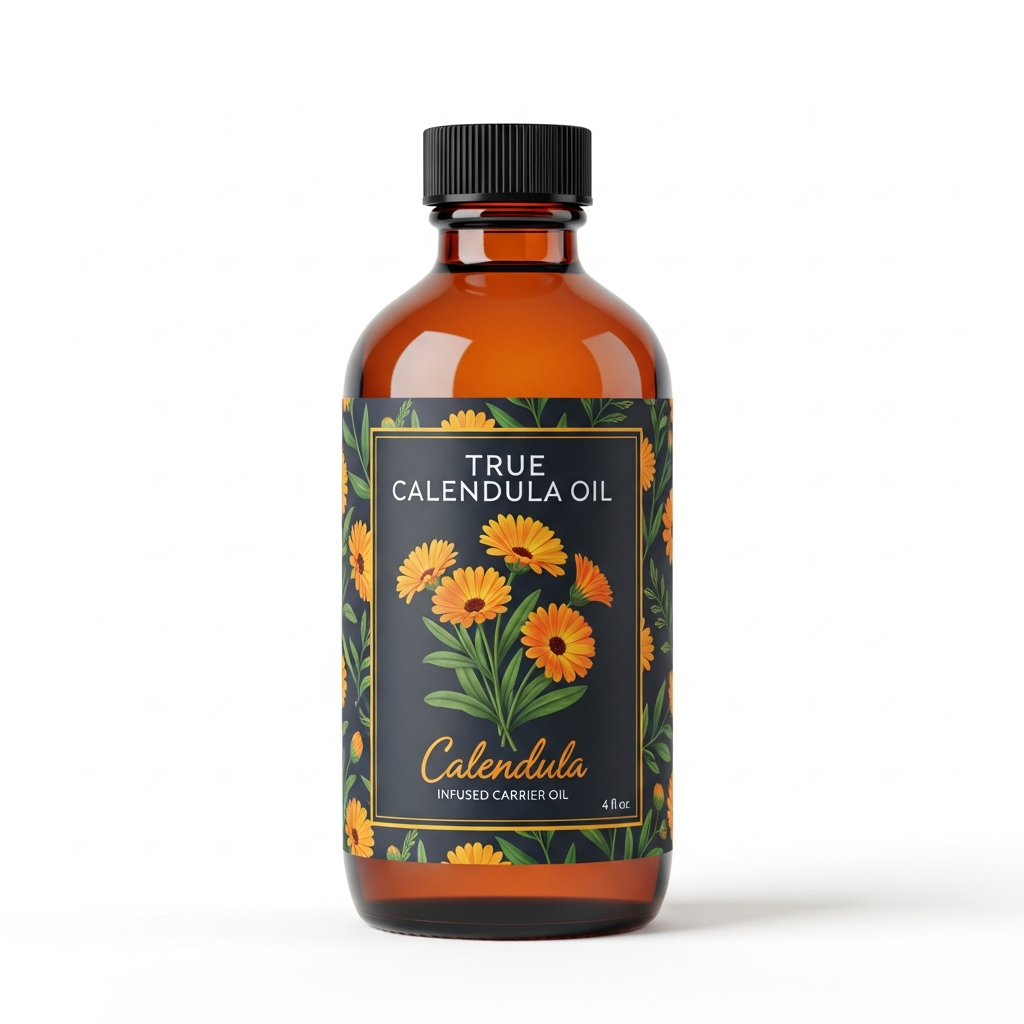 Calendula Oil
Our own small-batch calendula oil, in sizes from 0.5 oz to bulk. From $11.99.
Shop Calendula Oil →
Calendula Oil
Our own small-batch calendula oil, in sizes from 0.5 oz to bulk. From $11.99.
Shop Calendula Oil →
What follows is a protocol you can execute at home: the controls to set before day one, the photographic conditions that make two images comparable, the half-face design that gives you an internal control, the outcomes 30 days can plausibly move, and the ones it cannot touch no matter how consistent you are. Read the patch test section before you start rather than after.
The Challenge Framework: Setting Realistic Expectations
The framework has to be set before day one because almost every decision that determines whether the result means anything is made in advance. The central rule is one variable. If you start an oil and a new cleanser and a retinoid in the same week, you have learned nothing at the end of it, and that is the commonest way these challenges fail.
Study Parameters
- Duration: 30 consecutive days, with photographs on days 0, 7, 14, 21 and 30
- Product used: One product, unchanged, with a known composition and a batch number recorded
- Application: Twice daily, 3 to 4 drops, to skin still damp from cleansing
- Design: Half-face split where practical, with the untreated side as your control
- Documentation: Fixed-condition photographs plus a daily one-line log of sleep, alcohol, sun exposure and any change of routine
- Baseline: No change to any other skincare product for the 14 days before day 0
That fourteen-day run-in is not padding. A product introduced a week before baseline is still expressing itself during your first week, and you will read its effect as the new one's. Record the dose too: at roughly 20 drops per millilitre, 3 to 4 drops twice daily is about 0.3 to 0.4 mL a day, so a 30-day round consumes 9 to 12 mL. A 0.5 oz bottle at 14.8 mL covers one full round with a margin.
The Context: Why Calendula Oil?
Calendula is a reasonable subject for a single-ingredient challenge precisely because it is simple. An infused oil is one botanical in one carrier: ours is organic Calendula officinalis petals cold-infused into Helianthus annuus seed oil, with no fragrance, no preservative and no actives. When something changes, there are fewer candidates for what changed it, and when something goes wrong there are fewer suspects.
Know what is in it. The European Pharmacopoeia monograph for calendula flower requires not less than 0.4% flavonoids calculated as hyperoside, and the faradiol mono- and diesters that distinguish calendula concentrate in the ray florets rather than the disk florets or the green bracts, which is why petals rather than whole flower heads belong in the infusion jar. The golden colour comes from carotenoids, with flavoxanthin, auroxanthin and lutein dominant in the petals.
The Appeal of Botanical Oils
The practical reasons people reach for a single-ingredient oil map directly onto what makes it a good test subject:
- A short ingredient list means fewer variables when something reacts
- No fragrance and no preservative removes the two commonest causes of positive cosmetic patch tests
- An emollient's effect on surface hydration and flaking shows up inside weeks rather than months
- Cost per day is low enough that a 30-day trial is not an expensive mistake
The 30-Day Calendula Oil Face Challenge: Week by Week
The four weeks are not four equal stretches. Different things are observable at different points, and knowing which is which stops you from concluding too early.
Week 1: Initial Observations (Days 1-7)
Week one is a tolerance week and nothing else. You are establishing that the product does not cause stinging, redness, itching or new bumps, and the reactions that matter most often appear on days three to five rather than on day one. Do not assess appearance this week, because nothing visible in seven days is attributable to the product.
What to record on days 1 to 3:
- Time to absorb, and whether the skin feels coated or comfortable afterwards
- Any stinging, warmth or tightness in the first ten minutes
- Whether makeup applies over it without pilling or sliding
- The baseline photograph taken under the conditions set out below
What to record on days 4 to 7:
- Any redness, itching or new papules, which is what a late reaction looks like
- Whether the routine is actually happening twice a day, honestly counted
- Dose settling: many people find 2 to 3 drops covers a whole face once technique improves
Week 2: Settling into Routine (Days 8-14)
The first outcomes that can legitimately move are surface ones: how tight the skin feels on waking, whether the dry patches at the sides of the nose and along the jaw are still flaking, and how foundation sits. These are stratum corneum effects, and the stratum corneum turns over in roughly 14 to 20 days in a young adult, so week two is the earliest point at which a change is biologically plausible.
Guard against the trap here, which is that you now know what you expect to see. Score the specific things, not the overall impression: count visible flakes in a fixed area under a fixed light, rate tightness on waking out of ten before you look in a mirror, and write the numbers down before comparing them with last week's.
Week 3: Mid-Challenge Developments (Days 15-21)
Week three is where adherence usually slips and where the half-face design starts earning its keep. If you have been applying to one side only, this is the point at which any difference between the sides would begin to be visible, and it is also the point at which you will be tempted to abandon the split because it feels absurd. Do not abandon it. Without a control side you are comparing your face today with your memory of it, which is the least reliable instrument in the room.
Keep the log honest, including the days you skipped. A challenge with four missed applications is still interpretable; a challenge with four missed applications you did not write down is not.
Week 4: Final Observations (Days 22-30)
Thirty days is roughly one full epidermal turnover cycle for a young adult, where complete turnover runs about 28 to 30 days. It is about two thirds of a cycle for an older adult, where the same process takes closer to 45 to 50 days. If you are over about fifty, treat day 30 as an interim reading and consider running to day 45 before drawing a conclusion.
Take the final photograph under exactly the conditions of the first, at the same time of day, then stop. Resist adding a second product in the last week to see whether it helps; that is how a clean test becomes an uninterpretable one at the finish line.
Reading Your Results: What Photos Can and Cannot Show
Photographs are the weakest instrument in any cosmetic assessment and the one everybody relies on. Professional efficacy studies do not trust a phone camera: they use capacitance measurement, where a Corneometer reads the dielectric properties of the stratum corneum and reports hydration in arbitrary units, alongside instruments such as a Cutometer for elasticity, and imaging systems that capture standard, cross-polarised, parallel-polarised and UV modes under fixed illumination, commonly on a day 0, 7 and 28 schedule. Cross-polarised imaging exists specifically because ordinary photographs confuse surface shine with skin condition.
Photographic Documentation Process
You cannot buy that equipment, but you can remove most of the variance for nothing by fixing every condition you control:
- One light source only, with every other light in the room off, ideally a north-facing window or a fixed lamp in a windowless room
- The same time of day every time, since both daylight and your own skin change through the day
- Manual exposure and manual white balance, locked and written down, never automatic
- A fixed camera-to-face distance, marked on the floor with tape, and the same focal length
- A plain mid-grey or white background, included in every frame so you can check colour afterwards
- No makeup, no product applied that morning, skin washed and blotted 20 minutes before
- The same neutral expression and the same three angles: front, left profile, right profile
Observable Changes
When comparing day 0 with day 30, the differences that photographs can legitimately show are surface ones:
- Flaking and scale: visible or not visible in a fixed area, which is genuinely readable in an image
- Surface texture: the fine roughness that catches light, best judged with the flash off
- Redness: readable only if your white balance was locked, and not otherwise
- Shine: the most frequently misread signal of all, since an oil on the skin looks like radiance in every photograph regardless of what is underneath
Things a 30-day emollient challenge cannot change, and which no photographic trick will show: solar lentigines, which are melanin sitting in and below the epidermis; established wrinkles; scarring; and pore diameter. If those are your targets, this is the wrong protocol and a dermatologist is the right next step. For the routine this fits into, see our guide to calendula oil for skin.
Key Variables the Challenge Controls For
Four variables account for most of the noise in a self-run challenge, and each has a concrete control.
Consistency Matters
Adherence is the single largest determinant of whether you learn anything, and it is measurable rather than a feeling. Keep a tick sheet. Twice daily for 30 days is 60 applications; if you finish on 44, that is what you tested, and the conclusion has to be written that way.
Quality Considerations
Test a product you can describe. Record the botanical name, the carrier, the batch and any published analytical figures, so that a second round is genuinely a repeat. Our own True Calendula Oil ships with a certificate of analysis for every batch reporting relative density 0.922 at 20°C against a range of 0.910 to 0.930, refractive index 1.475 against 1.465 to 1.477, and optical rotation +0.16° inside a window of -1.0° to +1.0°. Those figures are what make one round comparable with the next.
Integration with Existing Routines
Apply to skin still damp from cleansing, because an emollient slows water leaving the stratum corneum rather than supplying any, and press it in rather than rubbing. If you use a sunscreen, keep it: removing sun protection for a month is not a neutral change, and it will undermine the very outcomes you are measuring.
Individual Variation
Sleep, alcohol, indoor humidity, ambient temperature, sun exposure, menstrual cycle phase and new medication all move skin on a timescale of days. You cannot control them, so record them in one line a day. When you look back at an unexpectedly good week three, that log is what tells you whether the oil or the holiday was responsible.
Important Considerations and Limitations
A self-run challenge is worth doing, and it is worth being clear-eyed about what it can and cannot support.
Study Limitations
- Single subject: an n of one supports a personal decision, never a general claim
- No blinding: you know which product you used, and expectation measurably shifts subjective scoring
- Uncontrolled confounders: weather, sleep, stress and diet all moved during the same 30 days
- Regression to the mean: people start challenges when their skin is bad, and skin that is unusually bad tends to improve anyway
- Photographic variance: lighting and white balance can manufacture a before and after on their own
- No control unless you build one: which is exactly what the half-face design is for
Two fixes cost nothing and address most of this. Run the half-face split, treating one side and leaving the other, so the comparison is between two cheeks on the same day rather than between two months. And get a second pair of eyes: hand the day 0 and day 30 photographs to someone else, unlabelled and shuffled, and ask them which is which. If they cannot tell, that is your answer.
Safety Considerations
Patch test before day 0, not during week one. The informative home version is the repeat open application test: apply twice daily to the same 2 to 3 cm patch of inner forearm for seven to fourteen days and watch for anything appearing after day three. In a series of 443 consecutive patch-tested patients, about 2% reacted to marigold and about 4% to the Compositae mix, so if you react to ragweed, chrysanthemum or daisy, treat yourself as higher risk. The Cosmetic Ingredient Review panel's 2010 amended assessment found calendula-derived cosmetic ingredients safe at cosmetic concentrations while flagging them as possible mild ocular irritants, so keep the product away from the eye itself. Stop at the first sign of stinging, redness or new bumps, and take anything persistent to a dermatologist.
Practical Tips for Your Own Challenge
Everything above reduces to a short list of things to do in the week before you start and the thirty days after.
Starting Your Journey
- Run the patch test first: seven to fourteen days on the inner forearm, before anything touches your face
- Hold everything else steady for 14 days: no new products, no new actives, no new supplements
- Set the photo rig once: tape on the floor, lamp position, manual exposure and white balance written down
- Choose the half-face split if you can commit to it: it is the only real control available at home
- Buy one bottle, not three: 9 to 12 mL covers the round, so a 0.5 oz bottle is sized for the job
- Decide in advance what would count as a change: written down on day 0, before you have any stake in the answer
Application Best Practices
- Apply within a few minutes of cleansing, while skin is still damp
- Press and pat rather than rubbing, which is friction you do not need twice a day
- Start at 3 to 4 drops and settle at whatever covers the face without leaving a film
- Let it absorb fully before sunscreen in the morning or a pillow at night
- Keep the bottle in a cool dark place, since an infused sunflower base is linoleic-rich and oxidises with heat and light
The Bigger Picture: Botanical Skincare Exploration
The reason to insist on method here is not pedantry. The internet is saturated with 30-day before and after posts, almost none of which control anything, and the aggregate effect is that nobody can tell which ingredients do anything. A single well-run self-experiment with a control side and a locked camera is worth more to you than a hundred of those posts, because it is about your face rather than someone else's lighting.
It also keeps expectations where the evidence keeps them. A plain emollient oil is a surface product: it can plausibly change flaking, tightness, texture and how makeup sits, on a timescale of two to four weeks. It is not going to move pigment, lines or scarring, and a protocol that sets out to measure those things with a phone camera will produce a conclusion regardless, which is precisely the problem.
If you want to compare, run the same protocol twice with two different products, thirty days apart, using the same rig and the same scoring. That is the closest thing to a controlled comparison available in a bathroom, and it is a genuinely useful exercise.
Conclusion: What a Well-Run 30 Days Can Tell You
At the end of a properly run challenge you will have six sets of photographs taken under identical conditions, a daily adherence count, a daily confounder log, a control side, and a pre-registered definition of what would have counted as a change. That combination can support a real personal conclusion, which is more than most published before and after content manages.
The honest summary of what the protocol is designed to deliver:
- A tolerance answer within seven days, which is the fastest and most valuable output
- A readable surface result, flaking and tightness, by day 14 to 21
- A photographic comparison at day 30 that is worth looking at because the conditions were fixed
- A control side that removes your memory from the comparison entirely
- A written record that makes a second round comparable with the first
Then decide on the evidence you generated rather than on anyone's testimonial. Our own True Calendula Oil is sized for exactly this: a 0.5 oz bottle at $11.99 covers one 30-day round with a margin, a 1 oz bottle covers two, and every size ships with the same certificate of analysis so that round two is a genuine repeat of round one rather than a new experiment wearing the same label.
Run the patch test first, change one thing at a time, lock the camera, and write it down. That is the whole method, and it is the only kind of before and after worth putting your face through thirty days for.
Calendula Oil
Nature's Golden Botanical, bottled: small-batch calendula oil in sizes from 0.5 oz to bulk.
From $11.99
Shop Calendula Oil →