20 Ways to Use Calendula Oil You've Never Tried
Ten of the twenty uses below work. Ten do not, and the reason is nearly always the same one: calendula-infused oil sits in a sunflower base that is rich in linoleic acid, and linoleic-rich oils oxidise. On skin that is fine, because skin renews itself and the bottle is finished in months. On leather, wood, metal, fabric or an instrument, the oil stays put and turns, and the result is a sour yellow film that cannot be washed back out. Each section below carries a verdict rather than a hedge.
 Calendula Oil
Our own small-batch calendula oil, in sizes from 0.5 oz to bulk. From $11.99.
Shop Calendula Oil →
Calendula Oil
Our own small-batch calendula oil, in sizes from 0.5 oz to bulk. From $11.99.
Shop Calendula Oil →
Where a use works, the numbers are here: drop counts, percentages, batch sizes. Where it does not, the alternative is named. One measurement to carry through the whole page, because every dilution depends on it: twenty drops from a standard dropper is roughly 1 mL, so 20 drops in 100 mL of carrier is a 1% dilution and 4 drops per tablespoon is the same figure.
1. Create a Signature Perfume Base
Half right. Calendula oil is close to odourless, which genuinely is what you want underneath a blend: it will not argue with the composition the way a nut or seed oil with its own character does. But an oil-based perfume made on a linoleic-rich base has a working life of months, and the smell of an oxidising carrier under a fragrance is unmistakable and unpleasant.
The fix is to split the roles. Build the roll-on on jojoba, which is a liquid wax ester rather than a triglyceride and is far slower to oxidise, and use the calendula oil for skin. If you want calendula in the blend anyway, keep it to a quarter of the base and make 10 mL at a time. Start at 5 to 10 drops of essential oil in 10 mL, which is roughly 2.5% to 5%, and check each oil's own ceiling before you commit: expressed bergamot, for one, has an IFRA leave-on limit of 0.4% on skin that will see sunlight.
Practical tip: Rest the blend a fortnight before judging it. Top notes dominate on day one and the base only reads properly after the blend has settled.
2. Natural Wood Polish and Conditioner
Skip it. The oil-and-vinegar polish is everywhere and it fails in two directions at once. The oil half oxidises inside a porous surface and leaves a sour, dust-attracting film that ordinary cleaning will not lift, because the residue is no longer sitting on top of the wood. The vinegar half is acetic acid, which dulls shellac and lacquer over time, and the two do not form a stable mixture anyway, so the bottle separates between uses.
Finished furniture wants a hard paste wax. Bare, unsealed wood that gets handled wants a food-grade mineral oil, which does not oxidise at all, or a genuine drying oil that polymerises into a film. Semi-drying infused sunflower oil does neither at any useful rate.
Practical tip: If oil has already gone onto an antique, stop and speak to a conservator rather than adding solvent. Aggressive removal usually costs more finish than the oil did.
3. Leather Care and Conditioning
Skip it, and this is the clearest no on the page. Leather care guidance is blunt about vegetable oils: driven into the fibres they go rancid, discolour the hide and leave it brittle, with the shine of the first week followed by stiffness and staining somewhere in the following six to twelve months. On a vintage handbag or a pair of fine gloves, that is a permanent result.
Use a proper leather conditioner, which is formulated to stay stable, and accept that this is one of those places where the natural swap is simply worse. The honest version of this tip is that the oil belongs on the hands that carry the bag.
Practical tip: Anything already oiled should be kept cool and dry and watched. Heat and humidity are what accelerate rancidity in an oiled hide.
4. Artist's Medium for Oil Painting
Not as a medium, and the reason is specific rather than snobbery. Refined sunflower oil does have a real place in oil painting: it is among the palest drying oils available, low in linolenic acid and therefore markedly less prone to the yellowing that linseed brings, which is why pale-colour paints have been ground in sunflower and safflower since the 1960s. What it is not is a painting medium. It dries slowly and forms a weaker film than linseed, and guidance from paint makers is consistent that these oils should not be used to replace linseed as a medium.
A petal-infused oil is a further step removed. It carries plant-derived material and pigment from the infusion, neither of which is refined out, and paint-grade oils are refined precisely to remove that. Buy artist-grade safflower or sunflower oil for the palette and keep the infusion for skin.
Practical tip: Whatever oil you use, spread oily rags flat to dry outdoors or keep them in water in a sealed metal container. Piled in a bin they generate heat and can ignite.
5. Natural Makeup Remover
This one works, and the mechanism is straightforward: sunscreen, sebum and long-wear makeup are oil soluble, so an oil dissolves what water cannot and a warm cloth carries the lot away. Massage about 5 mL into dry skin for 60 to 90 seconds, then remove with a cloth wrung out in water as hot as your hands comfortably take. Dry skin, not wet: water on the face first makes the oil bead instead of picking up pigment.
Follow with a gentle water-based cleanser if you wear heavy base or sunscreen, which is the step that clears the residue rather than smearing it. Keep it off the lash line and out of the eye itself: the Cosmetic Ingredient Review panel's 2010 amended assessment concluded calendula-derived cosmetic ingredients are safe at cosmetic concentrations but flagged them as possible mild ocular irritants.
Practical tip: One dedicated flannel per face, washed hot. A shared cloth reused for a week is the actual hygiene problem in oil cleansing, not the oil.
6. Cuticle and Nail Approach

Works, with the timeline stated up front. Fingernails grow about 3.47 mm a month and toenails about 1.62 mm when measured in healthy young adults, so a fingernail needs four to six months to grow out from matrix to free edge. An oil changes how the nail folds and the nail surface look within days; it cannot alter a plate that has already formed.
Apply after washing while the folds are still slightly damp, one drop per finger, massaged into the fold rather than painted across the plate. The target is skin: an intact, supple cuticle seals the gap at the base of the nail and a dry split one catches and tears. A 10 mL rollerball is a month of daily use and travels well.
Practical tip: Leave the cuticle in place. Cutting it removes the seal that the oil exists to keep supple.
7. Hair Serum for Frizz Control
Works as a surface serum, and it helps to know the limits of that. Two or three drops smoothed over mid-lengths and ends flattens the cuticle, which is what shine and reduced flyaway actually are. What it does not do is change the fibre: in the Rele and Mohile work published in the Journal of Cosmetic Science in 2003, coconut oil applied before washing reduced protein loss from hair while mineral oil and sunflower oil did not, the credit going to lauric acid and its ability to move into the fibre rather than rest on it.
Start at half what you think you need. Fine hair takes 2 to 3 mL for the whole head and any more reads as greasy within an hour. For a fuller breakdown of options, see our guide to calendula oil for hair.
Practical tip: Warm the drops between your palms first and apply to the ends, working upward. Starting at the roots is how people end up washing it straight back out.
8. Natural Deodorant Base
Works as a base, with one ingredient in the standard recipe that needs cutting. Baking soda has a pH around 9 while healthy skin sits between about 4.5 and 5.5, and that mismatch is the documented cause of the redness, stinging and rash that so many people hit a few weeks into a homemade deodorant. Underarm skin is thin and frequently shaved, which makes it the worst possible place for an alkaline powder.
Reformulate around magnesium hydroxide or zinc ricinoleate for odour control, keep arrowroot or tapioca starch for slip, and use coconut oil and calendula oil as the base. If you keep baking soda at all, hold it under 5% of the formula and stop at the first sign of irritation rather than pushing through it.
Practical tip: Never apply directly after shaving. Give it a few hours, which is when the abraded surface has recovered enough to tolerate anything at all.
9. Photography Equipment Care
Skip it. A leather camera strap is leather, and the same rancidity problem applies: the oil oxidises in the fibres, stains, and leaves the strap stiff rather than supple, on a timescale of months. On a vintage camera there is a worse failure mode, which is oil creeping into places no oil should be. Leather care products exist for straps and cases, and nothing at all should go near optics, shutters or electronics.
Wooden tripod legs, similarly, want a wax or a proper penetrating finish, not a semi-drying cosmetic oil that will stay tacky and pick up grit from every field session.
Practical tip: For gear the honest kit is a blower, a microfibre cloth and lens fluid. Almost every improvised alternative in this category costs more than it saves.
10. Candle Making Additive
Skip it, and this one ruins the whole candle rather than just underperforming. A wick works by capillary action, drawing liquid fuel up to the flame; anything in the wax that the wick cannot draw and the flame cannot burn off clogs the wick, starves the flame and eventually drowns it. A liquid vegetable oil also lowers the effective melt point of the wax, so the candle softens and tunnels. There is no way to salvage the result short of melting the wax out and keeping the jar.
If you want calendula visible in a candle, embed dried petals in the outer wax well away from the wick path, and scent with candle-grade fragrance oils added at the temperature the wax supplier specifies.
Practical tip: Test a single candle and cure it a week before you pour a batch. Almost every wick problem announces itself on the first honest burn.
11. Razor Care and Maintenance

Skip it. Carbon steel does need an oil film between uses, but it needs one that will not polymerise or turn. Drying and semi-drying vegetable oils cure into a sticky varnish on a blade and then go rancid on top of that, which is exactly the residue you do not want on a straight razor's edge. Woodworkers and knife makers use camellia oil or a light mineral oil for this, and even camellia draws complaints about gumming on long storage.
Dry the razor completely after every use, because water is the actual enemy, and store it somewhere the humidity does not swing. A blade kept dry rusts far more slowly than an oiled blade kept damp.
Practical tip: Whatever film you use, wipe it off before shaving. Oil in a lather ruins the lather and puts the film onto your face.
12. Pet Grooming Applications
Works, conditionally, and the condition is the whole story. Calendula officinalis appears on the ASPCA's non-toxic list for dogs, cats and horses under garden marigold, which is genuinely unusual among botanicals. What is not safe is what people blend in: cats are deficient in glucuronyl transferase, the liver enzyme that conjugates phenols and terpenes, so essential oil constituents that a dog clears simply accumulate in a cat, and a cat grooming a treated coat adds an oral dose to a dermal one.
Use the plain infused oil with nothing added, on dry winter paw pads, in small amounts, and expect it to be licked because it will be. Talk to your veterinarian before you start, and read the label of any product marketed for pets for essential oils rather than assuming a botanical product is free of them.
Practical tip: Apply at the end of a walk rather than before one. Oiled pads on a hard floor are slippery.
13. Gardening Tool Maintenance
Skip it, for the same reason as the razors. On steel, a semi-drying vegetable oil turns gummy and then rancid, and a gummy pruner is harder to use and harder to clean than a lightly rusted one. On wooden handles it stays tacky and collects soil. Use a light mineral oil or camellia oil on the metal, and a wax or a proper drying oil on the handles, treating oily rags with the same care as in section four.
The better move is the one the tool user needs anyway. Clean and dry the blades, sharpen them, and put the calendula oil on the hands afterwards, where a day of soil, gloves and cold water has genuinely dried the skin out.
Practical tip: Sap and soil left on a blade over winter cause more pitting than humidity does. A wipe with solvent before storage beats any oil applied over the residue.
14. Soap Making Enhancement
Works, at 3% to 5% of the total oils, with two numbers to get right. The saponification value for sunflower oil is 0.134 g of sodium hydroxide per gram of oil, so a 4 oz addition to a batch adds 0.54 oz of lye at full saponification; run your whole recipe through a calculator rather than trusting a published lye figure, because the ones in circulation are frequently wrong by enough to leave a soft, short-lived bar.
Adjust the expectation on colour. The carotenoids that make the infused oil golden do not survive the pH of saponification, so the bar will not come out gold from the oil alone. Whole dried petals suspended at trace keep their colour far better than the oil does, and they are what gives the bar its visible calendula.
Practical tip: Add it at trace as part of the superfat rather than at the start, and cure the cut bars on a rack with airflow for four to six weeks.
15. Natural Lip Approach Base
Works, and weighing rather than scooping is what separates a good batch from a soft one. For a stick, 18 g beeswax to 55 g calendula oil and 12 g coconut oil gives an 85 g batch at about 21% wax, enough to hold a twist tube, and that fills roughly twenty standard 4.25 g tubes. For a pot, drop the wax to 18% and it will be softer and easier to apply with a fingertip.
Leave the honey out: it is a sugar syrup, it will not dissolve in an anhydrous wax and oil base, and it beads out and sugars the inside of the tube within days. Beeswax melts at 62°C to 65°C so there is no reason to overheat the mixture, and pour while it is fully fluid because a 21% melt skins over within a minute off the heat. For related skin uses, our guide to calendula oil for skin covers the wider routine.
Practical tip: Substituting candelilla for beeswax is not a one-for-one swap. It melts around 70°C and has roughly twice the stiffening power, so start at about half the weight.
16. Meditation and Mindfulness Practice

Works as a carrier, and the reason is an absence rather than a property. Calendula-infused oil is close to odourless, because the faradiol esters and carotenoids that define calendula are non-volatile and the distillation yield from the flower is around 0.3%, which is why no genuine calendula essential oil exists commercially. Anything sold under that name is an infused oil or an extract cut into a carrier.
So it does not compete with whatever you choose as an aromatic anchor, and a drop on the wrists before sitting is a physical cue rather than a fragrance statement. Keep the essential oil percentage low, around 1%, because the value of an anchor is consistency rather than intensity.
Practical tip: Use the same oil in the same place every time. A cue works because it is repeated, not because it is strong.
17. Jewelry Care for Natural Materials
Skip it on anything porous, which is most of what this tip names. Oil absorbed into wood, bone or a porous stone darkens it permanently and then oxidises in place, so the piece that looked richer on day one reads as dirty by month six. On strung pieces it wicks into cord and rots it from the inside. Museum practice for organic jewellery is a soft dry brush and stable humidity, not oil.
Amber and pearls deserve a separate line because they are the ones people ruin. Both are soft and both are damaged by solvents and oils; wipe pearls with a slightly damp cloth after wearing and leave amber alone.
Practical tip: Body oils do this damage slowly too. Store organic jewellery in a soft pouch away from light rather than adding anything to it.
18. Musical Instrument Maintenance
Skip it entirely, with no partial credit. Tuning pegs are a friction fit and are adjusted with peg compound, so oil on a peg means a peg that slips and an instrument that will not hold pitch. Oil on any glued joint threatens the hide glue that holds the instrument together, and hide glue is deliberately reversible so that repairs are possible. On varnish, an oil film changes how the surface ages and is very difficult to remove without taking finish with it.
Fingerboards are maintained by luthiers with products chosen for the purpose, and the commercial ones that say lemon oil are mineral-oil based rather than food oils. On an instrument of any value, the correct action is to ask the person who set it up.
Practical tip: Humidity control does far more for a wooden instrument than any applied product. A case humidifier in winter prevents the cracks that oil is imagined to prevent.
19. Craft Project Medium
Mostly skip it, with one exception. Leather crafting is covered above and the answer is the same. Wood finishing wants a true drying oil that polymerises into a film or a wax that sits on top, and a semi-drying infused oil does neither, so it stays tacky and turns. As a natural dye ingredient it is a non-starter, since dyeing is a water-based process and an oil has nowhere to go in it.
The exception is soap and balm work, covered in sections 14 and 15, where the oil is a formulation ingredient rather than a finish and where the whole thing gets used up inside a year. That is the general rule worth taking away: calendula oil belongs in projects that get consumed, not in projects that get kept.
Practical tip: Anywhere you are tempted to use it as a finish, ask how long the object is meant to last. If the answer is longer than a year, use something that does not oxidise.
20. Travel Companion for Multiple Uses
Works, and the sizing is set for you by the rules rather than by preference. Carry-on liquids in the United States are limited to containers of 3.4 fl oz or 100 mL, all of which must fit in one quart-sized resealable bag, one bag per passenger. Our 0.5 oz, 1 oz and 2 oz bottles all clear that; a 4 oz bottle does not and has to go in checked baggage.
A 1 oz bottle covers a fortnight of realistic travel use: dry hands from aircraft cabin air, which runs at very low humidity, plus cuticles, lips, and makeup removal at the end of a long day. Decant into a rollerball if you are travelling light and want it in a pocket rather than a bag, and double-bag anything in checked luggage, because cargo hold pressure changes are what make bottles weep.
Practical tip: Wrap the cap with a strip of tape and fill the bottle to the shoulder rather than the neck. Leaving a little air lets the contents expand without forcing the seal.
Exploring New Possibilities
The pattern across twenty sections is a single one. Calendula-infused oil is excellent on living skin, where the product is used up in months and the surface renews itself, and it is a poor choice on any object that has to survive years, because the linoleic acid that makes it light and fast-absorbing is the same thing that turns it. Makeup removal, cuticles, hair, deodorant base, soap, lip balm, pet paws, travel kit, meditation carrier and a half-credit for perfume: ten uses that hold up. Leather, wood, instruments, jewellery, blades, tools, candles, camera gear, painting media and craft finishes: ten that do not, and now you know why rather than just being told to test first.
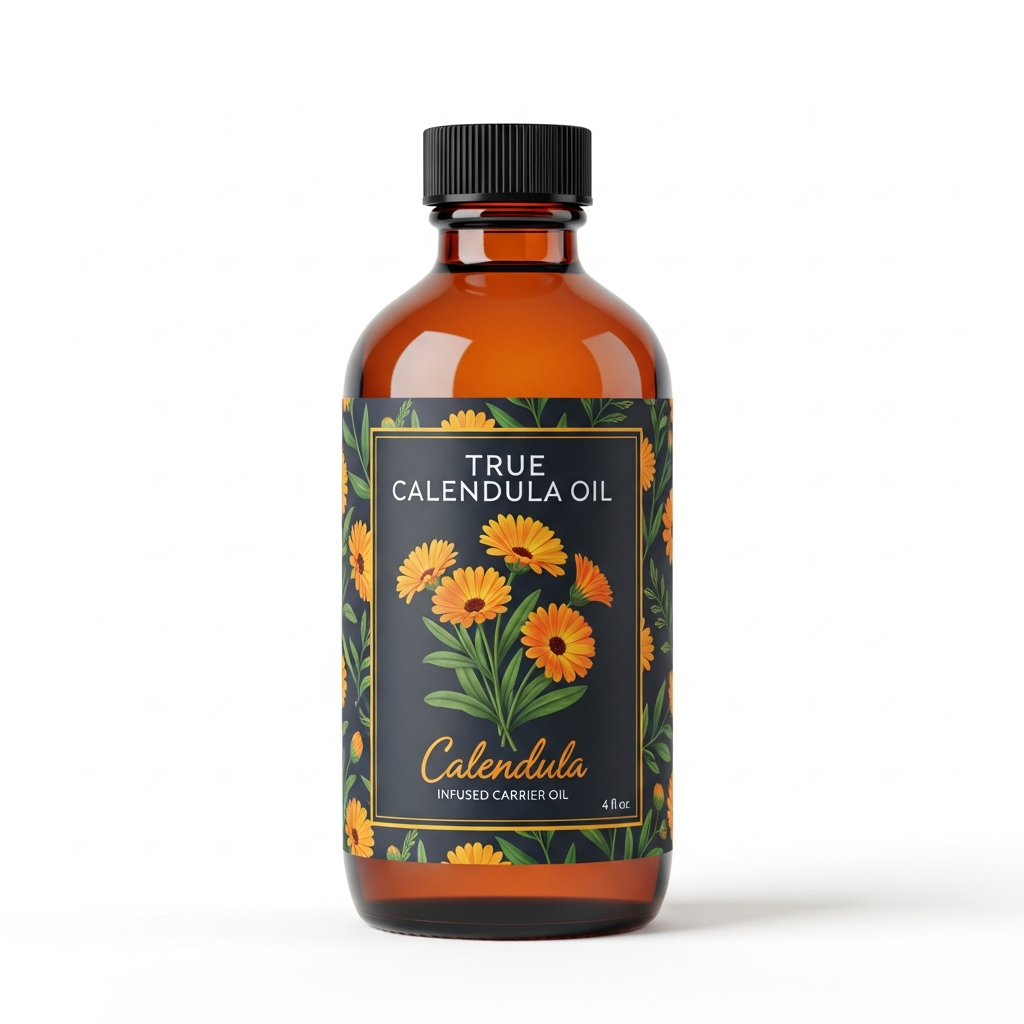
For the ten that work, the oil itself is the variable worth controlling. Our own True Calendula Oil is organic Calendula officinalis petals cold-infused into Helianthus annuus seed oil, and every batch ships with a certificate of analysis reporting relative density 0.922 at 20°C against a range of 0.910 to 0.930, refractive index 1.475 against 1.465 to 1.477, and optical rotation +0.16° inside a window of -1.0° to +1.0°. Sizes run from a 0.5 oz bottle at $11.99 through to bulk, and the analytical figures are identical on all of them.
Buy the size you will finish within six months, keep it in the dark and away from the stove, and patch test before the first skin use: apply twice daily to the same small patch of inner forearm for seven to fourteen days, since in a series of 443 consecutive patch-tested patients about 2% reacted to marigold and about 4% to the Compositae mix.
Calendula Oil
Nature's Golden Botanical, bottled: small-batch calendula oil in sizes from 0.5 oz to bulk.
From $11.99
Shop Calendula Oil →