
15 Surprising Benefits of Calendula Oil You Didn't Know About
Here is the fact that reframes most of what gets written about this plant: the orange colour in calendula petals is not beta-carotene. Analyses of the flower put flavoxanthin and auroxanthin as the dominant petal carotenoids, with lutein among the main components, while the beta-carotene sits in the stems and leaves, and one study identified 29 separate carotenoids across petals, florets and whole inflorescences. Calendula is chemically more interesting than the marketing copy, and it is also useful in fewer places than the marketing copy suggests.
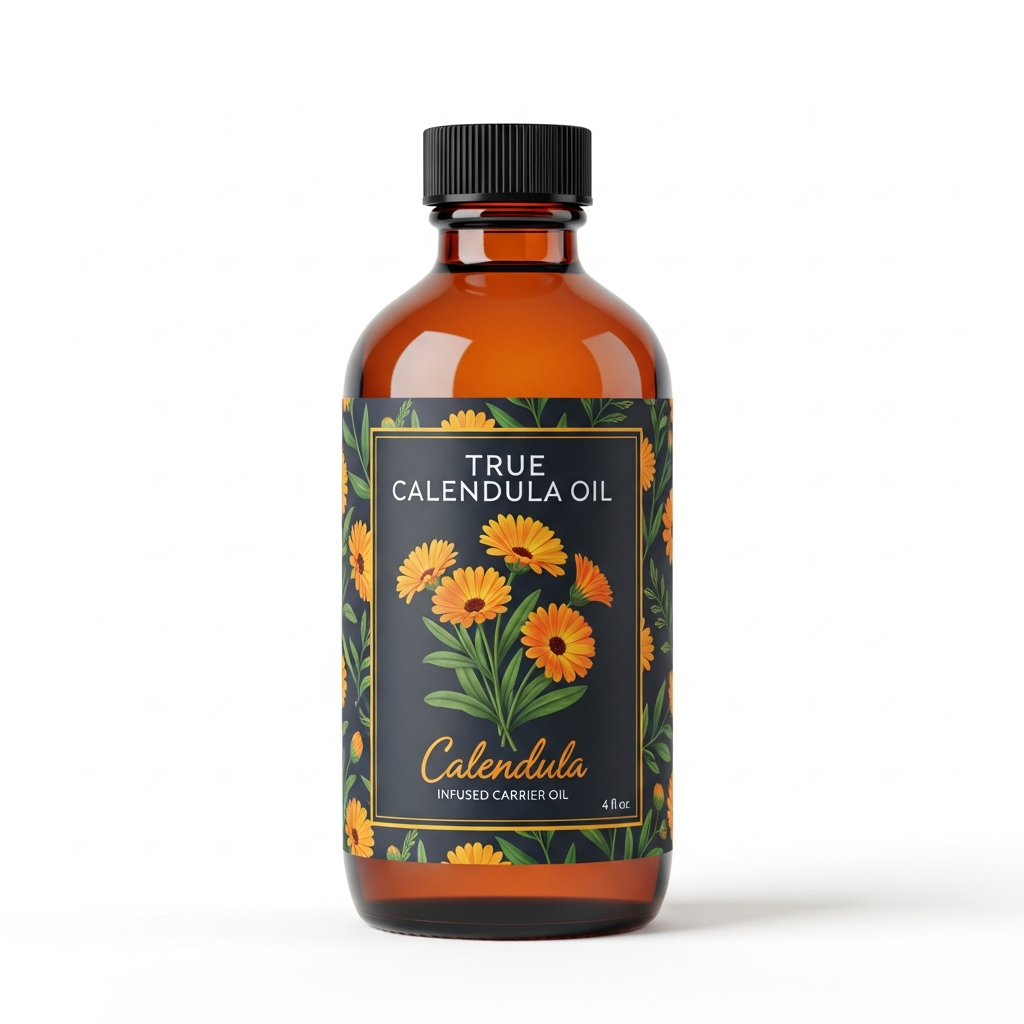 Calendula Oil
Our own small-batch calendula oil, in sizes from 0.5 oz to bulk. From $11.99.
Shop Calendula Oil →
Calendula Oil
Our own small-batch calendula oil, in sizes from 0.5 oz to bulk. From $11.99.
Shop Calendula Oil →
Fifteen sections follow. Some are genuinely surprising things calendula oil does. Several are surprising things it does not do, printed everywhere and wrong, and those are flagged as such rather than hedged into mush. Everything here concerns cosmetic use on intact skin.
1. Natural Support for Pet Care Routines
The plant itself is on the ASPCA's non-toxic list for dogs, cats and horses under garden marigold, which is genuinely unusual among the botanicals people reach for. That is the surprise, and it has a hard limit attached.
The limit is everything you blend into it. Cats are deficient in glucuronyl transferase, the liver enzyme that conjugates phenols and terpenes, so essential oil constituents that a dog or a human clears simply accumulate in a cat; a cat that grooms a treated coat has added an oral exposure to a dermal one. A plain infused oil with no essential oils and no fragrance is the only version of this that survives being licked off, which is what will happen. Dry paw pads in winter are the sensible use.
Practical takeaway: Ask your veterinarian before applying anything, and check the label for essential oils rather than assuming a botanical product does not contain them.
2. Traditional Crafting and Preservation Agent
This one is backwards, and the correction is worth more than the claim. Calendula oil is not a preservative and adding it to a formulation does not extend shelf life. An antioxidant slows the oxidation of the oil phase. A preservative inhibits microbial growth in the water phase. They are different jobs and neither vitamin E nor an infused botanical oil does the second one: anything in your formulation that contains water, from a lotion to a toner to a sugar scrub that gets wet fingers in it, needs an actual broad-spectrum preservative or it grows mould on a timescale of weeks.
The infused oil pushes the other way if anything, because a sunflower base is rich in linoleic acid and linoleic-rich oils are among the faster carriers to go rancid. Adding 5% of it to a balm shortens that balm's life rather than lengthening it. Work with it, do not pretend it away: buy in sizes you will finish, store in amber glass away from heat and light, and date every jar.
Practical takeaway: If your recipe has water in it and no preservative, the shelf life is about a week in the fridge, whatever else is in the bottle.
3. Supportive Element in Textile and Fabric Care
Do not put this oil on fabric. The version of this tip that circulates, softening linens or conditioning vintage textiles, describes the exact mechanism by which oil stains become permanent. A vegetable oil absorbed into cellulose fibres oxidises in place, darkens to a yellow-brown that ordinary laundering will not lift because the stain is no longer a surface deposit, and the older the stain the less any solvent will do. Textile conservation does not use oils on fibre, and that is not an oversight.
The related point deserves a safety line of its own. Rags soaked in oxidising oils generate heat as they cure, and piled in a bin they can reach ignition. Whether you are oiling anything or not, spread used oily rags flat to dry outdoors or store them in water in a sealed metal container, which is standard practice in any finishing shop.
Practical takeaway: Test any oil that has touched fabric on a hidden seam and leave it a month, not an hour. The damage here is slow and it is not reversible.
4. Garden and Plant Care Applications
There is a real garden story here and it is about the plant rather than the bottle. Calendula earns its bed space as a flowering annual that keeps producing through a long season, which is what the name points at: calendae, the first day of the month, because in a mild climate it flowers in most of them. It feeds pollinators, it is grown as a companion planting, and it gives you petals to infuse.
The seed is the genuinely surprising part. Calendula seed contains roughly 5% to 22% oil, and between about 53% and 62% of that oil is calendic acid, a conjugated trienoic fatty acid whose three conjugated double bonds make it oxidise fast. That is a defect in a cosmetic and a virtue in a coating, which is why calendula has been investigated as an oil crop for paints and as a reactive diluent in coatings. It is also an entirely different product from the petal-infused oil in your bathroom. What you should not do is spray any oil on foliage in sun: a film over the leaf surface interferes with gas exchange and scorches.
Practical takeaway: Grow the plant, harvest the petals, and keep the finished oil indoors.
5. Natural Addition to Meditation and Mindfulness Practices

The surprise here is an absence. Calendula-infused oil is close to unscented, and that is structural rather than a quality problem. The compounds calendula is valued for, the faradiol mono- and diesters and the carotenoids, are non-volatile, so steam distillation cannot carry them over, and the yield from distilling the flower is around 0.3%, which is why no genuine calendula essential oil exists at commercial scale. Anything sold under that name is an infused oil or an extract cut into a carrier.
So if you want an aromatic anchor for a practice, calendula oil is the carrier and something else supplies the aroma. Twenty drops of essential oil in 100 mL of carrier is 1%, and four drops per tablespoon is the same figure in kitchen units. For a pulse-point application before sitting, less is more: the point of an anchor is that it is consistent and quiet, not that it fills the room.
Practical takeaway: Buy an essential oil for scent and an infused oil for skin. They are not substitutes, and a product that claims to be both is one of them mislabelled.
6. Hair and Scalp Wellness Support
Split what an oil does to the scalp from what it does to the fibre, because the evidence lands differently on each. On the fibre, the reference point is the work by Rele and Mohile published in the Journal of Cosmetic Science in 2003: coconut oil applied before washing reduced protein loss from hair, and mineral oil and sunflower oil did not. The explanation offered was lauric acid, a small straight-chain molecule that moves into the fibre rather than resting on it. Calendula-infused sunflower oil is a surface oil: it flattens the cuticle, which is what produces shine and reduces the look of flyaway, and that is a cosmetic effect, not a structural one.
On the scalp it is simply an emollient, and the technique that makes it work is unglamorous. Section dry hair, work the oil in with fingertips rather than nails, cover, leave thirty minutes, and plan on two shampoo passes. One pass leaves a film that reads as greasy roots for two days.
Practical takeaway: If fibre condition is the goal, add virgin coconut oil for the pre-wash step. If shine and a comfortable scalp are the goal, calendula oil alone is enough, and 2 to 3 mL covers fine hair.
7. Gentle Support for Aging Skin Concerns
There is a number behind this that makes the case better than any adjective. Complete epidermal turnover runs roughly 28 to 30 days in a young adult and stretches to about 45 to 50 days in an older one. A slower cycle means a stratum corneum that holds less water and shows dryness sooner, concentrated on shins, forearms, elbows and heels, which is exactly the distribution older routines always worked on.
The application detail is worth more than the ingredient list. Apply within a few minutes of towelling off, while skin is still damp, because an emollient slows water leaving rather than supplying any. On thin skin use light gliding strokes rather than pressure, since aging skin bruises and tears easily. For a fuller routine, see our guide to the benefits of calendula oil for skin.
Practical takeaway: Timing beats quantity. The same few drops applied to damp skin do measurably more than a larger amount applied to dry skin two hours later.
8. Natural Nail and Cuticle Care
Set the calendar first. Measured in healthy young adults, fingernails grow about 3.47 mm a month and toenails about 1.62 mm, so a fingernail needs four to six months to grow out from matrix to free edge and a big toenail can take well over a year. Nothing applied to the surface changes a nail plate that has already formed, and any product promising otherwise is describing a timeline it cannot keep.
What does change within days is the skin. Apply after washing while the nail folds are still slightly damp, and massage into the fold rather than painting the plate. An intact, supple cuticle seals the gap at the base of the nail; a dry split one is what catches and tears. Leave the cuticle in place rather than cutting it.
Practical takeaway: Once a day, every day, beats a weekly soak. This is the one routine on the list where consistency genuinely outperforms intensity.
9. Soothing Addition to Bath and Body Rituals

The surprising part of a bath oil is how little of it reaches you. Oil and water do not mix, so an undispersed oil floats, spreads across the surface and deposits most of itself on the tub wall at the waterline and on your skin as you stand up. That last part is not useless, it is effectively a whole-body application at the end of the soak, but it is not the immersion people imagine, and it means the tub gets a film that makes the next person's footing genuinely unsafe.
One to two tablespoons is the working dose, which makes a 100 mL batch about seven baths. Use a non-slip mat, and clean the tub with a degreasing cleaner afterwards rather than a rinse. Keep the water warm rather than hot: hot water strips surface lipids, which is why a long hot bath leaves skin tighter than a short warm one no matter what was floating on it.
Practical takeaway: Apply the oil to damp skin after the bath instead, and you get the same oil doing considerably more work. The bath version is a pleasure, not a delivery system.
10. Natural Support for Exercise Recovery Routines
Be precise about what is doing the work, because this is a category built almost entirely on overstatement. Delayed onset muscle soreness is microtrauma and the inflammatory response to it, and no oil applied to the skin surface changes that process. What a massage oil contributes is glide, so that hands can work over skin without dragging, and glide is not a trivial contribution: it is the difference between a massage that is possible and one that is not.
The working numbers are small. A full-body hour takes 15 to 20 mL of carrier, so a 4 oz bottle is six or seven sessions. Where essential oils are added, about 1% is standard for full-body work on an adult, which is 20 drops in 100 mL. Skin that has been in salt sweat and then a hot shower is also genuinely dried out, and an emollient applied while it is still damp addresses that directly.
Practical takeaway: Warm the bottle in a bowl of hot water, never a microwave, which heats unevenly and degrades the aromatics in the hot spots.
11. Gentle Care for Sensitive Areas
The advantage of a single-ingredient oil is subtractive, and that is a more useful way to think about it than calling it gentle. Fragrance and preservatives account for a large share of positive results in cosmetic patch testing, and a fragrance-free, preservative-free, single-botanical oil removes both variables from a routine at once. When skin is reacting to something and nobody knows what, stripping the routine back to one boring product is a diagnostic step as much as a comfort one.
Boring does not mean risk-free, and the numbers are worth carrying. In a series of 443 consecutive patch-tested patients, about 2% reacted to marigold and about 4% to the Compositae mix. If you already react to ragweed, chrysanthemum or daisy, treat yourself as higher risk and test accordingly.
Practical takeaway: Run a repeat open application test before committing: twice daily to the same 2 to 3 cm patch of inner forearm for seven to fourteen days, watching particularly for anything that appears after day three.
12. Traditional Support for Minor Skin Irritations
The surprising thing in this section is a regulatory fact that explains the careful wording on every page like this one. In the European Union, calendula flower preparations hold a traditional-use herbal registration, having cleared the thirty-year medical-use threshold set by Directive 2004/24/EC. In the United States, an infused calendula oil sold for skin is a cosmetic, and a cosmetic may describe how skin looks and feels but may not claim an effect on disease or on the structure or function of the body.
So the same plant sits in two different legal categories on two continents, and American copy that reads as evasive is usually just accurate. What a cosmetic oil can honestly offer for everyday scuffs, wind-scoured cheeks, a mask line or a rucksack strap rub, is comfort on intact skin while the cause is removed, which is the part most people skip. No product outruns an ongoing rub.
Practical takeaway: Wash with lukewarm water and a non-foaming cleanser, apply while damp, and then stop adding products. Stacking actives onto irritated skin is the most common way a two-day problem becomes a two-week one.
13. Natural Enhancement for Aromatherapy Blends

Calendula oil belongs in an aromatherapy cupboard as a carrier, and it is worth knowing why it is a slightly unusual one. It is close to odourless, so it does not argue with a blend, which many nut and seed carriers do. It is also linoleic-rich and therefore relatively short-lived, so a blend built on it is a three-month blend rather than a year-long one, especially if you are cutting it with something like grapeseed.
The arithmetic that matters is the dilution, and it is simple enough to do in your head. Twenty drops is about 1 mL, so 20 drops in 100 mL of carrier is 1%, 10 drops is 0.5%, and 4 drops per tablespoon is 1%. Check the individual oil's own ceiling rather than assuming 1% is always fine: expressed bergamot, for instance, carries an IFRA leave-on limit of 0.4% for skin that will see sunlight because of its bergapten content, and the furanocoumarin-free version removes that constraint entirely.
Practical takeaway: Blend in small volumes and date the bottle. A 50 mL blend used twice a week is finished before it turns; a 250 mL blend is not.
14. Supportive Care for Weather-Related Skin Challenges
Winter skin is a humidity problem before it is a product problem. Cold air holds very little water, and heating that air indoors drops the relative humidity of a room sharply, which pulls water out of the stratum corneum all day regardless of what you applied that morning. A humidifier appears on dermatology bodies' own dry-skin lists for that reason, and it does more for winter hands than any amount of oil applied to dry skin.
Adjust the vehicle with the season rather than only the frequency. Dermatology guidance favours thicker ointments and creams over thin lotions in winter, which in practical terms means a wax-thickened balm on hands and lips when it is cold and plain oil when it is not. And in either season, apply within a few minutes of getting out of the shower.
Practical takeaway: Shorter, cooler showers. Hot water strips surface lipids, and a long hot shower in January undoes the product you are about to apply.
15. Natural Addition to Sleep and Relaxation Routines
There is no sedative claim to make here and it would be dishonest to imply one. The reason an evening oil application is worth the two minutes is adherence: a product applied as part of a fixed nightly sequence gets applied about thirty times a month, and a product that depends on remembering gets applied eight or nine. Every cosmetic result on this page is a function of repetition, so the ritual is doing real work even though the mechanism is behavioural rather than botanical.
There is also a practical argument for using a near-odourless oil at night specifically. Scent is personal and a strongly fragranced product in a bedroom is a gamble; an unscented carrier is not. Apply to hands, feet and forearms after washing, while damp, and let it absorb before touching bedding.
Practical takeaway: Put the bottle where the routine already happens, next to the toothbrush rather than in a cupboard. That single change does more for consistency than any amount of intention.
Embracing Nature's Golden Versatility
Gather the actual surprises in one place and the list is shorter and better than the usual fifteen. The petal colour comes from flavoxanthin, auroxanthin and lutein rather than beta-carotene. No real calendula essential oil exists, because the compounds that matter are non-volatile and the distillation yield is around 0.3%. The seed oil is a different substance from the petal-infused oil and runs 53% to 62% calendic acid, a conjugated fatty acid oxidising fast enough to interest the coatings industry. The plant is ASPCA non-toxic while the essential oils people blend into it are the actual hazard to a cat. And the oil is not a preservative, has no business on fabric and does not lighten a lentigo.
What is left after all that is a good, plain emollient with published analytical numbers behind it, which is a more useful thing to own than a miracle. Our own True Calendula Oil is organic Calendula officinalis petals cold-infused into Helianthus annuus seed oil, and every batch carries a certificate of analysis reporting relative density 0.922 at 20°C against a range of 0.910 to 0.930, refractive index 1.475 against 1.465 to 1.477, and optical rotation +0.16° inside a window of -1.0° to +1.0°. The European Pharmacopoeia standard for calendula flower requires not less than 0.4% flavonoids calculated as hyperoside, and the faradiol esters that distinguish calendula concentrate in the ray florets rather than in the disk florets or the green bracts, which is why petals rather than whole heads go into the jar.
Sizes run from a 0.5 oz bottle at $11.99 through to bulk, and the analytical figures are the same on every one of them. Buy the size you will finish inside six months, keep it in the dark, and use it on the jobs above where it genuinely earns its place.
Calendula Oil
Nature's Golden Botanical, bottled: small-batch calendula oil in sizes from 0.5 oz to bulk.
From $11.99
Shop Calendula Oil →