13 Calendula Oil Home Remedies Your Grandmother Knew
Calendula takes its name from the Latin calendae, the first day of the month, because in a mild climate it flowers in almost every one of them. That reliability is the real reason it ended up in so many household jars: it was the botanical that was always there. Pliny the Elder recorded uses for it in the first century, John Gerard wrote in his Herball of 1597 that Dutch cooks put the petals in their broths, which is where the name pot marigold comes from, and Nicholas Culpeper was still writing about it in 1653.
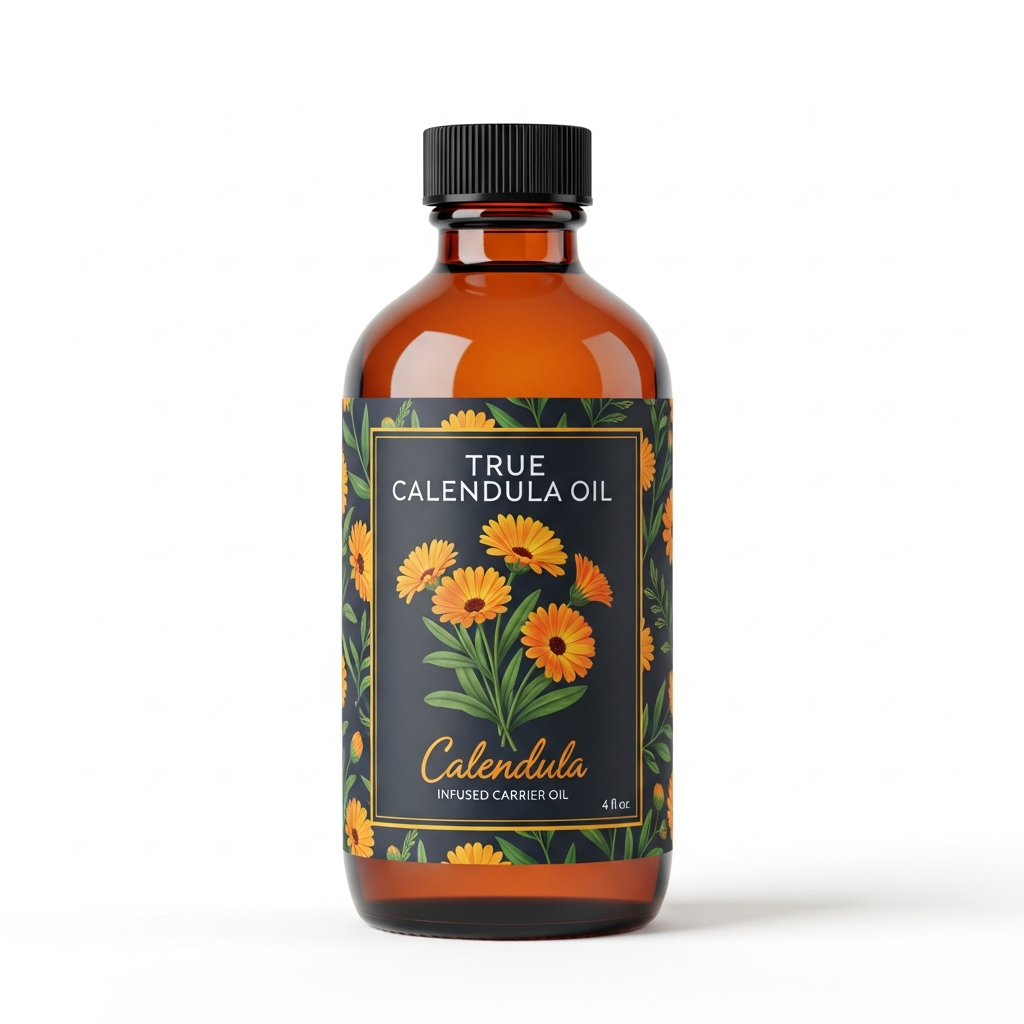 Calendula Oil
Our own small-batch calendula oil, in sizes from 0.5 oz to bulk. From $11.99.
Shop Calendula Oil →
Calendula Oil
Our own small-batch calendula oil, in sizes from 0.5 oz to bulk. From $11.99.
Shop Calendula Oil →
Thirteen practices are described below as they were actually carried out, alongside what current guidance says to do instead where the two differ, because in several cases they differ sharply. One framing note that explains the careful language on this page: in the European Union, calendula flower preparations hold a traditional-use herbal registration, having met the thirty-year medical-use threshold set by Directive 2004/24/EC. In the United States an infused calendula oil sold for skin is a cosmetic, and a cosmetic may describe how skin looks and feels but may not claim an effect on disease. That legal line, not coyness, is why this page stays where it stays.
1. Gentle Baby Bottom Balm
The practice was specific: oil warmed between the palms, applied after a change, on skin that had been patted dry rather than rubbed. What made it work was mostly the two steps around it, the drying and the airing, and grandmothers who left a baby to kick on a towel for ten minutes before redressing were doing the part that mattered most.
Where the historical version and the modern one part company is the word barrier. An infused oil is an emollient: it sinks in, softens and leaves skin feeling smooth. It does not form the occlusive film that keeps moisture off skin, which is what the diaper area actually needs. Treat calendula oil as the massage oil for legs, back and arms rather than as the barrier product, and keep expectations modest: in a pilot assessor-blinded randomised trial of 115 healthy full-term newborns given olive oil, sunflower oil or no oil twice daily for four weeks, both oil groups gained stratum corneum hydration but both showed less improvement in the structure of the skin's lipid lamellae than the babies who got nothing at all.
Traditional Preparation: No essential oils at any dilution on an infant. Patch test a coin-sized area of outer thigh and read it at 24 and 48 hours, and ask your pediatrician before you start.
2. Kitchen Burn Soother
This is the one household practice to retire outright, and it is worth being blunt about why. Putting any grease on a fresh burn, butter, oil or ointment, slows the release of heat from the skin, so the tissue keeps cooking under the film; the grease can also carry bacteria into damaged skin. Emergency and burn services say this plainly and have for years.
What the current evidence supports instead is water, and more of it than most people use. Twenty minutes of cool running water, started as soon as possible and still worth doing up to three hours after the injury, is the figure that shows up in the burn literature and in national first aid guidance, and it is associated with less scarring and faster re-epithelialisation in both adult and paediatric data. Cool, not iced. Remove rings and watches before the area swells. Cover loosely with cling film or a clean non-fluffy cloth, not with anything greasy.
Safety Note: Calendula oil belongs on that skin weeks later, once it is closed and intact and simply dry, and nowhere in the first aid sequence. Anything blistered, larger than the palm of the hand, or on the face, hands, feet or across a joint is a same-day medical problem.
3. Gardener's Hand Approach
The autumn batch was a real seasonal habit and it had a sound logic: make the year's supply while the flowers are on the plant, and thicken it with beeswax so it stays on hands that are about to go back into cold water. Household versions ran around 15% to 20% beeswax by weight, which is firm enough to sit in an open tin without slumping.
The overnight cotton glove is the part of the routine worth keeping exactly as it was. Occlusion holds the oil against the skin for eight hours instead of the twenty minutes it survives on a working hand, and it keeps the balm off the bedding. Concentrate on the knuckle creases and the skin either side of the nail fold, which is where garden work splits skin first, and apply at the end of the day rather than before gloves go on, when a slippery hand is a hazard.
Modern Application: Work it into clean, dry hands. If your hands have been in soil, the priority is washing and a look for splinters and thorn punctures before anything else goes on them.
4. Soothing Eczema Support
Households recognised the pattern of dry, itchy, angry skin long before it had a name, and they responded with oatmeal in the bathwater and oil on the skin afterwards. The oatmeal bath is the part of that routine that has survived into dermatology. The oil is where care is needed, and on this point the honest answer is that a botanical oil is a cosmetic, that eczema is a medical diagnosis, and that the two should not be confused.
Two specifics are worth knowing before anyone reaches for a jar. First, oils are not automatically kind to a damaged barrier: the neonatal trial cited above found less improvement in lipid lamellae structure in the oil groups than in the no-oil group, which is a real result and not a technicality. Second, sensitised skin is exactly the skin most likely to react to a botanical. In a series of 443 consecutive patch-tested patients, about 2% reacted to marigold and about 4% to the Compositae mix, and those odds do not improve on inflamed skin. The American Academy of Dermatology's own dry-skin guidance points people toward ointments and creams over lotions and names petrolatum, jojoba oil, shea butter, glycerin, mineral oil and lanolin as ingredients to look for.
Important Note: Persistent, spreading or weeping skin belongs with a dermatologist, who can prescribe. Nothing on this page is a substitute for that, and a new botanical on a flare is the worst time to find out you are in the 2%.
5. Natural Lip Balm Base
This is the recipe that transfers intact, provided you weigh rather than scoop. Beeswax pellets pack loosely and a teaspoon of them is not a teaspoon of melted wax. For a small kitchen batch, 14 g of calendula oil to 3 g of beeswax gives about 18% wax: soft enough for a pot, too soft for a twist tube. Push the wax to 21%, about 3.5 g against the same oil, and it will hold a stick.
Leave the honey out, as pleasant as the idea is. Honey is a sugar syrup and will not dissolve in an anhydrous wax and oil base; it beads out within days and sugars the inside of the container. Melt at the lowest heat that works, since beeswax liquefies at 62°C to 65°C and there is no reason to go far above it, and pour while the melt is still fully fluid, because wax at 18% starts skinning over within a minute off the heat.
Simple Recipe: 14 g calendula oil, 3 g beeswax pellets, melted together and poured hot. That fills roughly four 4.25 g tins, which is about a winter's worth.
6. Post-Shave Comfort Oil
The historical point here is sharper than it looks. The alternative in a straight-razor household was an alcohol-based aftershave, and alcohol on freshly abraded skin stings because shaving is abrasion: a blade takes the top of the stratum corneum with the hair. An oil applied to damp skin afterwards is simply the less aggressive option, and that is the whole of the claim.
Most of what people blame on their aftershave belongs to the shave itself. A blade used past its useful life pulls rather than cuts, shaving against the grain on the neck is the classic cause of ingrown hairs, and stretching the skin flat while shaving sets the hair to retract below the surface. Fixing those three things does more than any post-shave product. Apply a few drops to skin that is still damp, before it dries fully, and let it absorb before anything else goes on.
Application Method: Two or three drops covers a face. More than that sits on the surface, transfers to the collar and does nothing extra.
7. Elderly Skin Care Ritual
The warm-oil massage for aging skin was addressing something measurable. Epidermal turnover slows with age: the complete cycle that runs roughly 28 to 30 days in a young adult stretches to about 45 to 50 days in an older one, and the stratum corneum that results holds less water and shows its dryness on the shins, forearms, elbows and heels first. That is the distribution the old routine worked on, and it was not chosen at random.
Two refinements from current dermatology guidance make the ritual work better. Apply while the skin is still damp, within a few minutes of towelling off, because you are sealing water in rather than adding it. And on thin, fragile skin use light, gliding strokes rather than pressure: older skin bruises and tears easily, and a vigorous massage is a real risk rather than a theoretical one.
Gentle Technique: Warm the oil between the palms first. Cold oil on thin skin makes people tense against the touch, which defeats the point of the ritual.
8. Massage Oil for Tired Muscles
What an oil contributes to a massage is glide, and the amount is smaller than people expect: 15 to 20 mL covers a full-body hour, and a 4 oz bottle is therefore six or seven sessions. Where households added other botanicals, the working dilution was always low, and the modern equivalent is about 1% for full-body work on an adult, which is 20 drops of essential oil in 100 mL of carrier, or 4 drops per tablespoon.
Be precise about what is happening: the oil reduces friction so that the hands can work, and the warmth and the pressure do the rest. Warm the bottle in a bowl of hot water rather than a microwave, which heats unevenly and cooks the aromatics in the hot spots, and pour into your own palm rather than onto the person.
Enhancement Tip: Smell the bottle before every session. A linoleic-rich carrier oil past its best smells faintly of putty, and on warm skin that becomes obvious very fast.
9. Hair and Scalp Approach
Overnight scalp oiling is one of the oldest continuous practices in the article and one of the easiest to do badly. Section dry hair, work the oil into the scalp with fingertips rather than nails, cover with a towel or a cotton cap, and plan on two shampoo passes: the first lifts the oil, the second actually cleans. One pass leaves a film that reads as greasy roots for two days and puts people off the practice for good.
If you want an effect on the hair fibre rather than the scalp, add coconut oil. In the work by Rele and Mohile published in the Journal of Cosmetic Science in 2003, coconut oil used before washing reduced protein loss where mineral oil and sunflower oil did not, and the explanation offered was lauric acid, whose small, straight molecule moves into the fibre instead of sitting on it. Calendula-infused sunflower oil is a scalp and shine oil; coconut is the fibre one; a blend does both jobs.
Application Method: Thirty minutes under a warm towel is enough for a weekday version. Overnight is for hair that will be washed twice in the morning anyway.
10. Minor Cut and Scrape Care
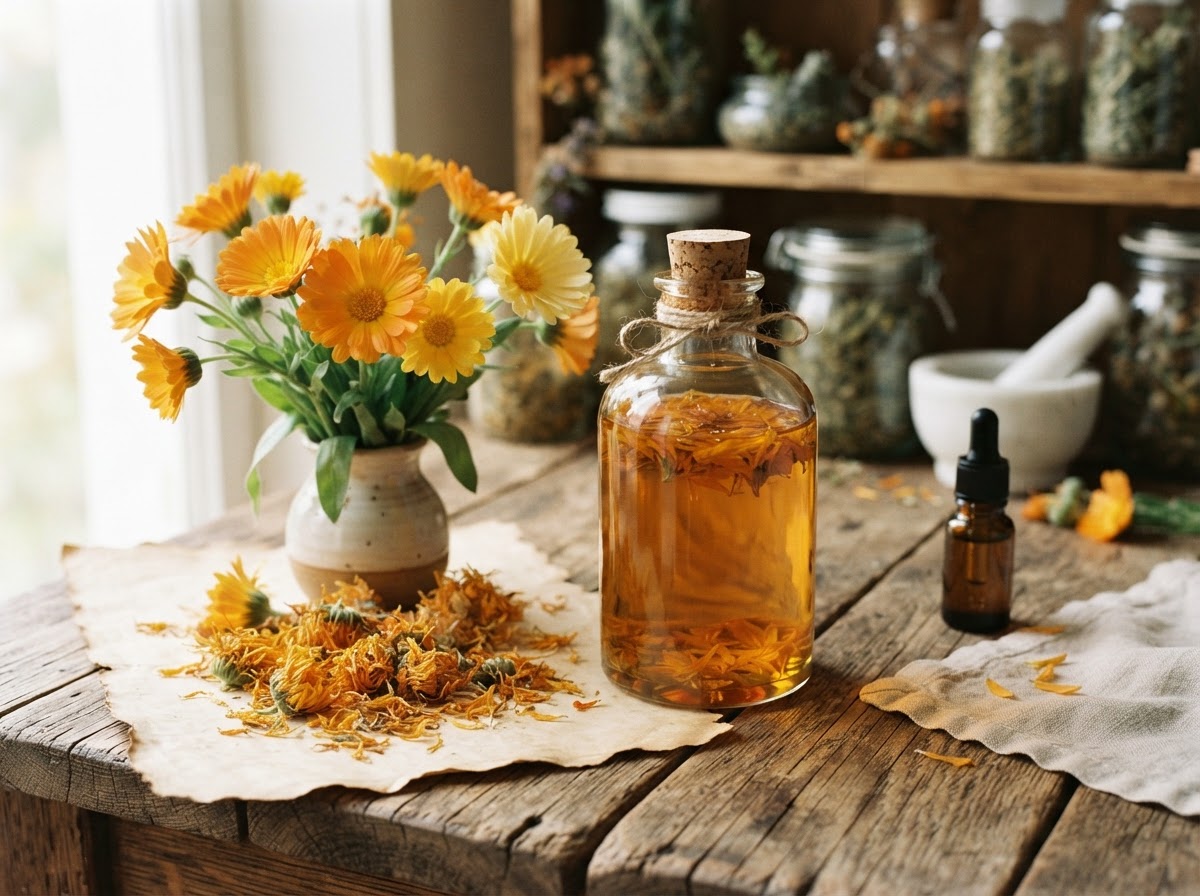
The historical sequence was clean, dress, cover, and the first and third steps are still correct. Rinse a scrape under clean running water, get the grit out, pat dry and cover it. What has changed is the middle step, and the change is not negotiable: do not put an infused botanical oil into broken skin.
The reason is simple and has nothing to do with calendula. A cold-infused oil is not a sterile product and is not made to be one; it is a cosmetic poured in a kitchen or a workshop, and open skin is exactly where non-sterile material should not go. It also does the wound-dressing job badly even setting that aside, because an oil film is not an adherent cover. Save the oil for the surrounding intact skin and for weeks later, when the area is closed and simply dry and tight.
Safety First: Anything that will not stop bleeding with ten minutes of firm pressure, gapes, was caused by something dirty or rusty, or shows spreading redness, warmth or pus needs a clinician the same day.
11. Sunburn Comfort Application
Cool first, and keep cooling: cool showers or cool damp cloths, repeated, plus water to drink, because a burn of any size pulls fluid to the skin surface and away from the rest of you. Oil is not part of that stage. Like any grease on a fresh burn it slows heat loss from the skin, which is the opposite of what the moment needs.
Where an oil genuinely earns a place is days later, at the tight, flaking, peeling stage, on skin that is unbroken. Apply it to damp skin after a cool shower rather than to dry skin, and leave the peeling alone; pulling it removes skin that is still doing a job. Skip the oil entirely on anything blistered, and treat blistering, chills, fever or a burn over a large area as a reason to call someone rather than to reach for a jar.
Cooling Enhancement: A bottle kept in the fridge feels better on hot skin and lasts longer in the bargain. Cold storage slows the oxidation that eventually turns a linoleic-rich oil stale.
12. Insect Bite Soother
Get the mechanics right first, because they matter more than whatever goes on afterwards. A honeybee sting should be scraped out sideways with a fingernail or a card edge rather than pinched, and the speed of removal matters more than the method. A cold compress for ten to fifteen minutes does the real work on swelling and itch. Wash the area with soap and water, and then leave it alone, because scratching is what turns a bite into a broken, crusted mess.
Calendula oil's role here is honest but small: it is applied to the intact skin around and over an unbroken bite because it feels pleasant and keeps the area from drying and tightening. If the skin is open, see the cut and scrape section above; the same reasoning applies.
Application Note: Spreading redness, difficulty breathing, swelling of the face, lips or tongue, dizziness or a rash away from the bite site means emergency care immediately, not a compress.
13. Winter Skin Protection Ritual
Winter dryness is a humidity problem before it is a skincare problem. Cold outdoor air holds very little water, and heating it indoors drops the relative humidity of a room sharply, which pulls water out of the stratum corneum all day. A humidifier is on the American Academy of Dermatology's own list of dry-skin measures for exactly that reason, and it does more for winter hands than any amount of oil applied to dry skin.
The application detail that turns the old ritual into a modern one is timing. Moisturise within a few minutes of getting out of the bath or shower, while the skin is still damp, because the oil's job is to slow the water leaving rather than to supply it. Dermatology guidance also favours thicker ointments and creams over thin lotions in winter, which in kitchen terms means the wax-thickened balm from section three rather than the plain oil.
Seasonal Preparation: Make small batches through the season rather than one large autumn batch. Every opening exposes the surface to air, and a tin opened daily since October has oxidised long before an unopened one would.
Preparing Your Own Traditional Calendula Oil
Solar infusion is the method the old households used and it still works, with two rules that are not optional. Use fully dried petals, never fresh: residual water in the jar is what grows mold under the oil and ruins a six-week batch in the last fortnight. And use the petals, the ray florets, rather than whole flower heads swept up with the green bracts, because that is where the faradiol mono- and diesters that distinguish calendula from any other yellow flower are concentrated. ESCOP's monograph lists those triterpene esters alongside triterpene saponins and carotenoids as the characteristic constituents, and the European Pharmacopoeia requires calendula flower to carry not less than 0.4% flavonoids calculated as hyperoside.
Pack a clean dry jar loosely with dried petals, cover them by two fingers of carrier oil, cap it, and stand it in a warm window for four to six weeks, shaking daily. Strain through muslin, then let the strained oil stand undisturbed for another two days and decant off the top, leaving behind any trace of water that settled out. Our guide to how to make calendula oil goes through the ratios and the strain in more detail.
Safety Reminders: Dried material only, dark glass for storage, away from the stove and the window once it is strained, and a date on every jar.
Honoring Traditional Wisdom
Several of these thirteen practices deserve to survive unchanged: the overnight glove, the two-pass wash after scalp oiling, the damp-skin application, the autumn batch. One deserves to be abandoned, and the burn section is it. That is a reasonable score for a body of household knowledge assembled without controlled trials, and it is a better argument for taking folk practice seriously than any amount of soft language about ancestral wisdom.
The thing these households could not do is the thing we can. They had no way to know whether one jar of oil was as good as the next. Our own True Calendula Oil is organic Calendula officinalis petals cold-infused into Helianthus annuus seed oil, and every batch ships with a certificate of analysis reporting relative density 0.922 at 20°C against a range of 0.910 to 0.930, refractive index 1.475 against 1.465 to 1.477, and optical rotation +0.16° inside a window of -1.0° to +1.0°. Sizes run from a 0.5 oz bottle at $11.99 to bulk drums, and the analytical figures are identical across every one of them.
Always remember: This page describes cosmetic use on intact skin and the history behind it. Anything that persists, spreads or worsens is a question for a clinician, and no jar on a kitchen shelf changes that.
Calendula Oil
Nature's Golden Botanical, bottled: small-batch calendula oil in sizes from 0.5 oz to bulk.
From $11.99
Shop Calendula Oil →