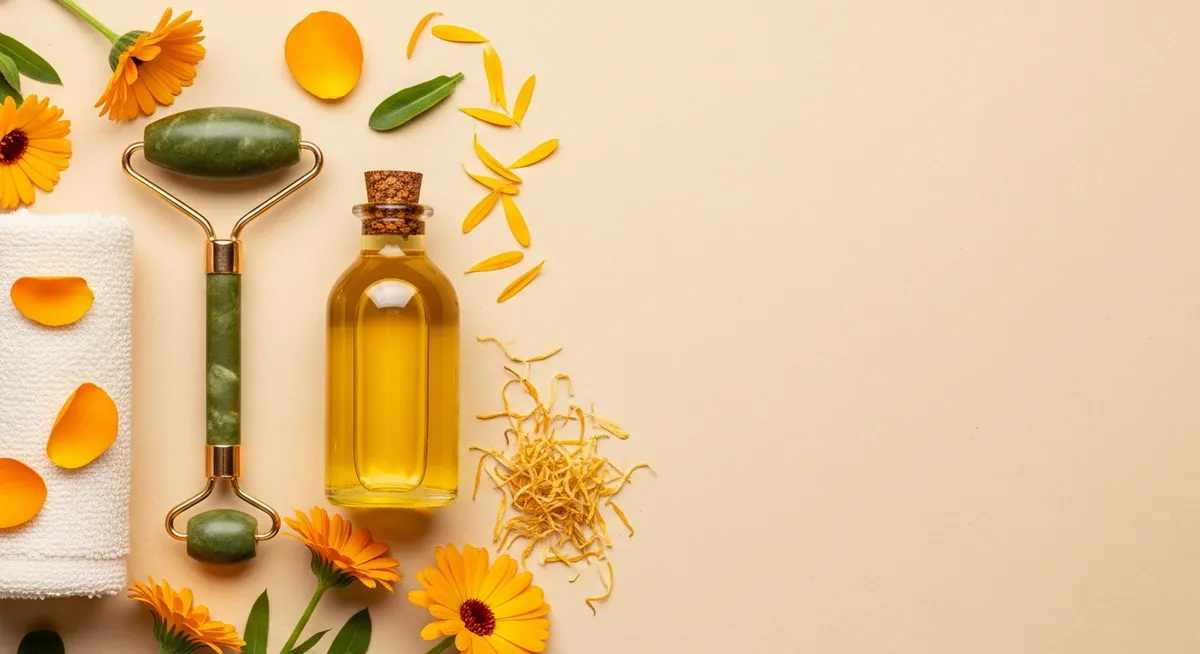
12 DIY Calendula Oil Recipes for Skin, Hair & Home
Twelve recipes, twelve sets of numbers. Everything below is given in millilitres and grams as well as spoons, because two tablespoons of beeswax pellets and two tablespoons of melted beeswax are not the same quantity of wax, and that difference decides whether a balm sets firm or stays a puddle. Our infused oil measures a relative density of 0.922 on its certificate of analysis, so one fluid ounce weighs about 27 g and one tablespoon about 13.6 g. Twenty drops from a standard dropper is roughly 1 mL, which is the figure every essential oil percentage on this page is built on.
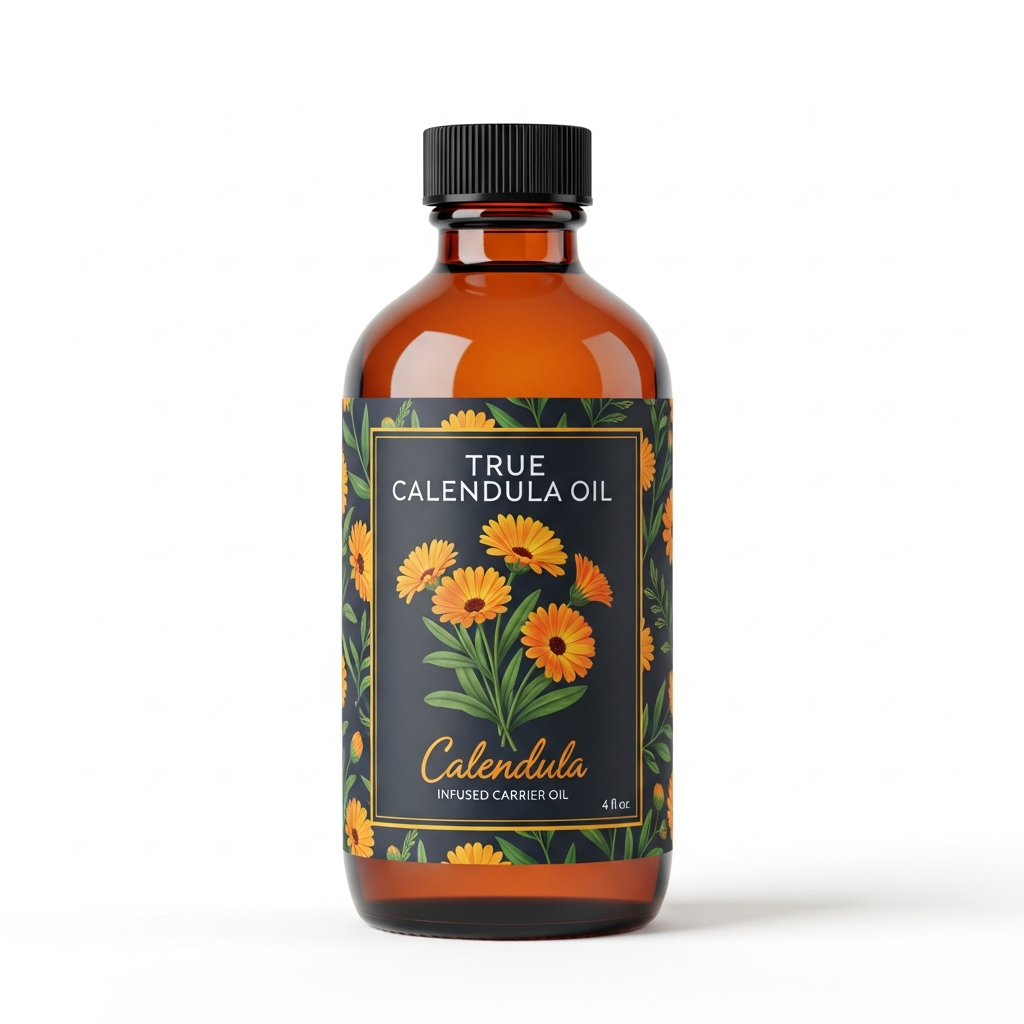 Calendula Oil
Our own small-batch calendula oil, in sizes from 0.5 oz to bulk. From $11.99.
Shop Calendula Oil →
Calendula Oil
Our own small-batch calendula oil, in sizes from 0.5 oz to bulk. From $11.99.
Shop Calendula Oil →
Making all twelve recipes once consumes close to 29 fluid ounces of infused oil, which is why the sizes matter: two 16 oz bottles cover the full set, while a single 4 oz bottle covers the cleansing oil, the hair oil, the lip balm, the cuticle oil and the nail-sized batches with a little left over. Before any of them touch your skin, read the patch test protocol at the end of this page. In a study that patch tested 443 consecutive patients, roughly 2% reacted to marigold and roughly 4% to the Compositae mix, so the odds are small but they are not zero, and they rise if you already react to ragweed, chrysanthemum or daisy.
1. Gentle Facial Cleansing Oil
Oil cleansing works on a simple principle: the sebum, sunscreen and long-wear makeup that water cannot lift are all oil soluble, so an oil dissolves them and a warm cloth carries the lot away. The blend matters less than the technique, but the blend decides how long the bottle lasts before it smells like old crayons.
Combine 30 mL of our calendula oil with 15 mL of jojoba and 5 mL of rosehip seed oil, then add 2 drops of lavender, which puts the essential oil at about 0.2% of the 50 mL batch. The jojoba is doing structural work rather than skincare work: it is a liquid wax ester rather than a triglyceride, which makes it far slower to oxidise than the seed oils around it. Rosehip seed is the opposite, high in alpha-linolenic acid and the first thing in the bottle to turn, so keep the finished blend in the fridge and use it inside three months rather than six. Massage 60 to 90 seconds into dry skin, then remove with a cloth wrung out in water as hot as your hands comfortably take.
Practical takeaway: Keep it off the lash line and out of the eye itself. The Cosmetic Ingredient Review panel's 2010 amended assessment found calendula-derived cosmetic ingredients were not irritating, sensitising or photosensitising in animal and clinical testing, but did flag them as possible mild ocular irritants.
2. Soothing Body Butter
The whipped body butter that goes gritty in the jar a week later has not gone off. Shea butter contains fatty acids with different melting points, and when the melt cools slowly they crystallise at different rates and grow into large, gritty crystals you can feel on the skin. The fix is thermal, not ingredient-based.
Melt 106 g of shea butter (about 1/2 cup) with 54 g of coconut oil (about 1/4 cup) in a double boiler, hold the melt at roughly 79°C for 20 minutes to dissolve every existing crystal seed, then take it off the heat and whisk in 41 g of calendula oil. Add vitamin E at about 0.5% of the batch, which is 1 g here, roughly 20 drops: a full tablespoon, as most versions of this recipe print, is fifteen times more than the oil can use and leaves the butter tacky. Add 10 drops of Roman chamomile for scent, about 0.25%. Then chill the bowl fast in an ice bath rather than letting it cool on the counter, and whip once it has gone opaque but still yields to a spoon.
Practical takeaway: Store below room temperature and dispense with a clean spatula. The product has no water in it, so it does not grow microbes, but wet fingers introduce the water that changes that.
3. Nourishing Hair Approach Oil
This blend does two different jobs with two different ingredients, and it helps to know which is which. Blend 45 mL of calendula oil with 30 mL of argan and 15 mL of fractionated coconut oil, then add 3 drops of rosemary and 2 drops of ylang ylang, which lands the essential oils at about 0.3% of the 90 mL batch.
The calendula and argan sit on the cuticle and flatten it, which is what produces shine and reduces the look of flyaway. The measurable effect on hair itself belongs to coconut oil: in the Rele and Mohile work published in the Journal of Cosmetic Science in 2003, coconut oil applied before washing cut protein loss substantially where mineral oil and sunflower oil did not, and the reason given was lauric acid, whose straight chain and low molecular weight let it move into the fibre instead of resting on it. Fractionated coconut oil has had the lauric fraction removed, so if that pre-wash effect is what you want, swap the 15 mL of fractionated coconut for virgin coconut oil and accept that the blend will go solid below about 24°C. Apply mid-length to ends on damp hair, leave 20 to 30 minutes, then shampoo twice.
Practical takeaway: Strand test first if your hair is bleached, relaxed or colour-treated, and start at half the quantity you think you need. Fine hair takes 2 to 3 mL for the whole head.
4. All-Natural Lip Balm
Lip balm is the recipe where volume measurements do the most damage, because beeswax pellets pack loosely and melted beeswax does not. Weigh instead: 18 g beeswax, 55 g calendula oil and 12 g coconut oil gives an 85 g batch at 21% wax, which is firm enough to hold a stick shape without dragging. That fills about twenty standard 4.25 g lip tubes.
Leave the honey out. It is a sugar syrup and does not dissolve in an anhydrous wax and oil base; it beads out and sugars the inside of the tube within days. Peppermint at 3 drops is about 0.18% of this batch, far under the 5.4% dermal maximum Tisserand and Young publish for peppermint oil, so the scent is a stylistic choice rather than a safety one. If you are substituting candelilla wax for the beeswax, do not swap it one for one: candelilla melts around 70°C against beeswax at 62°C to 65°C and has roughly twice the stiffening power, so start at about half the weight, around 9 g, and adjust from there.
Practical takeaway: Pour fast and pour hot. A wax and oil melt at 21% wax starts skinning over within a minute of leaving the heat, and a tube filled from a half-set melt sets with a hollow core that collapses on first use.
5. Relaxing Bath Oil Blend
Combine 59 mL of calendula oil with 30 mL of sweet almond and 15 mL of jojoba, then add 8 drops of lavender, 4 of bergamot and 2 of frankincense. That is 14 drops in 104 mL, about 0.7%. At 1 to 2 tablespoons per bath the 104 mL batch runs to roughly seven baths.
The bergamot is the ingredient with a real constraint attached. Expressed bergamot oil contains bergapten, a furanocoumarin, and the IFRA standard limits it to 0.4% in leave-on products for skin that will see sunlight; the wider citrus guidance caps bergapten itself at 15 ppm in leave-on products. A bath is short and largely rinsed, but the simplest way to remove the question entirely is to buy bergamot FCF, which is the same oil with the furanocoumarins distilled out, and use it at the same drop count.
Practical takeaway: Oil floats, so it coats the tub wall at the waterline and then coats your feet. Use a mat, and wipe the tub with a degreasing cleaner afterwards rather than rinsing, or the next person in finds the film you left.
6. Handcrafted Calendula Salve
Salve firmness is a single ratio, so learn the ratio rather than the recipe. By weight, 1 part beeswax to 8 parts oil, about 11% wax, gives a soft salve you can scoop with a fingertip. 1 part to 5, about 17%, gives a firm salve that holds a surface in a tin. 1 part to 4, 20%, is stick territory. This recipe is the middle one: 109 g of calendula oil, which is the half cup most versions call for, with 22 g of beeswax.
Vitamin E belongs in here at about 0.5%, roughly 0.7 g, and it is worth being precise about what it does. It is an antioxidant, so it slows the oil's oxidation and pushes back the day the tin smells like putty. It is not a preservative and does not inhibit microbial growth. What keeps an anhydrous salve stable is the complete absence of water, which is why the rule about clean dry fingers is not fussiness. Test firmness before you pour by chilling a spoon in the freezer for five minutes and dipping it: what sets on the cold spoon is what sets in the tin.
Practical takeaway: Pour at around 60°C, just above beeswax's melting point, and leave the tins undisturbed until fully set. Moving a tin while the wax is crystallising is what produces the sunken crater in the middle.
7. Gentle Baby Oil (For External Use Only)
Be conservative here, because the trial evidence on oiling newborn skin is more mixed than the recipe circuit suggests. In a pilot assessor-blinded randomised trial of 115 healthy full-term newborns, assigned to olive oil, sunflower oil or no oil twice daily for four weeks, both oil groups showed significantly better stratum corneum hydration than baseline, but both showed less improvement in the structure of the skin's lipid lamellae than the babies who received no oil at all. Separate work in newborns has found high-linoleate sunflower seed oil supports barrier recovery where some other traditional oils do not, and note that high-linoleate and high-oleic sunflower oil are two different products sold under one name.
Mix 59 mL of calendula oil with 30 mL of organic sunflower oil and 15 mL of fractionated coconut oil. No essential oils: there is no dilution at which they earn a place on an infant. Use it for hands-on massage of arms, legs and back rather than as a whole-body daily moisturiser, keep it away from the face and airways, and store it in a sterilised glass bottle for no more than four months, because the linoleic acid that makes sunflower oil useful is also what makes it oxidise.
Practical takeaway: Ask your pediatrician before starting, patch test a coin-sized area of the outer thigh and check it at 24 and 48 hours, and stop at the first sign of redness that was not there before.
8. DIY Calendula Soap Base
Check the lye figure before you use any published cold-process recipe, including the version of this one that has been copied across the internet. Saponification values are published per oil: sodium hydroxide takes 0.183 g per gram of coconut oil, 0.135 g per gram of olive oil and 0.134 g per gram of sunflower oil, which is our carrier.
For 16 oz coconut, 12 oz olive and 4 oz calendula-infused sunflower, full saponification needs 5.09 oz of sodium hydroxide. Take 5% off for superfat and you want 4.83 oz of lye with 9.8 oz of distilled water, which is a 33% lye solution. The 4.2 oz figure that circulates leaves about 17% of the oils unsaponified: that is a soft bar that sweats, dents under a thumbnail and goes rancid inside a few months. Add lye to water, never the reverse, work in ventilation with goggles and nitrile gloves, and bring both phases to 38°C to 43°C before blending to trace. Do not expect the bar to come out gold; the carotenoids that colour the infused oil do not survive the pH of saponification.
Practical takeaway: Cure the cut bars on a rack with airflow for four to six weeks before use. Cure is water evaporating, not saponification finishing, and it is the difference between a bar that lasts three showers and one that lasts three weeks.
9. Aromatherapy Massage Oil
Blend 118 mL of calendula oil with 30 mL of grapeseed and 15 mL of sweet almond, then add 12 drops of lavender, 6 of sweet orange and 4 of geranium. Twenty-two drops is about 1.1 mL in a 163 mL batch, which works out at roughly 0.7%, comfortably inside the 1% that is standard for full-body work on an adult. A full-body hour takes 15 to 20 mL, so the batch covers eight to ten sessions.
Revise the shelf life downward from the eight months usually printed with this recipe. Grapeseed oil is heavily linoleic and among the faster carrier oils to oxidise, and it is a fifth of this blend. Treat it as a three-month blend, keep it in amber glass away from the window, and smell it before every session: rancid carrier oil on warm skin is unmistakable and unpleasant.
Practical takeaway: Warm the bottle in a bowl of hot water rather than the microwave, which heats unevenly and degrades the essential oils in the hot spots. Pour into your own palm, never directly onto the person.
10. Natural Wood Furniture Polish
This is the one recipe on the list we would tell you to skip, and it is worth explaining why, because the oil-and-vinegar polish is everywhere. Vegetable oils oxidise. On leather, conservation and care guidance is blunt about it: a vegetable oil driven into the fibres goes rancid, discolours the material and leaves it brittle within six to twelve months, and a porous wood surface behaves the same way. A film that smells faintly sour and attracts dust is not a finish, and on an antique it is a problem you cannot wash back out.
The other half of the recipe does not survive scrutiny either. Vinegar is acetic acid and will dull a shellac or lacquer surface over time, and a 4:1 oil-to-vinegar mixture is an unstable emulsion that separates in the bottle between uses anyway. Finished furniture wants a hard paste wax. Bare, unsealed wood that will be handled wants a food-grade mineral oil or a genuine drying oil that polymerises into a film, which sunflower-based infused oil does not do at any useful rate.
Practical takeaway: Use the oil on the hands that hold the tools, not on the wood. Recipe 12 on this page is where that ends up.
11. Cuticle and Nail Care Oil
Mix 30 mL of calendula oil with 15 mL of jojoba and 10 drops of vitamin E, which is about 1% of the 50 mL batch and the right order of magnitude for an antioxidant; the teaspoon printed in most versions is ten times that and does nothing extra. Add 3 drops of tea tree, putting it near 0.3%, well under the 5% ceiling normally treated as a cosmetic maximum for tea tree. This fills five 10 mL rollerballs.
Leave the expressed lemon oil out, or use steam-distilled lemon instead. Cold-pressed citrus peel oils carry furanocoumarins and the phototoxicity limits that come with them, and the backs of the hands are among the most sun-exposed skin you own. The jojoba earns its place for the same reason it does in the cleansing oil: wax esters resist oxidation, and this is a bottle you will open daily for months.
Practical takeaway: Set expectations by the growth rate. Measured in healthy young adults, fingernails grow about 3.47 mm a month and toenails about 1.62 mm, so a fingernail takes four to six months to grow out from matrix to free edge. Oil changes how the cuticle and the nail surface look within days. It cannot change a nail plate that is already formed.
12. Homemade Calendula Balm for Gardeners
This is the heaviest balm on the list and it is built for hands that have been in soil, gloves and cold water all day. By weight: 30 g beeswax, 109 g calendula oil, 26 g coconut oil, 14 g shea butter and 1 g vitamin E, which puts the wax at about 17% of a 180 g batch. Add 4 drops of tea tree and 3 of lavender, around 0.2%. It fills three 2 oz wide-mouth tins, which is the right container because you will open it with dirty hands and a narrow neck is useless for that.
Raise the wax to 36 g, 20%, for a summer tin that lives in a shed. Beeswax itself melts at 62°C to 65°C so the balm will not liquefy, but the oil phase softens well before that and a 17% balm slumps to a glaze on a hot afternoon. Work it in at the end of the day rather than before gloves go on, and pay attention to the knuckle creases and the skin either side of the nail fold, which is where garden work splits skin first.
Practical takeaway: Make it in 180 g batches through the season rather than one large batch in autumn. Every opening exposes the surface to air, and a tin opened daily for six months has oxidised long before an unopened one would.
Essential Safety Tips for DIY Calendula Oil Recipes
Run a proper patch test, not a five-minute one. The clinic standard is a 48-hour occluded patch read at 48 and 96 hours, but for a leave-on product you are going to use daily, the more informative home version is the repeat open application test: apply the finished product twice a day to the same 2 to 3 cm patch of inner forearm for seven to fourteen days and watch for anything that appears after day three. Late reactions are the ones a single-day test misses. The numbers are reassuring rather than dismissive: in a series of 443 consecutive patch-tested patients, about 2% reacted to marigold and about 4% to the Compositae mix, and the Cosmetic Ingredient Review panel concluded in its 2010 amended assessment that calendula-derived cosmetic ingredients are safe at the concentrations in cosmetic use.
Start with the oil, because nothing downstream is better than the infusion. The European Pharmacopoeia monograph for calendula flower requires not less than 0.4% flavonoids calculated as hyperoside, and the faradiol monoesters that distinguish calendula from any other yellow flower are concentrated in the ray florets, the petals, rather than in the disk florets or the green bracts. Our own True Calendula Oil is organic Calendula officinalis petals cold-infused into Helianthus annuus seed oil, and every batch ships with a certificate of analysis reporting relative density 0.922 at 20°C against a range of 0.910 to 0.930, refractive index 1.475 against 1.465 to 1.477, and optical rotation +0.16° inside a window of -1.0° to +1.0°. If you would rather infuse your own, our guide to how to make calendula oil covers the petal-to-oil ratio and the strain.
Remember: Every recipe here is a cosmetic preparation for intact skin. Label each container with its contents and the date you made it, because anhydrous products give you no visible warning as they oxidise, only a smell like putty or old crayons. Stop using anything that stings, reddens or itches, and take persistent or worsening skin problems to a dermatologist rather than to a jar.
Calendula Oil
Nature's Golden Botanical, bottled: small-batch calendula oil in sizes from 0.5 oz to bulk.
From $11.99
Shop Calendula Oil →