11 Essential Oils That Pair Perfectly with Calendula Oil
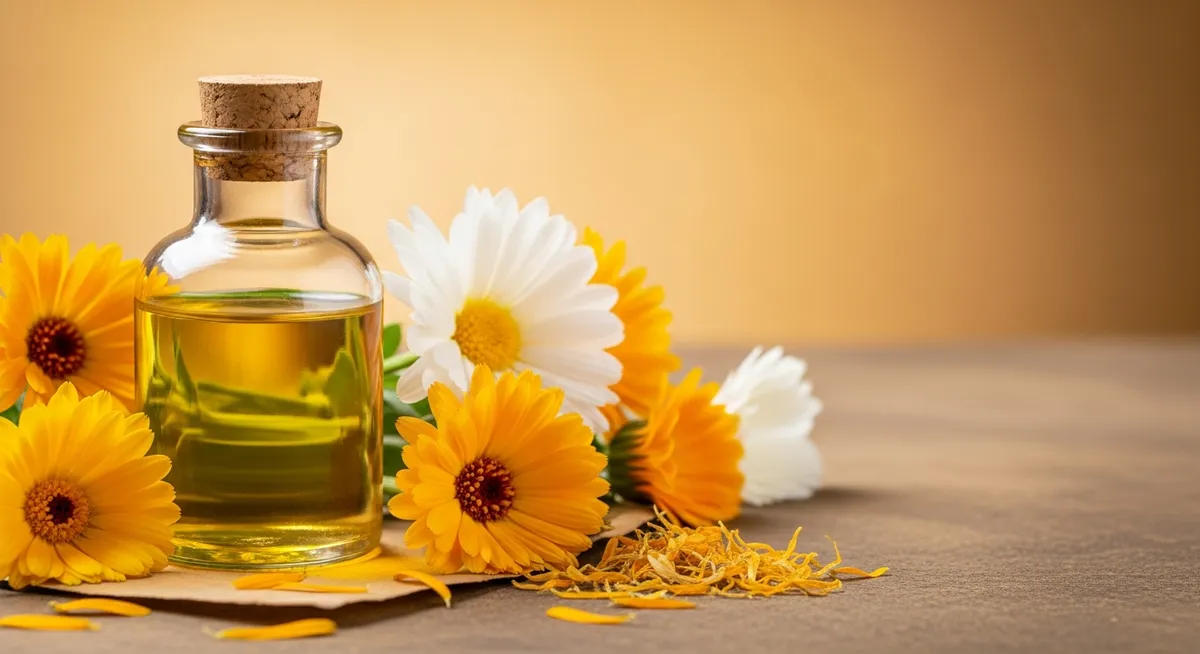
Calendula oil is an infused carrier, not an essential oil, which is exactly what makes it a good blending base: it brings body and a mild odour of its own without competing aromatically. Our certificate of analysis describes that odour as earthy, nutty and herbal, which sits underneath almost anything you put on top of it.
 Calendula Oil
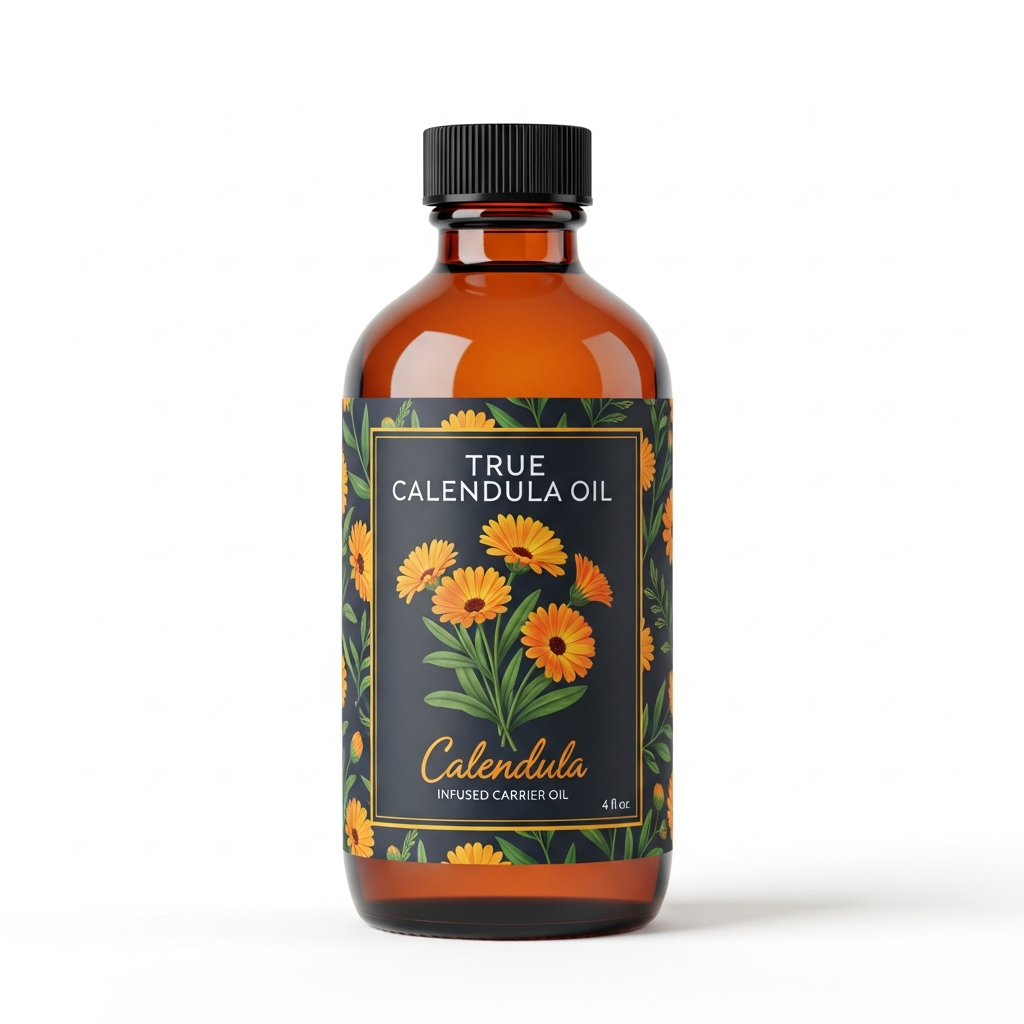
Our own small-batch calendula oil, in sizes from 0.5 oz to bulk. From $11.99.
Shop Calendula Oil →
Calendula Oil
Our own small-batch calendula oil, in sizes from 0.5 oz to bulk. From $11.99.
Shop Calendula Oil →
Every pairing below gives you three things: what the oil is chemically, the maximum dilution it should be used at on skin, and the exact drop count for a 1 fl oz bottle of calendula base. The arithmetic is the same throughout. One fluid ounce is about 30 mL, which at 20 drops per mL is roughly 600 drops, so 1% is six drops, 2% is twelve, and any lower ceiling scales from there. Where an oil has its own published maximum, take the lower of the two numbers.
1. Lavender Essential Oil
Lavandula angustifolia. A middle note, and the most forgiving oil on this list. ISO 3515 defines genuine lavender by its two dominant constituents: 25% to 38% linalool and 25% to 45% linalyl acetate, with camphor held to 0.5% to 1.0%. If a lavender is cheap and camphorous, it is usually lavandin rather than true lavender, and the camphor figure is the tell.
No special dermal ceiling applies, so the general guideline governs: six drops per fluid ounce of calendula for facial use, twelve for body. One caution worth knowing is that linalool oxidises on storage into hydroperoxides that are more sensitising than the fresh compound, so an old, flat-smelling lavender is not merely weaker, it is a worse choice. Keep it capped and replace it every couple of years.
Blend it for: an everyday body oil. Twelve drops in 1 oz of calendula is the default starting blend for anyone new to this.
2. Roman Chamomile Essential Oil
Chamaemelum nobile. A middle note with a soft, sweet, slightly fruity character that comes from an unusual chemistry: Roman chamomile is dominated by esters of angelic and tiglic acid, which together can make up as much as 80% of the oil, with isobutyl angelate commonly reported in the range of 28% to 38%. Almost no other essential oil is built this way.
There is one thing to flag before you reach for it. Roman chamomile is an Asteraceae, the same family as calendula, and the family's principal contact allergens are sesquiterpene lactones. Blending it into a calendula base stacks two Asteraceae botanicals in one bottle. For most people that is fine, but roughly 2% of North American patch-tested populations react to Compositae mix, and if you are in that group this is the pairing to avoid rather than the one to start with.
Blend it for: a gentle facial oil, at six drops per fluid ounce. Patch test the finished blend, not just the calendula.
3. Frankincense Essential Oil
Boswellia species. A base note, resinous and dry, and the oil that most changes the character of a calendula blend rather than just scenting it. Frankincense is monoterpene-dominated, with alpha-pinene and limonene as principal constituents, which has a practical consequence: like the citruses, it oxidises relatively quickly and is best bought in small quantities and used inside a couple of years.
Twelve drops per fluid ounce for body use, six for the face. Frankincense is a base note, so it anchors a blend and slows how fast the top notes flash off, which is why it works well as the second oil in a three-oil blend rather than the lead.
Blend it for: a facial oil with more depth than lavender alone. Try four drops frankincense plus two drops lavender in 1 oz for a 1% total.
4. Geranium Essential Oil
Pelargonium graveolens. A middle note, rosy and green, and chemically a citronellol and geraniol oil. It is one of the least restricted oils on this list: Tisserand and Young put its maximum dermal use level at 17.5%, far above anything a sensible blend would use, and it carries a low risk of skin sensitisation.
That high ceiling is not permission to use it heavily. The general 1% to 2% guideline still governs, because dermal maxima address a specific hazard rather than defining a useful dose. What the high ceiling does mean is that geranium is a safe oil to be slightly imprecise with, which makes it a good choice for a first attempt at blending.
Blend it for: a rose-adjacent facial oil at a fraction of rose's cost. Six drops per fluid ounce.
5. Sweet Orange Essential Oil
Citrus sinensis. A top note, and the simplest oil chemically on this page: citrus oils are frequently 90% or more monoterpenes, and sweet orange can run as high as 97% limonene. Unlike most expressed citrus oils, sweet orange is not considered phototoxic by Tisserand and Young, which makes it the citrus you can use in a daytime blend.
The trade-off is shelf life. Citrus oils typically deteriorate between six and twelve months after bottling, and limonene oxidises to epoxides, alcohols and ketones, with limonene hydroperoxides more sensitising than fresh limonene. Buy small bottles, keep them cold and capped, and do not blend from a citrus oil that has lost its brightness.
Blend it for: a morning body oil. Twelve drops per fluid ounce, made in small batches you will finish quickly.
6. Ylang Ylang Essential Oil
Cananga odorata. A base to middle note, intensely floral and sweet, and the oil with the tightest general ceiling on this list. The published maximum dermal use level is 0.8%, which in a 1 fl oz bottle of calendula is four drops. Not six, not twelve. Four.
Ylang ylang is also among the essential oils most associated with sensitisation, which is why that ceiling sits where it does. It is also aromatically dominant enough that four drops is genuinely sufficient: at twelve drops it overwhelms both the calendula base and anything else in the blend.
Blend it for: a single-accent evening body oil. Four drops per fluid ounce, and treat that as a hard maximum rather than a starting point.
7. Bergamot Essential Oil
Citrus bergamia. A top note, and the one oil here with a photochemical hazard attached. Cold-pressed bergamot contains bergapten, a furanocoumarin, and IFRA caps expressed bergamot oil at 0.4% in leave-on products applied to skin that will see sunlight, with bergapten itself limited to 15 ppm in leave-on products. At 0.4%, a 1 fl oz calendula base takes two drops.
There is a straightforward alternative. Bergamot FCF has the furocoumarin fraction removed by distillation, which eliminates the phototoxic component and lets you blend it at the normal 1% to 2% range. If you want bergamot in a daytime facial oil, use the FCF grade. If you use the expressed oil, keep it to two drops per ounce and to products applied at night.
Blend it for: an evening blend at two drops per fluid ounce of expressed oil, or a daytime one at six to twelve drops using FCF.
8. Sandalwood Essential Oil
Santalum album and related species. A base note, and the slowest-evaporating oil on this list, which is precisely what it contributes: it holds a blend together and extends how long the other notes read. Tisserand and Young recommend a dermal maximum of 2%, which is twelve drops per fluid ounce and coincides with the general body-use guideline.
Sandalwood is expensive enough that it is worth being deliberate about. Because it is a fixative, three or four drops in a blend will do measurable work on how the whole thing behaves over an hour, which is a better use of the oil than loading it to the 2% ceiling.
Blend it for: anchoring a floral or citrus blend. Three to four drops per fluid ounce alongside your lead oil.
9. Peppermint Essential Oil
Mentha x piperita. A top note, sharp and cooling, and unusual in that its published dermal maximum of 5.4% is well above the general guideline rather than below it. That does not mean you should approach it: peppermint is aromatically overwhelming and physically cooling, and two to three drops in a fluid ounce is already assertive.
The real caution with peppermint is age. It is not recommended for young children, and guidance generally keeps it away from the face of children under six. It is also the oil most likely to be blamed for irritation when the actual cause was blending by eye rather than counting drops.
Blend it for: a foot and leg oil for adults. Two to three drops per fluid ounce, and keep it well away from the eye area.
10. Rose Essential Oil
Rosa damascena. A middle to base note and the most expensive oil most people will ever blend. Rose otto carries a recommended dermal maximum of 0.6% because of its methyleugenol content, which in a 1 fl oz calendula base is three drops. That constraint is financially convenient: three drops is also about as much rose otto as most budgets tolerate.
Rose otto and rose absolute are different products made by different processes, and the absolute is a solvent extraction rather than a distillation. If you are working to the 0.6% figure, make sure you know which one is in your bottle, because they are not interchangeable in a formulation.
Blend it for: a special-occasion facial oil. Three drops per fluid ounce, with geranium underneath it if you want to extend the rosy character without extending the cost.
11. Helichrysum Essential Oil
Helichrysum italicum. A middle note with a distinctive honeyed, slightly curry-like character, driven largely by neryl acetate, which lots from established producers typically run at around 25% to 35%. It is the other expensive oil on this list and, like rose, is best used in small, deliberate amounts.
Helichrysum is the second Asteraceae here, alongside Roman chamomile. Blending it into calendula stacks the same botanical family twice, which is worth knowing if you have any history of ragweed, chrysanthemum or chamomile sensitivity. If that applies to you, geranium or lavender gets you a comparable structural role in the blend without the family overlap.
Blend it for: a concentrated facial oil at three to six drops per fluid ounce, patch tested as a finished blend before regular use.
Creating Your Perfect Calendula Pairings
Build blends in three notes rather than one. A top note (sweet orange, bergamot FCF, peppermint) gives the first impression and disappears fastest. A middle note (lavender, geranium, Roman chamomile, rose, helichrysum) carries the body of the blend. A base note (sandalwood, frankincense, ylang ylang) fixes it and slows the whole thing down. A workable starting ratio is roughly three parts middle to two parts base to one part top, kept inside your total dilution target.
Then do the arithmetic before you pour. Decide your total percentage first, 1% for the face or 2% for the body, convert to drops (six or twelve per fluid ounce), and divide those drops among your chosen oils. Check each oil against its own ceiling and take whichever number is lower: ylang ylang at four drops, expressed bergamot at two, rose otto at three, and everything else governed by the general figure. A blend of four drops lavender, four drops frankincense and four drops sweet orange in 1 oz of calendula is a complete 2% body oil, and every component is inside its limit.
The base matters as much as the accents. Our own True Calendula Oil is organic Calendula officinalis petals cold-infused into Helianthus annuus seed oil, fragrance-free and preservative-free, so nothing in the base competes with what you add. It comes in sizes from 0.5 oz for a single test blend up to bulk for production, and for worked recipes rather than ratios, see our guide to blending essential oils with calendula.
Calendula Oil
Nature's Golden Botanical, bottled: small-batch calendula oil in sizes from 0.5 oz to bulk.
From $11.99
Shop Calendula Oil →