Calendula Oil Skincare: 10 Checks Before You Buy
"Dermatologist recommended" is a marketing phrase, not a standard. What dermatology organisations do publish is specific, checkable consumer guidance: how to patch test, which ingredient classes cause most reactions, and what to do with broken skin. This article turns that published guidance, plus the analytical facts about what calendula oil actually is, into ten checks you can run on any calendula oil skincare product in about five minutes.
 Calendula Oil
Our own small-batch calendula oil, in sizes from 0.5 oz to bulk. From $11.99.
Shop Calendula Oil →
Calendula Oil
Our own small-batch calendula oil, in sizes from 0.5 oz to bulk. From $11.99.
Shop Calendula Oil →
Run them in order. The first five decide whether a product is worth buying at all. The last five decide whether you are getting anything out of the one you already own.
1. Check That It Is an Infused Oil, Not a "Calendula Essential Oil"
This one check eliminates a large share of the category. Calendula's characteristic constituents, the faradiol esters and the carotenoids, are non-volatile, which means steam distillation cannot carry them over. Steam distillation of calendula yields roughly 0.3%, too little to be commercially viable, and there is no meaningful steam-distilled calendula essential oil on the market. A product sold under that name is something else wearing the wrong label: usually an infused oil, or a CO2 extract cut into jojoba at around 20%.
What you want is stated plainly as an infusion. Ours is organic Calendula officinalis petals cold-infused into a named carrier, and the certificate of analysis lists the extraction method as infused and the CAS number as 84776-23-8.
2. Check That the Carrier Oil Is Named
The carrier is the overwhelming majority of the bottle and determines almost everything about how the product feels. It is also the variable most often left off the front label. Conventional sunflower seed oil runs 48% to 74% linoleic acid, a polyunsaturated profile that reads as light and fast-absorbing. Olive oil is predominantly oleic acid, monounsaturated, and reads as distinctly heavier. High-oleic sunflower, where oleic can reach around 90%, behaves like the latter while sharing a name with the former.
So a complaint that "calendula oil is too greasy for my face" is usually a complaint about a carrier, not about calendula. Ours is Helianthus annuus (sunflower) seed oil, chosen for the lighter high-linoleic profile, and it is named on the ingredient line rather than implied. If you are choosing an oil specifically for facial use, our guide to calendula oil for face goes through the texture question in more depth.
3. Check That It Is Fragrance-Free

This is the single highest-yield check in cosmetic ingredient selection, and it comes straight from the American Academy of Dermatology: fragrance and preservative allergies account for the majority of positive cosmetic patch test results. Not a large share. The majority. Adding fragrance to a product you intend to apply daily to facial skin is adding the most statistically likely irritant in the whole ingredient dictionary.
Read the ingredient line rather than the front of the bottle, because "unscented" and "fragrance-free" are not the same claim. Unscented can mean a masking fragrance has been added to cover a base odour. Our oil has no fragrance, no preservatives and no synthetic additives at all: the ingredients are Calendula officinalis and Helianthus annuus seed oil, and the odour the certificate of analysis reports is the oil's own, described as earthy, nutty and herbal.
4. Check That You Have Patch Tested It Properly
Most people's version of a patch test is a dab on the wrist and a day's wait. The American Academy of Dermatology Association's consumer protocol is considerably more demanding, and the difference matters: choose a test spot about the size of a quarter on skin that will not be rubbed or washed frequently, such as the inner forearm or the bend of the elbow, cleanse it with a fragrance-free gentle cleanser and pat dry, then apply the product twice daily for about seven to ten days, using the same amount and thickness you would use normally.
A 24-hour test catches immediate irritation. It does not catch allergic contact sensitisation, which develops over days and is the pattern that matters for a plant in the Asteraceae family. In North American patch test populations, roughly 2% react to Compositae mix and roughly 0.5% to sesquiterpene lactone mix; an Australian series found about 1.2% of 3,679 patients positive to Compositae. Buy the 0.5 oz size for the trial rather than committing to a large bottle, and see our calendula oil patch test guide for the full schedule.
5. Check for Batch Analytical Data
Ingredient lists tell you what went in. Analytical data tells you what came out. A genuine infused calendula oil has measurable physical constants, and they are the one thing a padded or tinted oil cannot reproduce. Our current batch reports a relative density of 0.922 at 20°C against a pharmacopoeia range of 0.910 to 0.930, a refractive index of 1.475 against 1.465 to 1.477, and an optical rotation of +0.16° inside a window of -1.0° to +1.0°, with appearance and odour also checked against standard.
The other reason to want batch data is provenance within the flower. Faradiol-3-O-monoesters are concentrated in the ray florets, the petals, at roughly ten times the level found in the disk florets and roughly a hundred times the level in the green involucral bracts. An infusion made from whole heads swept up with bracts is a different product from one made from separated petals, and only the producer knows which you are holding unless they publish.
6. Check Where It Sits in Your Routine
An oil is the most occlusive step in a typical routine, so anything applied after it has to get through it. The rule is thinnest to thickest, water-based before oil-based, with the oil last. Serums and water-based moisturisers layered over a facial oil are largely wasted, and that gets misread as the oil not working.
Apply to skin that is still slightly damp rather than fully dry. The same three to five drops spread thinner and more evenly over damp skin, which is the difference between an oil that sinks in and one that sits as a visible film. It also means you use less of it.
7. Check How Much You Are Actually Using
Put a number on the dose. A facial application is three to five drops, roughly 0.15 to 0.25 mL. A full-body application is 5 to 10 mL. A 1 oz bottle holds about 30 mL, near enough 600 drops, which at four drops a day is four to five months of use. At fifteen drops a day the same bottle is gone in six weeks and does not deliver three times the result, it just sits on the surface.
If an oil feels heavy, halve the dose before you conclude the product is wrong. Most reports of a botanical oil never absorbing are reports of over-application.
8. Check Your Dilution If You Blend Anything Into It

The standard adult topical dilution for essential oils is 2%, which is 12 drops per fluid ounce of carrier, and 1%, or six drops per fluid ounce, for facial skin. Blending by eye routinely lands people well above that, and the irritation then gets blamed on the calendula oil that made up 95% of the blend.
Several oils carry their own lower ceilings. IFRA caps expressed bergamot at 0.4% in leave-on products for sun-exposed skin because of its bergapten content, with bergapten itself limited to 15 ppm in leave-on products, and published dermal maxima for ylang ylang and lemongrass sit at 0.8% and 0.7% respectively. Check the individual oil rather than assuming the general 2% figure applies to it.
9. Check Whether the Bottle Is Still Good
Oxidation is a measurable process, not a vague decline. It starts with hydroperoxides, quantified as peroxide value in milliequivalents of oxygen per kilogram, which break down into aldehydes and ketones, the stale cardboard smell of rancidity. Oils high in polyunsaturated fatty acids reach the end of their acceptable range at relatively low peroxide values, between 1 and 10 mEq per kilogram, well below the 10 to 20 mEq tolerated in refined or predominantly monounsaturated oils.
Sunflower seed oil carries 403 to 935 mg per kilogram of tocopherols as its natural antioxidant reserve, and that reserve is consumed as it works. Our batch is stamped best by 05/31/2028 sealed; the working figure once opened is 12 to 24 months stored cool, dark and capped. Write the opening date on the bottle, and learn the fresh smell in the first week so you have a baseline to compare against.
10. Check That the Skin You Are Treating Is Intact
Calendula oil is a cosmetic product and it is not sterile. It is bottled rather than sealed under aseptic conditions, and once opened it meets air and whatever touches the dropper. Broken skin, burns, surgical sites and anything that is not intact healthy skin belong with a healthcare professional, not with a bottle from a shelf. Wait until skin has fully closed and returned to normal before resuming cosmetic use on that area.
Nothing on this page is medical advice, and our oil is not intended to diagnose, treat, cure or prevent any disease. For general skin-condition questions, see a clinician. For what calendula oil is and how it behaves as a cosmetic, our guide to calendula oil for skin covers the ground in detail, and our guide to the best calendula oil works through selection criteria for sensitive skin.
What the Ten Checks Have in Common
Every one of them replaces an adjective with something you can verify. Not "high quality" but a density of 0.922 against a range of 0.910 to 0.930. Not "gentle" but fragrance-free, because fragrance and preservatives drive most positive cosmetic patch test results. Not "well tolerated" but a seven to ten day patch test on a quarter-sized area, because roughly 2% of a patch-tested population reacts to Compositae. Not "a little goes a long way" but three to five drops.
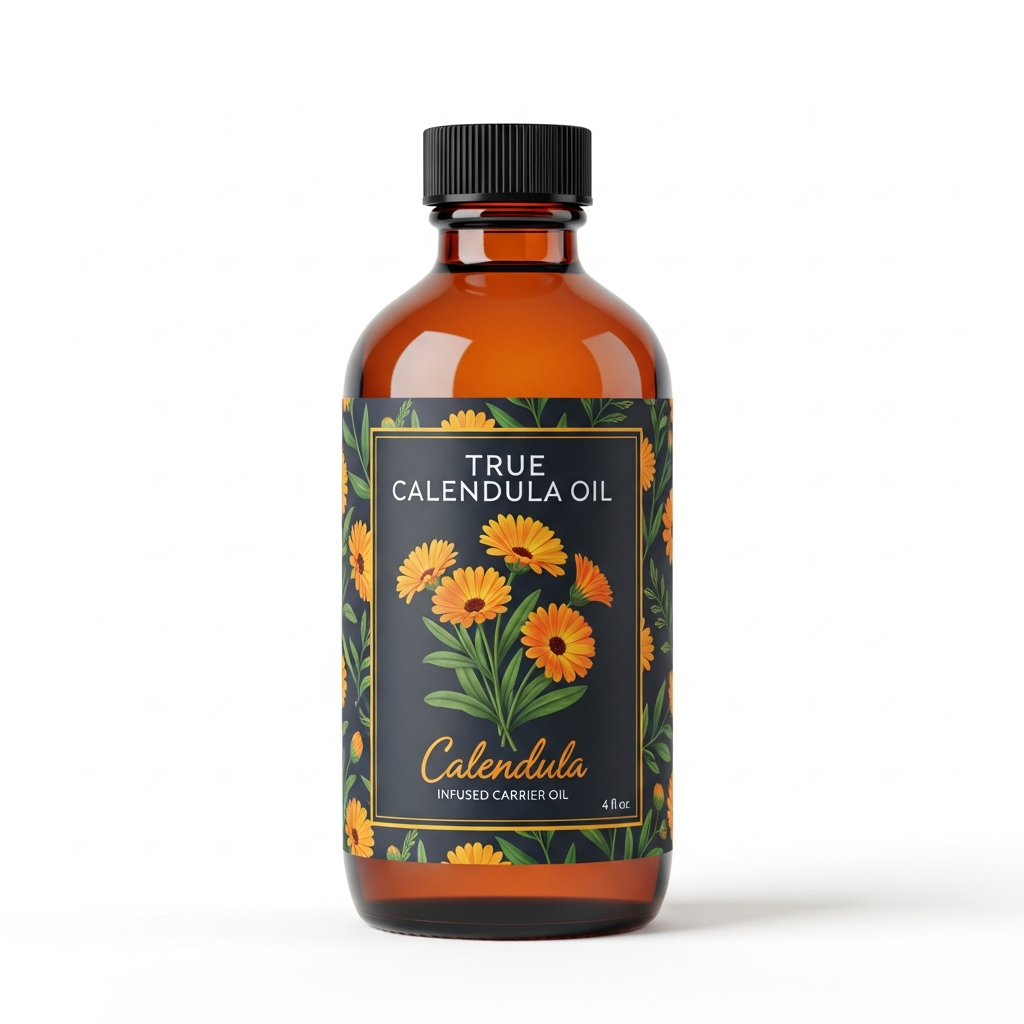
That is also the standard we hold our own product to. True Calendula Oil is organic Calendula officinalis petals cold-infused into named Helianthus annuus seed oil, fragrance-free, preservative-free, with the batch certificate of analysis published on the product page in sizes from 0.5 oz to bulk. You can run all ten checks against it before you buy rather than after.
Important Safety Considerations
The Cosmetic Ingredient Review Expert Panel's amended safety assessment of Calendula officinalis derived cosmetic ingredients concluded that they are safe for use in cosmetics at the practices and concentrations of use reviewed, finding them not genotoxic and not irritating, sensitising or photosensitising in the animal and clinical tests considered, while noting they may be mild ocular irritants. Keep it away from the eyes.
Individual sensitivity is the exception that general safety findings do not cover. Calendula is an Asteraceae, the family whose principal contact allergens are sesquiterpene lactones, and if you have known ragweed, chrysanthemum, chamomile or feverfew sensitivity, that is a reason to run the full patch test protocol rather than an abbreviated one. If you are pregnant, breastfeeding, treating a child, or managing a diagnosed skin condition, ask a healthcare professional before adding any new topical product, botanical or otherwise.
Calendula Oil
Nature's Golden Botanical, bottled: small-batch calendula oil in sizes from 0.5 oz to bulk.
From $11.99
Shop Calendula Oil →