10 Calendula Oil Myths Debunked by Science
Calendula is one of the better-characterised cosmetic botanicals in the literature, which makes the amount of folklore attached to it slightly odd. There is a European Pharmacopoeia monograph for the flower, an EU herbal monograph and assessment report from the European Medicines Agency, a published Cosmetic Ingredient Review safety assessment of Calendula officinalis derived cosmetic ingredients, and decades of analytical chemistry on the petals. Ten of the most durable claims are below, each one checked against what that work actually shows.
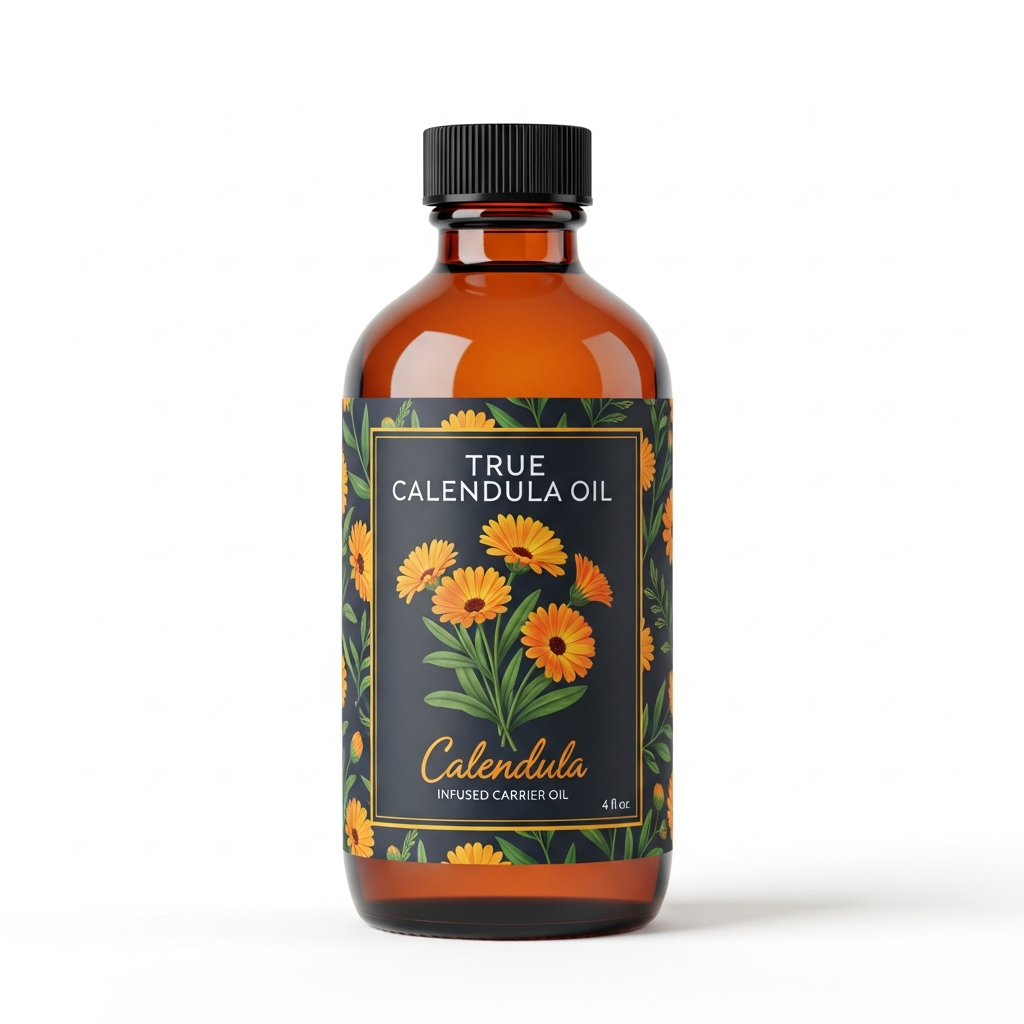 Calendula Oil
Our own small-batch calendula oil, in sizes from 0.5 oz to bulk. From $11.99.
Shop Calendula Oil →
Calendula Oil
Our own small-batch calendula oil, in sizes from 0.5 oz to bulk. From $11.99.
Shop Calendula Oil →
A note on what follows. This is cosmetic and analytical chemistry, not medicine. Nothing here is intended to diagnose, treat, cure or prevent any disease, and the myths addressed are about what calendula oil is, how it is made and how it behaves, not about what it does to health.
Understanding Calendula Oil: The Foundation of Facts
Start with the object itself. Calendula oil, as the phrase is used in skincare, is an infused oil: Calendula officinalis petals steeped in a carrier oil until the oil-soluble fraction of the flower transfers across. Our own is organic petals cold-infused into Helianthus annuus (sunflower) seed oil, reported on its certificate of analysis as CAS 84776-23-8, a yellow liquid with an earthy, nutty, herbal odour, at a relative density of 0.922 at 20°C, a refractive index of 1.475 and an optical rotation of +0.16°.
The fraction that transfers is well described. Calendula flowers carry roughly 4% diols, mostly as faradiol monoesters, and analysis of ten cultivars quantified eight triterpenoid monoesters and characterised a ninth previously unreported one. The petals also carry a large carotenoid load, with one HPLC-DAD-MS survey resolving 29 components, dominated by flavoxanthin at around 28.5% of total carotenoids, auroxanthin at around 7.1% and lutein at around 2.0%. The European Pharmacopoeia requires calendula flower to contain not less than 0.4% flavonoids calculated as hyperoside. That is the chemistry every myth below runs into.
Myth #1: Calendula Oil Is the Same as Marigold Essential Oil
The Myth
Calendula is commonly called pot marigold, so calendula oil and marigold essential oil are two names for the same bottle.
The Science-Based Truth
They are different plants and different products. Calendula is Calendula officinalis; the marigold sold as tagetes essential oil is Tagetes minuta or a related species. Same family, Asteraceae, different genus entirely. More decisively, there is effectively no such thing as calendula essential oil. Steam distillation of calendula flowers yields on the order of 0.3%, far too little to be commercially viable, and the compounds that define calendula, the faradiol esters and the carotenoids, are non-volatile. Steam cannot carry them over. A distillate of calendula, if you made one, would not contain the fraction anyone wants.
Products labelled "calendula essential oil" are therefore something else: usually an infused oil under the wrong name, or a CO2 extract cut into jojoba at around 20% because the neat extract is thick and sticky to work with.
Why This Myth Persists
Because "marigold" is one common name for two unrelated genera, and because the retail category "essential oils" is where shoppers look for any plant oil. Labelling has followed shopper behaviour rather than botany.
Myth #2: All Calendula Oil Is Created Equal

The Myth
Calendula is calendula. Once flowers have sat in oil, one infusion is much like another.
The Science-Based Truth
The composition varies by an order of magnitude depending on which part of the flower was used. Faradiol-3-O-monoesters are concentrated in the ray florets, the petals. Disk florets carry roughly ten times less, and the green involucral bracts roughly ten times less again. An infusion made from whole flower heads harvested with the bracts intact is chemically a different product from one made from separated petals, even at identical flower weight.
Cultivar matters too. Across ten Calendula officinalis varieties analysed for triterpenoid monoesters, the yields differed substantially, with Calypso Orange Florensis producing the highest amounts, followed by Fiesta Gitana Gelb and May Orange Florensis. Carotenoid profiles likewise vary between orange-flowered and yellow-flowered types. A standardised extract can be certified at 24.1% faradiol esters after acid hydrolysis; an unspecified infusion has no such figure attached to it at all.
Why This Myth Persists
Because none of this is visible. Two bottles of infused oil look alike, smell alike and feel alike, and the difference sits in a number nobody prints. The only practical answer is to buy from a producer who publishes batch analytical data, which is why our certificate of analysis is on the product page rather than available on request.
Myth #3: Calendula Oil Works Instantly
The Myth
A good botanical oil shows its effect the first time you use it, and if it does not, it is not working.
The Science-Based Truth
Two different timescales get conflated here. Surface effects are immediate: an oil applied to damp skin changes slip, softness and the appearance of flaking within minutes, because it is sitting on and between the outermost cells. Anything cumulative runs on the skin's own schedule, and epidermal renewal in a healthy adult takes on the order of a month, lengthening with age. Judging a cosmetic oil on day two is judging it against a process that has not had a single cycle to run.
There is a practical corollary: a fair trial needs a fixed protocol. Same amount, same time of day, same area, nothing else new introduced, for at least four weeks. Change three variables at once and the result is uninterpretable regardless of how good the oil is.
Why This Myth Persists
Because the immediate surface effect is real and satisfying, which sets an expectation the cumulative timescale cannot meet. The first application overdelivers and the second week underdelivers, and people quit in between.
Myth #4: More Concentrated Always Means Better
The Myth
A stronger, more concentrated calendula preparation will always outperform a diluted one.
The Science-Based Truth
Dilution is not a compromise in topical botanicals, it is the specification. The standard adult dermal dilution for essential oils is 2%, which is 12 drops per fluid ounce of carrier, and 1%, or six drops, for facial skin. Several oils carry their own lower ceilings: IFRA caps expressed bergamot at 0.4% in leave-on products intended for sun-exposed skin because of its bergapten content, with bergapten itself limited to 15 ppm in leave-on products, and published dermal maxima for ylang ylang and lemongrass sit at 0.8% and 0.7% respectively.
Calendula CO2 extract makes the same point from the other direction. It is deliberately sold pre-diluted at around 20% in jojoba, not because the supplier is padding it but because the neat extract is thick, intensely aromatic and impractical to work with. Concentration above the level a formulation needs adds irritation risk and cost, and nothing else.
Why This Myth Persists
Because "concentrated" is marketing language that reads as value, and because dose-response intuition from other product categories does not transfer to dermal application, where the limiting factor is skin tolerance rather than potency.
Myth #5: Calendula Oil Has No Side Effects
The Myth
Calendula is gentle enough that nobody reacts to it, so patch testing is optional.
The Science-Based Truth
The Cosmetic Ingredient Review Expert Panel's amended safety assessment of Calendula officinalis derived cosmetic ingredients concluded they are safe in cosmetics at the practices and concentrations of use reviewed, finding them not genotoxic and not irritating, sensitising or photosensitising in the animal and clinical tests considered, while noting they may be mild ocular irritants. Safe in general use is not the same as safe for every individual.
Calendula is an Asteraceae, and the family's principal contact allergens are sesquiterpene lactones. In North American patch test populations, roughly 2% react to Compositae mix and roughly 0.5% to sesquiterpene lactone mix. An Australian series found 44 positives among 3,679 patients tested, about 1.2%. Diagnostically, Compositae mix detects about 87% of Compositae-allergic patients and sesquiterpene lactone mix about 65%, with parthenolide catching about 75% of sesquiterpene lactone allergic patients, which is why individual plant extracts are sometimes needed to confirm. Small percentages, but real ones.
Why This Myth Persists
Because "natural" and "gentle" are treated as synonyms for "inert," and because the great majority of users genuinely do tolerate it, so the exceptions rarely surface in reviews.
Myth #6: Calendula Oil Can Replace All Other Skincare Products
The Myth
A single botanical oil can do the work of a cleanser, a hydrator and a moisturiser, so a minimal routine is one bottle.
The Science-Based Truth
An oil is an emollient and a partial occlusive. It softens the surface and slows water loss from it. What it cannot do is supply water, because there is none in it: an infused oil is lipid throughout. Hydration in a routine comes from water-based steps, and the oil's role is to sit above them and reduce how fast that water leaves. This is also why order matters, thinnest to thickest, water-based before oil-based, with the oil last.
Nor does it clean. Oil cleansing is a distinct technique with its own emulsification step, and a leave-on facial oil is not formulated for it. The realistic minimal routine is two or three steps, not one.
Why This Myth Persists
Because oil delivers the most immediately noticeable change of anything in a routine, and immediacy gets mistaken for sufficiency.
Myth #7: Homemade Calendula Oil Is Always Superior
The Myth
An infusion you make yourself is fresher and therefore better than anything bottled commercially.
The Science-Based Truth
Home infusion is a genuinely good technique and the methods are well established: a cold infusion runs four to six weeks, often eight, while a warm infusion is held at 100°F to 120°F for two to four hours, with the temperature cap there specifically because carotenoids are heat-sensitive. Many herbalists prefer the cold method for exactly that reason.
What home production cannot do is measure. There is no kitchen method for determining peroxide value, refractive index, relative density or optical rotation, so you cannot tell whether your base oil was already partway through its oxidation curve when you started. Residual moisture from incompletely dried petals is the other uncontrolled variable, and it is the usual cause of a batch spoiling. Homemade is fresher in one sense and unverified in another, and which matters more depends on what you are making.
Why This Myth Persists
Because the visible part of quality, fresh flowers going into clean oil, is the part home production does best, and the invisible part is invisible by definition.
Myth #8: Calendula Oil Never Expires
The Myth
Oil is shelf-stable, so a bottle of calendula oil keeps indefinitely.
The Science-Based Truth
Oxidation is measurable and it is running the whole time. It begins with hydroperoxides, quantified as peroxide value in milliequivalents of oxygen per kilogram, which then break down into aldehydes, ketones, alcohols and hydrocarbons. Those secondary products are the stale, cardboard smell of rancidity. For oils high in polyunsaturated fatty acids, the end of acceptability arrives at relatively low peroxide values, between 1 and 10 mEq per kilogram, well below the 10 to 20 mEq tolerated in refined or predominantly monounsaturated oils. The standard accelerated method, the Schaal oven test, holds samples at 50°C to 60°C until peroxide value reaches 10.
Conventional sunflower seed oil is 48% to 74% linoleic acid, which is polyunsaturated, and carries 403 to 935 mg per kilogram of tocopherols as its natural antioxidant reserve. That reserve is consumed as it works. Our batch carries a best-by of 05/31/2028 sealed, and the working figure once opened is 12 to 24 months stored cool, dark and capped.
Why This Myth Persists
Because oils do not spoil visibly the way food does. Nothing grows, nothing changes colour dramatically, and the only reliable early signal is smell, which people stop noticing on a bottle they use daily.
Myth #9: Calendula Oil Works the Same for Everyone
The Myth
One person's experience of a calendula oil predicts another's, so reviews transfer cleanly.
The Science-Based Truth
Two independent sources of variation stack here. The first is the carrier, which supplies the overwhelming majority of the bottle and determines nearly all of how it feels. Conventional sunflower oil runs 48% to 74% linoleic acid; high-oleic cultivars invert that, with linoleic at 0.8% to 20.4% and oleic up to around 90%. Even within conventional sunflower, growing climate shifts the ratio: hybrids grown in Serbia showed oleic at 30.54% to 42.72% and linoleic at 46.03% to 58.44%, measurably different from the same material grown in Argentina, because temperature affects desaturase activity. Two oils labelled identically can feel quite different on skin.
The second is the person. The Compositae sensitivity figures above mean a small but real fraction of people will react to calendula regardless of how well it is made, and nothing in a review will tell you whether you are in that fraction. That is a patch test question, not a research question.
Why This Myth Persists
Because labels name the botanical and rarely specify the carrier's fatty acid profile, so the largest source of variation between two bottles is the one least often disclosed.
Myth #10: Scientific Research on Calendula Is Limited
The Myth
Calendula is folk medicine with little serious analytical work behind it.
The Science-Based Truth
The analytical record is substantial and specific. One HPLC-DAD-MS survey resolved 29 carotenoid components in calendula petals, with an earlier study identifying about 18, and a later analysis established the configuration of the 5,8-epoxy-carotenoids, identifying chrysanthemaxanthin in the 8S configuration as the main one. Eight triterpenoid monoesters have been simultaneously quantified across ten cultivars with a ninth newly characterised. Faradiol monoester distribution has been mapped across ray florets, disk florets and involucral bracts.
On the regulatory side, calendula flower has a European Pharmacopoeia monograph with a quantitative flavonoid specification, the European Medicines Agency has published both an EU herbal monograph and an assessment report on Calendula officinalis L., flos, and the Cosmetic Ingredient Review Expert Panel has published an amended safety assessment of calendula-derived cosmetic ingredients. Major cancer centres and academic health libraries maintain standing reference entries on the plant. Whatever else is true, the composition of this flower is not an open question.
Why This Myth Persists
Because most of that work is phytochemistry rather than clinical trial work, and it is published in analytical journals that do not surface in consumer searches. Absence from the front page is not absence from the literature.
Making Informed Decisions About Calendula Oil
The through-line across all ten is that the questions worth asking about a calendula oil are answerable with numbers. Which part of the flower. Which carrier, and its fatty acid profile. What the batch measured at for density, refractive index and optical rotation. When it was made and when it should be used by. A producer who can answer those has done the work; a producer who answers in adjectives has not.
That is the standard we hold our own oil to. Organic Calendula officinalis petals, cold-infused, into named Helianthus annuus seed oil, with the batch analytical data published against pharmacopoeia ranges and a stated best-by date. You can check every figure in this article against the certificate rather than taking the description on trust.
The Future of Calendula Oil Research
The most active analytical thread at the moment is the chemistry of the faradiol esters and their relatives, where recent work has continued to refine how these compounds are separated and quantified rather than treating "faradiol esters" as a single lumped figure. That granularity matters commercially, because it makes cultivar-level and plant-part-level differences measurable rather than merely plausible.
The second thread is carotenoid stereochemistry, where establishing the configurations of the 5,8-epoxy-carotenoids has revised earlier assumptions about which compound dominates the petal profile. Neither line of work will change how you use an oil tomorrow. Both make it progressively harder for an unspecified infusion to pass itself off as a characterised one, which is the direction the whole category should be going.
Calendula Oil
Nature's Golden Botanical, bottled: small-batch calendula oil in sizes from 0.5 oz to bulk.
From $11.99
Shop Calendula Oil →