10 Calendula Oil Mistakes That Are Ruining Your Results
Most disappointing experiences with calendula oil trace back to one of ten specific, fixable errors, and almost none of them are about the oil itself. They are about what was in the bottle before you bought it, how you stored it, how much you used, and how long you gave it. Each mistake below comes with the number, the measurement or the protocol that fixes it.
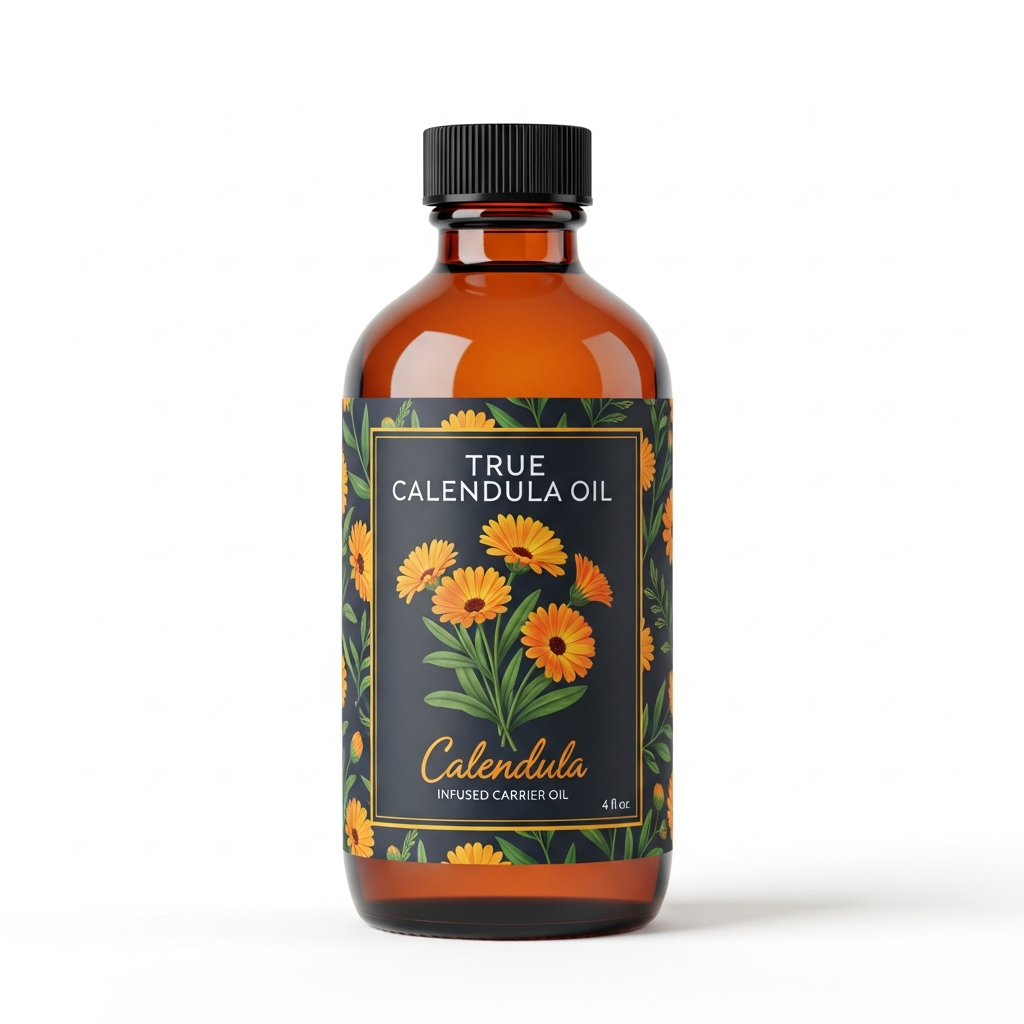 Calendula Oil
Our own small-batch calendula oil, in sizes from 0.5 oz to bulk. From $11.99.
Shop Calendula Oil →
Calendula Oil
Our own small-batch calendula oil, in sizes from 0.5 oz to bulk. From $11.99.
Shop Calendula Oil →
Where a fix depends on a figure, the figure is here: the drop counts for a safe dilution, the patch test schedule dermatology bodies actually recommend, the reason a bathroom shelf ruins an oil faster than a cupboard, and the label wording that tells you a product is not what it says it is.
1. Using Poor Quality or Adulterated Oil
There is one label phrase that settles this question instantly: if a product is sold as "calendula essential oil," it is not what the name claims. Calendula's characteristic constituents, the faradiol esters and the carotenoids, are non-volatile, which means steam distillation cannot carry them across. Steam distillation of calendula yields around 0.3%, too little to be commercially viable, and the resulting distillate does not contain the compounds people buy calendula for. Products sold under that name are almost always an infused oil, or a CO2 extract cut into jojoba at something like 20%, relabelled.
The second quality variable is which part of the flower went into the jar. Faradiol-3-O-monoester levels are highest in the ray florets, the petals. Disk florets carry roughly ten times less, and the green involucral bracts roughly ten times less again. An infusion made from whole flower heads swept up with the bracts is measurably weaker than one made from separated petals, even at identical flower weight. The European Pharmacopoeia standard for calendula flower requires not less than 0.4% flavonoids calculated as hyperoside, and a supplier who can quote a figure like that is a supplier who has measured something.
The Fix: Buy an infused oil that names both the botanical and the carrier and publishes analytical data. Our own True Calendula Oil is organic Calendula officinalis petals cold-infused into Helianthus annuus seed oil, and every batch carries a certificate of analysis reporting relative density (0.922 at 20°C against a range of 0.910 to 0.930), refractive index (1.475 against 1.465 to 1.477) and optical rotation (+0.16° inside a window of -1.0° to +1.0°). Those three numbers are what a tinted or padded oil cannot fake.
2. Ignoring Patch Testing
The usual advice, dab some on and wait a day, is not a patch test. Consumer patch testing guidance from dermatology bodies is specific: choose a spot about the size of a quarter on skin that will not be washed or rubbed, such as the inner forearm or the crease of the elbow, cleanse and dry it, then apply the product at your normal amount and thickness twice daily for seven to ten days. A single application over 24 hours detects immediate irritation but misses allergic contact sensitisation, which is exactly the reaction pattern that matters here.
It matters here because calendula is an Asteraceae, also called Compositae, and the family's principal contact allergens are sesquiterpene lactones. In North American patch test populations, roughly 2% react to Compositae mix and roughly 0.5% to sesquiterpene lactone mix. In an Australian series, 44 of 3,679 patients tested, about 1.2%, were positive to Compositae. Those are small numbers, but they are not zero, and they are the reason ragweed, chrysanthemum and chamomile sensitivities are worth knowing about before you use calendula over a large area.
The Fix: Run the full seven to ten day protocol on a quarter-sized area before any widespread use, and buy the 0.5 oz size for the trial rather than committing to a large bottle. Our calendula oil patch test guide walks the schedule step by step, and our calendula oil allergy FAQ covers the cross-reactivity question in detail.
3. Improper Storage Leading to Rancidity
Rancidity is a measurable chemical process, not a vague decline. Oxidation begins with hydroperoxides, which are quantified as peroxide value in milliequivalents of oxygen per kilogram. For oils high in polyunsaturated fatty acids, the end point of acceptability arrives at relatively low peroxide values, somewhere between 1 and 10 mEq per kilogram, far below the 10 to 20 mEq tolerated in refined or predominantly monounsaturated oils. Those hydroperoxides then break down into aldehydes and ketones, which is the stale, cardboard, crayon smell you recognise as rancid.
This is directly relevant to a calendula infusion because the usual base is sunflower seed oil, which is 48% to 74% linoleic acid, a polyunsaturated fatty acid. Sunflower oil compensates with a high tocopherol load, typically 403 to 935 mg per kilogram, but tocopherols are consumed as they work. A bathroom shelf is the worst place you can pick: it delivers heat, humidity and light in one location, and it is where most people keep the bottle.
The Fix: Cool, dark, cap sealed after every use. Kept that way our oil holds its quality for 12 to 24 months. Buy a size you will finish inside that window rather than the largest one on offer, and if you own a large bottle, decant a working quantity into a small amber bottle so the main stock is opened rarely. Our guide on how to store calendula oil covers container choice and temperature in full.
4. Using Excessive Amounts
Put a number on it. A facial application is three to five drops, which is roughly 0.15 to 0.25 mL. A full-body application is 5 to 10 mL. Most people who report that calendula oil "sits on top and never sinks in" are applying several times that, which is the entire explanation: a film of oil thick enough to remain visible is a film thick enough to stay visible.
The waste is quantifiable too. A 1 oz bottle holds about 30 mL, near enough 600 drops. At four drops a day it lasts four to five months. At fifteen drops a day it is gone in six weeks, which is the difference between one bottle a year and four, and it does not deliver four times the result.
The Fix: Dispense three to five drops for the face, warm between the palms, and press rather than rub into slightly damp skin so the oil spreads thin. Wait two minutes before deciding you need more. Our guide on calendula oil dosage gives per-area amounts for body, hands and scalp.
5. Applying to Dirty or Unprepared Skin
The order-of-operations rule in any routine is thinnest to thickest, water-based before oil-based. An oil is the most occlusive thing in a typical routine, so anything applied after it has to get through it. Serums, hydrating toners and water-based moisturisers applied over calendula oil are largely wasted, and that mistake gets misread as the oil not working.
Damp skin is the detail most people miss. Applying an oil to skin still slightly wet from cleansing gives you a much thinner, more even spread from the same number of drops, because the water helps the oil distribute before it sets. Skin that is fully dry, or still carrying sunscreen or makeup from the day, takes more oil to cover the same area and holds that residue underneath.
The Fix: Cleanse with a fragrance-free cleanser, pat until just damp rather than bone dry, apply water-based steps first, and finish with calendula oil as the last layer. Fragrance and preservatives account for the majority of positive cosmetic patch test results, so a fragrance-free cleanser underneath a fragrance-free oil removes the most common confounder if something does react.
6. Mixing with Incompatible Products
The real mixing errors are quantifiable, and the biggest one is overdosing essential oils into a carrier. (See: NIH — Calendula Research.) The standard adult topical dilution is 2%, which is 12 drops of essential oil per fluid ounce of carrier, and 1%, or six drops per fluid ounce, for facial skin. People blending by eye routinely land at 5% or higher, and the resulting irritation gets blamed on the calendula oil that made up 95% of the blend.
The second error is phototoxicity. Cold-pressed bergamot contains bergapten, a furanocoumarin, and IFRA sets a maximum of 0.4% expressed bergamot oil in leave-on products for skin that will see sunlight, with bergapten itself capped at 15 ppm in leave-on products. Add bergamot to a facial oil by eye and you can clear that limit easily. Furanocoumarin-free bergamot, sold as bergamot FCF, has the phototoxic fraction removed. Some oils carry their own low ceilings regardless of phototoxicity: ylang ylang at 0.8% and lemongrass at 0.7% are both well under the general 2% figure.
The Fix: Measure, do not estimate. Six drops per fluid ounce for the face, twelve for the body, and check the individual oil's own maximum before assuming 2% is safe for it. Keep phototoxic citrus out of anything you apply before sun exposure.
7. Expecting Immediate Results

Set the timeline against how skin actually turns over. Epidermal renewal in a healthy adult runs on the order of a month, and it lengthens with age. A cosmetic oil applied today is working on skin that will still be replaced on that schedule, which is why a fair assessment window is weeks rather than days.
Two things do change immediately and are worth separating out, because confusing them causes most of the frustration. Surface feel, slip and the look of dry flaking respond within minutes of the first application. Anything cumulative does not, and judging the oil on day two on the basis that day one felt good is how people end up with half-used bottles.
The Fix: Commit to a fixed protocol for at least four weeks: same amount, same time of day, same area, nothing else new introduced during the window. Photograph the same area in the same light weekly rather than relying on memory. Changing three variables at once means you learn nothing from any of them.
8. Using Calendula Oil on Open Wounds
Calendula oil is a cosmetic product, not a sterile one, and that distinction is the whole point. It is bottled, not sealed under aseptic conditions, and once opened it is exposed to air and to whatever touches the dropper. Broken skin, surgical sites, burns and anything that is not intact healthy skin belong to a healthcare professional, not to a bottle from a shelf.
This is worth stating plainly because calendula's long folk history invites the assumption that it substitutes for proper care. It does not. Nothing on this site is medical advice, and our oil is not intended to diagnose, treat, cure or prevent any disease. Its place is intact skin, as part of a cosmetic routine.
The Fix: Intact, healthy skin only. If skin is broken, see a healthcare provider and wait until it has fully closed and returned to normal before resuming cosmetic use on that area.
9. Ignoring Expiration Dates
Two dates matter and they are not the same. The best-by date on the bottle reflects sealed storage from the batch date. The clock that actually governs your bottle starts the day you open it, because that is when oxygen gets in and the tocopherol reserve starts being spent. Our current batch carries a best-by of 05/31/2028, but once open, the working figure is 12 to 24 months depending on how you store it.
Your senses are a reasonable instrument here as long as you know what to look for. Fresh calendula oil is a yellow liquid with an earthy, nutty, herbal smell, and that is the appearance and odour profile our certificate of analysis reports against. A sharp, stale or crayon-like note means secondary oxidation products have formed. Colour alone is a weak signal, since infusions vary by petal batch, but a clear change in smell is decisive.
The Fix: Write the opening date on the bottle with a marker the day you break the seal, not the purchase date. Smell it before each use for the first week so you know the fresh baseline. Our article on whether calendula oil expires covers what changes and when.
10. Failing to Consider Individual Skin Types
The carrier oil determines almost everything about how a calendula infusion feels, and people pick by the calendula and ignore the base. The relevant variable is the fatty acid profile. Conventional sunflower seed oil runs 48% to 74% linoleic acid, a polyunsaturated fatty acid that gives a light, fast-absorbing feel. Olive oil is predominantly oleic acid, which is monounsaturated and reads as noticeably heavier and slower on the skin. High-oleic sunflower oil, where oleic can reach around 90%, behaves more like the latter than the former despite sharing a name with the former.
So "calendula oil felt too heavy for my skin" usually means "that particular carrier felt too heavy," and the fix is a different base rather than abandoning the botanical. This is also why comparing two calendula oils on feel alone tells you about their carriers, not about their calendula content.
The Fix: Read the base before you buy. Ours is Helianthus annuus seed oil, chosen for the lighter high-linoleic profile. If you want to compare bases directly, our guides to the best carrier oils to mix with calendula oil and to calendula oil versus jojoba oil set out how each one behaves.
Moving Forward with Calendula Oil Success
Nine of these ten mistakes come down to four numbers: three to five drops for the face, six to twelve drops of essential oil per fluid ounce if you blend, seven to ten days for a proper patch test, and 12 to 24 months of shelf life from a cool dark cupboard. Write those down and most of the frustration people report simply does not occur.
The tenth is the one that happens before you apply anything, and it is the choice of oil. An infusion made from bracts rather than petals, or a "calendula essential oil" that cannot chemically contain what the name implies, will not perform however carefully you use it. Analytical data on the batch is the only way to tell from outside the bottle, which is why ours is published rather than described.
Go through the list against your own routine. Check the base oil on the label, check where the bottle lives, count your drops for a week, and give the next four weeks a fixed protocol. That is the whole of it.
Calendula Oil
Nature's Golden Botanical, bottled: small-batch calendula oil in sizes from 0.5 oz to bulk.
From $11.99
Shop Calendula Oil →